
Yes, kojic acid and niacinamide are compatible and are often combined to reduce dark spots because they interrupt pigmentation at different points in the process. Niacinamide slows how pigment transfers to the skin’s surface while kojic acid limits how much pigment gets produced in the first place. Together they tend to work gradually over several weeks, and daily sunscreen is what keeps the results from fading.
TL;DR:
- Most clinical evidence tests kojic acid and niacinamide alongside tranexamic acid, so the three active combination has stronger support than the pair alone.
- A split face study found 4% niacinamide plus 4% kojic acid comparable to 4% hydroquinone for epidermal melasma after eight weeks; mild irritation occurred.
- Patch test for three nights, begin every other night, and consider starting concentrations of 0.5% to 2% kojic acid and 2% to 5% niacinamide.
- Daily sunscreen helps prevent pigment from returning, and tinted formulas with iron oxides protect against visible light that standard UV filters do not.
- Because kojic acid can oxidize and lose potency, choose leave on products that disclose concentrations and explain how they stabilize the ingredient.
Table of Contents
- How Kojic Acid and Niacinamide Work Together
- Clinical Evidence for the Kojic Acid and Niacinamide Combination
- How to Use Niacinamide With Kojic Acid: A Step-by-Step Routine
- Safety, Irritation, and the Photoprotection Rule You Cannot Skip
- What to Look for in a Kojic Acid and Niacinamide Product
- Why Transparent Concentrations and a Full Routine Matter
- Our Take on Treating Post-Acne Dark Spots
- Try the Cellura Routine Built Around This Research
- FAQ
- Sources
How Kojic Acid and Niacinamide Work Together
Dark spots form through a chain of events, not a single step, which is exactly why pairing two ingredients with different jobs tends to outperform using either one alone. Kojic acid works upstream: it inhibits tyrosinase, the enzyme that melanocytes rely on to produce melanin. Less active tyrosinase means less pigment gets manufactured in the first place.
Niacinamide works further down the chain. Rather than blocking the enzyme, it interferes with how melanosomes (the tiny pigment-carrying packets) transfer from melanocytes into surrounding skin cells. It also calms the low-grade inflammation that can trigger more pigment production after a breakout, which matters for anyone whose dark spots started as acne marks.
Because these two mechanisms hit separate stages of melanogenesis, using them together addresses more of the pathway than either ingredient can on its own. A review of kojic acid research notes that kojic acid is frequently paired with other depigmenting agents for this reason, and that topical formulations commonly use concentrations in the 1% to 4% range. For readers who want a deeper look at how kojic acid behaves on its own, our kojic acid primer covers concentration ranges and tolerability in more detail.
Formulation matters as much as the ingredient list. Kojic acid is chemically unstable: it can oxidize and lose potency over time, especially in poorly formulated or improperly stored products. A serum built around stabilized kojic acid at a disclosed concentration behaves very differently than a product that lists it near the bottom of the ingredient panel at a trace amount.
A few practical takeaways follow from the mechanisms:
- Kojic acid reduces new pigment production by inhibiting tyrosinase.
- Niacinamide slows pigment transfer and reduces inflammation that can worsen dark marks.
- Combining the two targets multiple points in the pigmentation pathway rather than just one.
- Kojic acid’s instability means concentration and formulation quality affect real-world results more than the ingredient name alone.
A review of kojic acid formulations found that products commonly use concentrations between 1% and 4%, and that combining kojic acid with complementary actives is a common strategy for better outcomes than using it alone.
Clinical Evidence for the Kojic Acid and Niacinamide Combination
The idea that kojic acid and niacinamide pair well is not just theoretical. A handful of clinical studies have tested formulations containing both, usually alongside a third ingredient, tranexamic acid, and the results give a reasonably clear picture of what to expect.
A 12-week clinical evaluation tested a serum containing 3% tranexamic acid, 1% kojic acid, and 5% niacinamide on participants with facial dyschromia, including melasma and post-inflammatory hyperpigmentation. The study reported significant improvement starting around week 2, with continued gains through week 12, and measurable decreases in melanin index recorded by instrument at the study’s end. That timeline, early movement by week 2 to 4 and more substantial change by weeks 8 to 12, shows up consistently across similar trials.
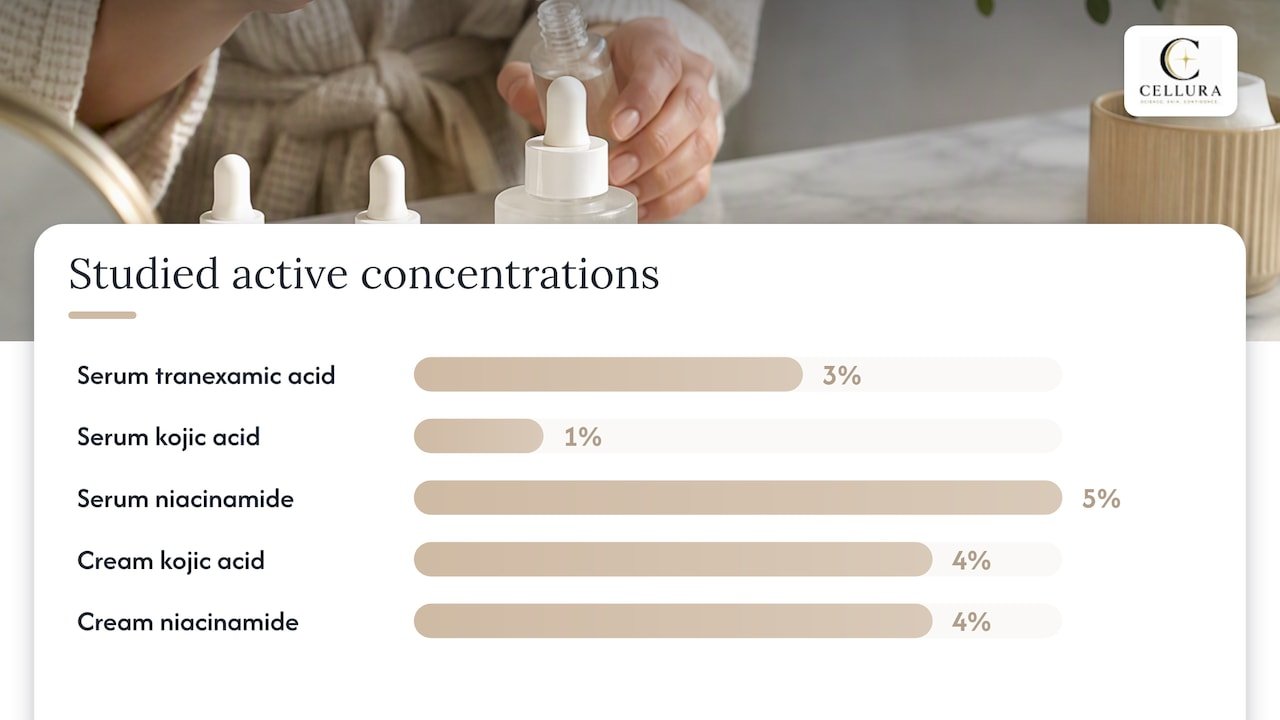
A separate split-face randomized study compared a 4% niacinamide plus 4% kojic acid cream against 4% hydroquinone cream for epidermal melasma over 8 weeks. The niacinamide and kojic acid combination performed comparably to hydroquinone on MASI scores and spectrophotometer L* readings, which measure skin lightness. Some participants experienced transient irritation, mild erythema or itching, which is worth planning for rather than being surprised by.
A third report on a topical formulation with tranexamic acid, niacinamide, and kojic acid echoed the same pattern: significant improvement in melasma by week 12, with good overall tolerability.
“Significant improvements” in melanin index and clinical dyschromia scores were observed beginning at week 2 and continuing through week 12 in participants using the combination serum.
Taken together, these studies measure outcomes with two main tools: the MASI (Melasma Area and Severity Index), a clinician-scored rating of how dark and widespread pigmentation is, and Mexameter or spectrophotometer readings, which quantify melanin content directly from the skin’s surface. Both point to the same conclusion: visible change tends to start within the first month and builds over two to three months of consistent use.
A few practical caveats are worth flagging:
- Most of the strongest trial data pairs kojic acid and niacinamide with tranexamic acid, not just the two alone.
- Results are generally measured over 8 to 12 weeks, so expecting change in days is unrealistic.
- Study sample sizes in this space tend to be modest, so the findings support cautious optimism rather than guaranteed outcomes for every skin type.
What this means practically is that a three-active approach, kojic acid, niacinamide, and tranexamic acid, has more direct clinical support than kojic acid and niacinamide used in isolation from everything else. If tranexamic acid is new to you, our comparison of tranexamic acid and niacinamide walks through how it complements the other two.
How to Use Niacinamide With Kojic Acid: A Step-by-Step Routine
Starting a new combination slowly protects your skin barrier and gives you a clearer read on what is actually working.
- Patch test first. Apply a small amount of the product to your inner forearm or behind your ear for three nights in a row before using it on your face.
- Start at reduced frequency. Begin with every other night, watching for redness, stinging or flaking before increasing use.
- Increase gradually. If your skin tolerates the product well after one to two weeks, move to nightly application.
- Choose sensible starting concentrations. Over-the-counter formulas commonly use kojic acid in the 0.5% to 2% range and niacinamide in the 2% to 5% range, concentrations that balance efficacy with tolerability for most skin types.
- Layer in the right order. Cleanse, apply a hydrating serum if you use one, follow with your kojic acid and niacinamide treatment, then seal with a moisturizer and, in the morning, sunscreen.
- Wait between layers. Give each product 60 to 90 seconds to absorb before applying the next one, especially with actives.
- Monitor for a month before judging results. Early clinical changes typically appear around week 2 to 4, with fuller results by week 8 to 12.
- Consider adding tranexamic acid or seeing a dermatologist for stubborn cases. Melasma and deep post-inflammatory hyperpigmentation sometimes need a third active or professional-strength options that a dermatologist can prescribe.
Pro Tip: Apply your treatment to slightly damp skin rather than fully dry skin, it can reduce the sting some people feel from kojic acid without diluting its effect.
If you already use other actives like vitamin C or exfoliating acids, space them out rather than stacking everything in one session. Our comparison of niacinamide and vitamin C covers how to sequence those without overwhelming your skin barrier.
Safety, Irritation, and the Photoprotection Rule You Cannot Skip
Niacinamide is broadly well tolerated and actually helps calm the kind of inflammation that can make irritation worse, which is part of why the pairing works better than kojic acid alone for many people.
A few habits reduce irritation risk without giving up on results:
- Avoid layering kojic acid and niacinamide on the same night as a strong exfoliating acid or retinoid until your skin has adjusted to the combination.
- Use a barrier-supporting moisturizer, one with ceramides or squalane, if you notice dryness or tightness.
- Reduce frequency to every other night rather than stopping altogether if mild irritation shows up.
- Pull back and consult a dermatologist if redness, burning or peeling persists beyond a few days.
The step people skip most often is photoprotection, and it matters more than almost anything else in this routine. Visible light, the 400 to 700 nanometer range that makes up roughly 45% of sunlight, can trigger pigment darkening on its own, separate from UV exposure. A photoprotection study on diverse skin tones found that iron-oxide-containing tinted sunscreens delivered better outcomes for melasma than plain SPF alone over 12 weeks, because iron oxides specifically block visible light that standard UV filters do not. A guide to tinted sunscreens for darker skin tones breaks down what to look for on a label if you are shopping for one. Skipping daily sunscreen while using kojic acid and niacinamide risks undoing weeks of progress in a single sunny afternoon.
What to Look for in a Kojic Acid and Niacinamide Product
Reading a label well matters more than most people assume. Look for the active ingredient names spelled out, the actual percentage disclosed rather than a vague “contains kojic acid,” and a format suited to leave-on use rather than quick rinse-off contact.
A few label-reading habits help you compare products fairly:
- Check whether the percentage of kojic acid and niacinamide is disclosed, not just listed by name.
- Favor a pH appropriate for the actives involved, since an unstable pH can reduce how well kojic acid performs.
- Look for notes on formulation stability, since kojic acid degrades more easily than many other brightening ingredients.
- Consider the format: a serum left on skin for hours delivers more sustained exposure than a cleansing bar rinsed off in under a minute.
That last point is worth sitting with. A cleansing bar containing kojic acid can still contribute to a routine, but the contact time is measured in seconds, while a serum’s active ingredients sit on skin for hours. Our comparison of kojic acid soap versus serum breaks down exactly how that exposure difference affects results.
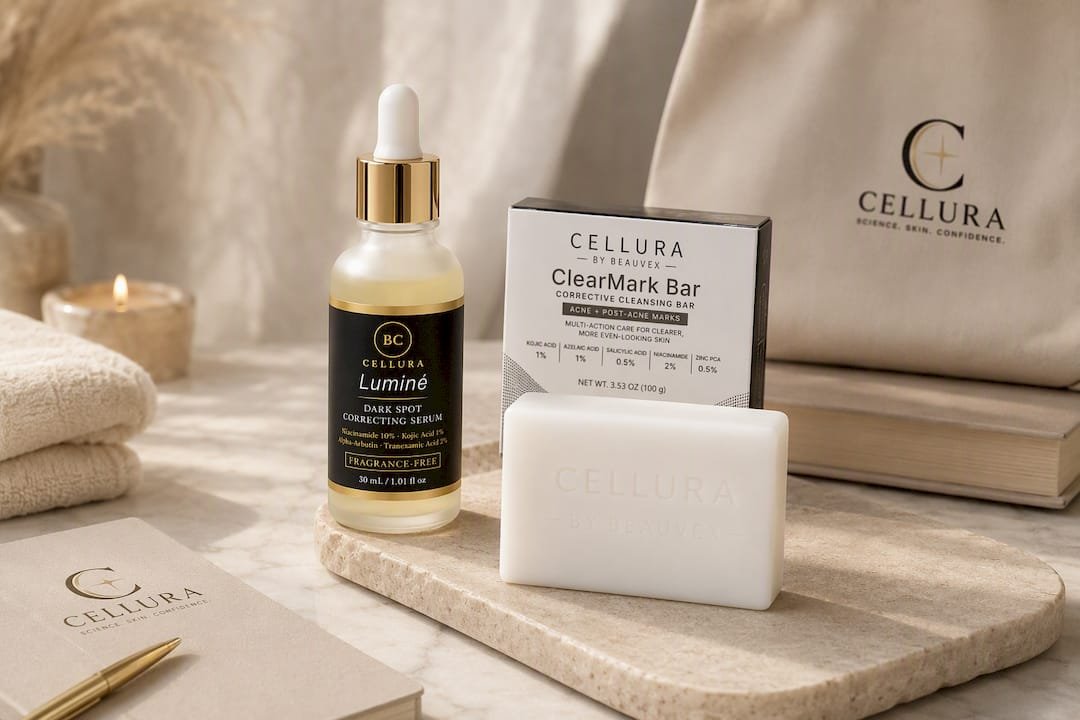
Within our own Cellura line, the Cellura Luminé Brightening Serum combines niacinamide, kojic acid, tranexamic acid and alpha-arbutin in one leave-on formula, built around the same multi-active logic the clinical studies point to. The Cellura ClearMark Bar is a multi-active cleansing bar formulated with salicylic, azelaic and kojic acid, designed to prep skin and support the treatment step rather than replace it.
| Feature | Best for | Typical active levels | Tolerability | Use case |
|---|---|---|---|---|
| Leave-on serum (e.g., Luminé) | Post-acne dark spots, uneven tone | Niacinamide 5%, kojic acid up to 1%, tranexamic acid, alpha-arbutin | Generally well tolerated; patch test first | Nightly treatment step |
| Multi-active cleansing bar (e.g., ClearMark) | Prepping and clearing skin before treatment | Salicylic, azelaic, and kojic acid (brief contact) | Mild; short contact time limits irritation | Daily cleansing step |
Why Transparent Concentrations and a Full Routine Matter
Clinical studies test specific concentrations, 1% kojic acid, 5% niacinamide, 3% tranexamic acid, in specific formulations. A product that hides its percentages makes it impossible to know whether you are getting anywhere near those tested levels or a fraction of them.
That is the core of how we formulate. We disclose the concentration of each active in our products so you can compare what you are applying against the levels used in published research, rather than guessing from a marketing claim.
We also build our line around a three-step ritual rather than a single product, because the clinical evidence behind kojic acid and niacinamide points to multi-pronged approaches working better than any one ingredient alone:
- Cleanse with a multi-active bar to prep skin and support gentle exfoliation.
- Treat with a serum carrying disclosed concentrations of niacinamide, kojic acid, tranexamic acid and alpha-arbutin.
- Support the skin barrier with a copper-peptide balm, since irritation from active ingredients is easier to manage when the barrier stays intact.
A split-face clinical study found that combining niacinamide and kojic acid produced lightening effects comparable to hydroquinone over 8 weeks, which is the kind of benchmark we reference when explaining why our treatment step is formulated the way it is.
Our Take on Treating Post-Acne Dark Spots
If you are dealing with post-acne dark spots, the evidence points toward a layered approach rather than a single hero ingredient. Kojic acid and niacinamide target different steps in how pigment forms, and the clinical data on combining them, especially alongside tranexamic acid, is more convincing than data on any one ingredient alone.
What tends to get overlooked is that the product matters less than the system around it. A serum with undisclosed concentrations asks you to trust a label blindly, and skipping daily sunscreen, particularly one with iron oxides for visible light, can erase weeks of progress. Patch testing before committing to nightly use is not optional caution, it is what keeps irritation from turning into a new dark spot.
For stubborn melasma or hyperpigmentation that does not respond after a couple of months, a dermatologist consult is worth the appointment. For everyone else, consistency with a transparent, well-formulated routine is what the evidence supports.
— Beauvex LLC
Try the Cellura Routine Built Around This Research
If you have read this far, you already know what the evidence supports: kojic acid and niacinamide working together, applied consistently, and backed by daily sun protection. The Cellura Luminé Brightening Serum delivers niacinamide, kojic acid, tranexamic acid and alpha-arbutin in one leave-on formula with every concentration disclosed on the product page, so you know exactly what you are applying. The Cellura ClearMark Bar preps skin each morning and night with salicylic, azelaic and kojic acid, setting up the serum to do its work more effectively.
- Patch test both products for three nights before adding them to your nightly routine.
- Pair the serum with daily sunscreen, ideally one with iron oxides, to protect your progress.
- Explore the full Cellura line to build the complete three-step ritual.
FAQ
Can I use niacinamide and kojic acid together?
Yes, niacinamide and kojic acid are considered compatible and are frequently combined in dark spot formulas because they work at different stages of pigment production. Clinical evaluations of combination formulas have shown measurable improvement in hyperpigmentation over 12 weeks when the two are paired, often alongside tranexamic acid.
What should I avoid mixing with kojic acid?
Avoid combining kojic acid with strong exfoliating acids or retinoids in the same session, especially early on, since stacking multiple actives raises the risk of irritation. The American Academy of Dermatology advises choosing dark spot ingredients mindful of your skin’s tolerability rather than layering several at once.
Which serum works well with kojic acid?
A serum that pairs kojic acid with niacinamide, and ideally tranexamic acid or alpha-arbutin, has the strongest clinical backing for fading dark spots, since split-face trials show this kind of multi-active combination performing comparably to hydroquinone. Our Cellura Luminé Brightening Serum combines all four of those actives with disclosed concentrations.
Why does my skin look darker after starting kojic acid?
Darkening after starting an active ingredient is usually a sign of irritation-driven post-inflammatory pigmentation rather than the ingredient itself causing harm. Introducing kojic acid slowly, patch testing first, and supporting your skin barrier with a gentle moisturizer reduces this risk considerably.
How long until I see results from kojic acid and niacinamide?
Clinical studies typically show early improvement around week 2 to 4, with more noticeable results by week 8 to 12 of consistent use. Daily sunscreen, particularly one with iron oxides for visible light protection, is necessary to maintain those results over time.