
Topical niacinamide and tranexamic acid can be used together, and for many people with post-acne dark spots, the combination outperforms either ingredient alone. A typical approach pairs them in one serum applied twice daily under sunscreen, while avoiding aggressive acids or retinoids on the same nights. Oral tranexamic acid is a different matter entirely and should only be considered after a conversation with a dermatologist.
TL;DR:
- Choose formulas with 4% to 5% niacinamide and 2% to 5% topical tranexamic acid; encapsulated versions may reduce irritation at lower concentrations.
- For reactive skin, begin every other day for one to two weeks, keep exfoliating acids and retinoids to separate nights, and apply sunscreen each morning.
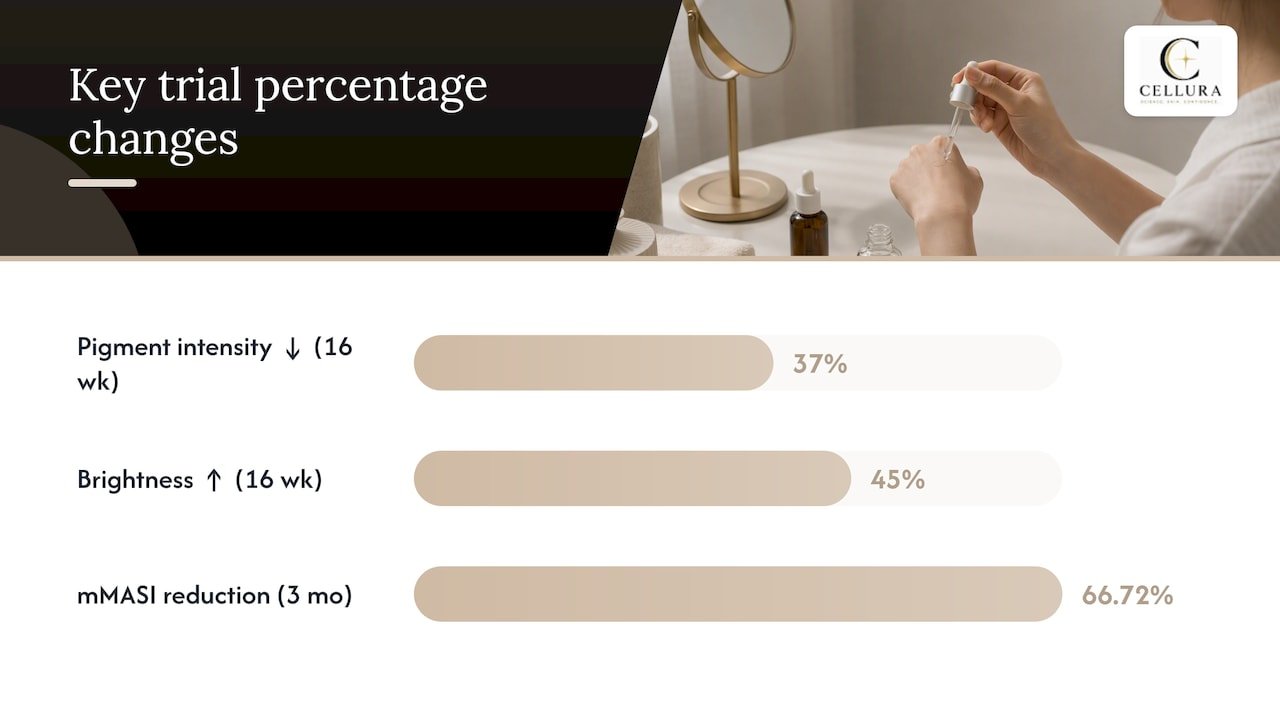
- Visible fading often takes 8 to 16 weeks; a trial’s niosomal cream, with 2% of each active, reduced mMASI by 66.72% after three months.
- Study results vary because trials differed in skin types, follow up periods, and baseline severity, so individual outcomes may not match reported averages.
- Continue sunscreen after spots fade, because UV exposure can restart pigment production; maintenance often means using the routine less frequently rather than stopping.
Table of Contents
- How Niacinamide and Tranexamic Acid Work Together
- What the Clinical Evidence Shows About Combining TXA and Niacinamide
- How to Combine Them Safely in a Routine
- Safety, Interactions, and When to See a Dermatologist
- What Results Look Like and How Long They Take
- Our Take on Formulation Transparency for Post-Acne Dark Spots
- Bringing This Routine to Life With Cellura
- FAQ
- Sources
How Niacinamide and Tranexamic Acid Work Together
Dark spots from acne form when inflammation triggers melanocytes to overproduce pigment, which then gets ferried into surrounding skin cells. Niacinamide and tranexamic acid interrupt that process at different points, which is why dermatology researchers keep pairing them in the same formulas.
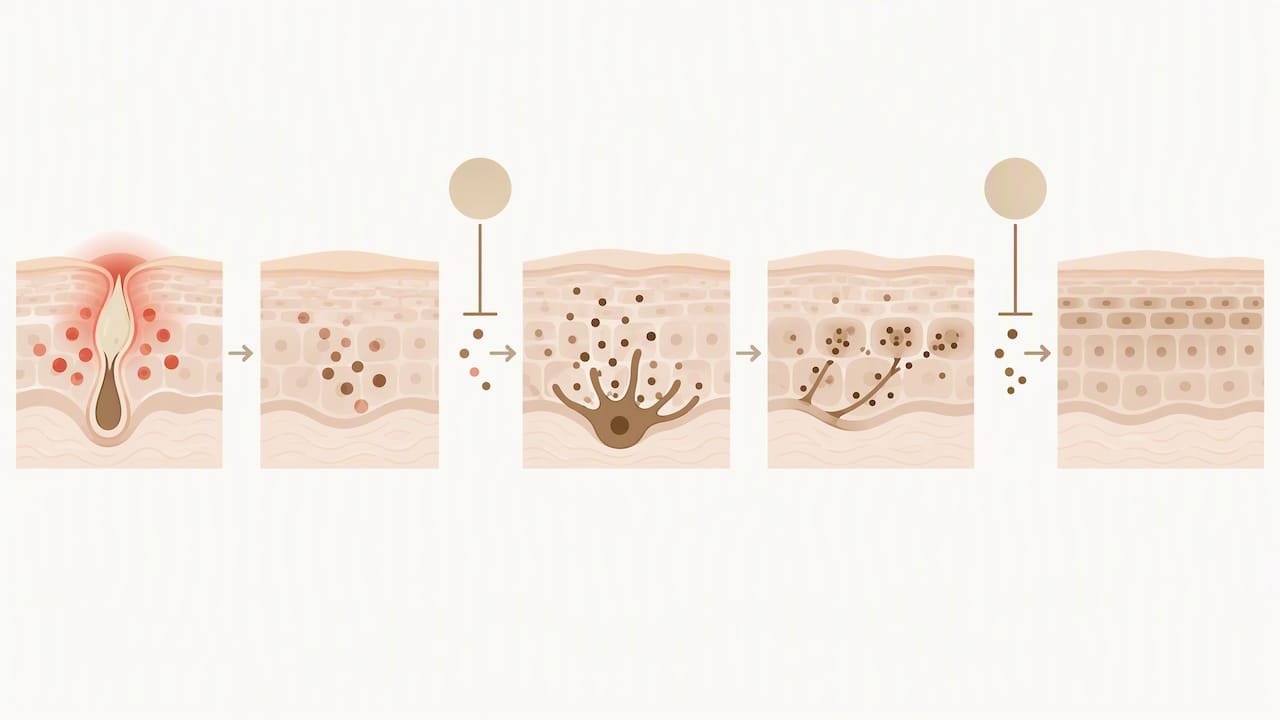
Niacinamide, a form of vitamin B3, works mainly by slowing the transfer of melanosomes (the pigment-carrying packets) from melanocytes into keratinocytes. It also calms inflammation and supports the skin barrier, which matters for post-acne skin that is often reactive. Most published formulas use niacinamide in the 4% to 5% range, a concentration that shows up repeatedly in clinical trials without causing excessive irritation.
Tranexamic acid works upstream of that. It inhibits plasmin activity in keratinocytes, which reduces the signaling cascade that activates melanocytes in the first place, and it may also calm the vascular component that contributes to blotchy, uneven tone.
- Niacinamide slows pigment transfer and supports barrier repair.
- Tranexamic acid blocks the signaling pathway that tells melanocytes to ramp up.
- Combining the two targets separate steps in the same pigmentation cascade, which is why trials pairing them tend to outperform single-ingredient formulas.
- Encapsulation technologies such as niosomes can improve how deeply these actives penetrate, sometimes allowing lower concentrations to match the effect of higher ones.
That last point matters more than it sounds. Encapsulation and delivery research on niosomal and liposomal carriers shows they can extend release and improve cutaneous penetration, which lets formulators use less raw active while still reaching the dermal-epidermal junction where pigment correction needs to happen. A well-designed 2% niosomal cream can rival a conventional 4% cream in results, with less surface irritation.
Pro Tip: Check the ingredient list for encapsulation terms like “niosomal” or “liposomal” delivery, since these formulations often tolerate better on reactive post-acne skin without sacrificing results.
What the Clinical Evidence Shows About Combining TXA and Niacinamide
The research on pairing these two ingredients is more substantial than most skincare combinations get, and it spans randomized trials, instrumental pigment measurements, and at least one updated meta-analysis.
A randomized clinical evaluation of a multimodal topical serum containing tranexamic acid and niacinamide found a 37% decrease in pigment intensity and a 45% improvement in brightness after 16 weeks of use compared with a vehicle control. That trial is one of the clearer demonstrations that combining actives, rather than relying on a single ingredient, produces measurable change in facial dyschromia.
A separate double-blind trial compared a niosomal tranexamic acid 2% and niacinamide 2% cream against hydroquinone 4%, the long-standing benchmark for pigment correction. The niosomal combination produced a 66.72% reduction in mMASI (the modified Melasma Area and Severity Index) after three months, a result comparable to hydroquinone, but with fewer reported adverse reactions. That outcome supports the idea that encapsulated delivery can let a lower-percentage combination match a higher-percentage single ingredient.
A 2024 study of a multimodal gel-serum containing tranexamic acid and niacinamide alongside other actives found melanin production dropped by 50% in vitro by day 14, with brown-spot area reduced by roughly 16.7% by day 28 and continued gains through day 84 in trial participants. That timeline, early biochemical change followed by slower visible improvement, is a useful way to set expectations before starting a research-grade glutathione and related peptides routine.
A 2023 updated meta-analysis of randomized controlled trials found that tranexamic acid, across oral, topical, and intradermal routes, improved MASI and mMASI scores significantly within 4 to 16 weeks. Oral tranexamic acid combined with routine topical agents often produced the largest effect sizes, while topical tranexamic acid performed well as an adjuvant treatment rather than a standalone fix.
- Trials consistently cluster visible improvement between 8 and 16 weeks of consistent use.
- Niosomal or encapsulated formulas can match higher-concentration conventional creams while causing fewer adverse reactions.
- Oral tranexamic acid tends to show a faster, more robust early response than topical use alone.
- Study heterogeneity (different skin types, follow-up lengths, and baseline severity) means individual results vary, so these figures describe trial averages, not guarantees.
For a deeper ingredient-by-ingredient breakdown of how these two actives compare head-to-head, our comparison of tranexamic acid and niacinamide walks through the distinctions in more detail.
How to Combine Them Safely in a Routine
Getting results from this pairing comes down to formulation choice, concentration, and sequencing more than any single trick.
- Pick a combined, pH-stable serum when one is available, since a single formula engineered to carry both actives avoids the guesswork of layering two separate products at mismatched pH levels.
- If layering separately, apply from thinnest to thickest texture, typically a water-based tranexamic acid serum before a niacinamide treatment, waiting a minute or two between layers.
- Look for niacinamide in the 4% to 5% range and topical tranexamic acid between 2% and 5%, the concentrations most consistently tested in clinical research.
- Start slowly if your skin is reactive, applying every other day for the first one to two weeks before moving to twice daily.
- Reserve exfoliating acids or retinoids for separate nights, since stacking them with active treatment serums raises irritation risk without adding benefit.
- Apply broad-spectrum sunscreen every morning without exception, since unprotected UV exposure can undo weeks of pigment correction in a single afternoon.
Morning and evening routines can look nearly identical for this combination: cleanse, apply the treatment serum, moisturize, and in the morning, follow with sunscreen. Evening routines can add a barrier-supporting step, since post-acne skin often needs the extra repair work overnight.
Pro Tip: Introduce one new active at a time rather than starting tranexamic acid and niacinamide on the same day you add an exfoliating acid, so you can tell which ingredient is responsible if irritation shows up.
For a closer look at realistic timelines and what a day-by-day routine looks like with topical tranexamic acid specifically, our guide to 8 to 12 week topical tranexamic acid use covers the formulation side in more depth.
Safety, Interactions, and When to See a Dermatologist
Topical tranexamic acid and niacinamide are generally well tolerated, but “generally” is not “universally,” and the distinction between topical and oral use matters enormously for safety.
- Mild irritation, redness, or a temporary stinging sensation can occur, especially during the first two weeks of use or on skin with an already compromised barrier.
- Contact dermatitis is possible, particularly when either active is combined with strong exfoliating acids, high-strength retinoids, or repeated at-home peels in the same week.
- Oral tranexamic acid carries a real systemic risk: it is contraindicated for people with a personal or family history of thromboembolic disease, and according to American Academy of Dermatology guidance on melasma treatment, it should only be used under a clinician’s supervision after a risk assessment.
- Topical tranexamic acid has not been linked to the same clotting concerns seen with oral use, since very little is absorbed systemically through intact skin.
- Watch for signs of barrier compromise, flaking, persistent stinging, or a tight feeling, and pull back to every-other-day use or pause entirely if they appear.
If irritation persists beyond two weeks of conservative use, or if you notice swelling, blistering, or spreading redness, stop the product and consult a dermatologist. Our safety plan for tranexamic acid serum side effects outlines a patch-testing and escalation approach step by step.
What Results Look Like and How Long They Take
Most people using a niacinamide and tranexamic acid combination see early signs of change by week four, typically a slight evening of overall tone, with more defined fading of individual dark spots between 8 and 16 weeks of consistent twice-daily use.
Clinical trials track this with the mMASI score and instrumental melanin index readings, tools not available at home. A practical consumer substitute is taking progress photos under the same lighting and angle every one to two weeks and tracking one or two specific target spots rather than judging overall improvement day to day, which fluctuates too much to be useful.
- Early biochemical change can register within 2 to 4 weeks, but visible, photographable change tends to cluster later.
- The 66.72% mMASI reduction reported in the niosomal TXA and niacinamide trial took a full three months of consistent application to reach.
- Once spots fade, relapse is common without ongoing sunscreen use, since UV exposure is one of the strongest triggers for renewed pigment production.
- Maintenance usually means continuing the same routine at a lower frequency rather than stopping entirely once results plateau.
Our Take on Formulation Transparency for Post-Acne Dark Spots
Most of the frustration people describe with dark spot products traces back to formulas that hide their actual concentrations behind vague marketing language. We think that’s backward. If a serum claims to use tranexamic acid and niacinamide, shoppers deserve to know the percentages and see the research those percentages are based on, not just a photo of clear skin and a promise.
That’s the reasoning behind structuring a routine as three distinct steps rather than one multitasking product: a cleanser to clear sebum and post-acne debris, a treatment serum to deliver the actives that actually interrupt pigment production, and a barrier step to keep skin resilient enough to tolerate active ingredients long term. Skipping the barrier step is one of the more common reasons people quit a treatment routine early, not because the actives failed, but because the skin couldn’t keep up.
— Beauvex LLC
Bringing This Routine to Life With Cellura
We built this skincare line around the exact mechanism-pairing described above, with transparent concentrations so you can compare the formulas against the research instead of taking claims at face value.

The Cellura ClearMark Bar uses salicylic, azelaic, and kojic acids to clear sebum and post-acne residue before treatment actives go on, which matters because a congested surface limits how well any serum can penetrate. The Cellura Luminé Brightening Serum combines niacinamide, tranexamic acid, kojic acid, and alpha-arbutin in one formula, disrupting the pigmentation pathway at multiple stages rather than relying on a single mechanism.
- Apply the cleansing bar morning and night before any treatment step.
- Follow with the brightening serum on clean, dry skin, both AM and PM.
- Give the routine 8 to 12 weeks before judging results, in line with the timelines seen in published trials.
- Layer a barrier-supporting moisturizer afterward, especially during the adjustment period.
| Step | Product | Role |
|---|---|---|
| Cleanse | Cellura ClearMark Bar | Clears sebum and debris before treatment |
| Treat | Cellura Luminé Brightening Serum | Delivers niacinamide, tranexamic acid, kojic acid, alpha-arbutin |
| Protect | Barrier-supporting moisturizer | Maintains tolerance during active use |
Pro Tip: Photograph your target spots before starting the Luminé Serum so you have an honest baseline to compare against at the 8 to 12 week mark.
If you’re ready to see how the full three-step approach fits your skin, browse the Cellura line and start with the Luminé Serum as your core treatment step.
This article is general information, not a substitute for advice from a qualified doctor. Consult a qualified healthcare professional about your own circumstances before acting on anything here.
FAQ
Can I use niacinamide with tranexamic acid?
Yes, niacinamide and tranexamic acid are commonly combined in the same topical routine, and research on multimodal serums containing both shows meaningful pigment reduction over several weeks. They target different steps in the pigmentation process, which is part of why they’re paired rather than used alone.
Can I use tranexamic acid serum and niacinamide together?
Yes, applying a tranexamic acid serum alongside a niacinamide product, either layered or combined into one formula, is a standard approach in both clinical research and commercial skincare. A double-blind trial using a niosomal 2% TXA and 2% niacinamide cream found results comparable to 4% hydroquinone after three months.
What can I not mix with tranexamic acid?
Avoid stacking topical tranexamic acid with strong chemical peels, high-strength AHA or BHA exfoliants, or potent retinoids on the same night, since the combined irritation risk outweighs any added benefit. Separating these into different evenings or alternating nights lets each ingredient work without overwhelming the skin barrier.
Can I use tranexamic acid daily on my face?
Topical tranexamic acid is generally used once or twice daily in most studied formulations, often starting with less frequent application for sensitive skin before building up to daily use. Oral tranexamic acid is a different consideration entirely and should only be taken under a dermatologist’s guidance given its systemic contraindications, as noted in AAD melasma treatment guidance.
Sources
- Effect of a Tranexamic Acid, Kojic Acid, and Niacinamide Containing Serum on Facial Dyschromia: A Clinical Evaluation — Seemal R. Desai et al.
- Randomized double-blind trial comparing niosomal TXA/NCA cream with hydroquinone
- Efficacy and safety of tranexamic acid in the treatment of adult melasma: An updated meta-analysis of randomized controlled trials
- Clinical benefit of a multimodal topical approach comprising tranexamic acid, niacinamide and other actives — Journal findings (2024)
- American Academy of Dermatology — Melasma: Diagnosis and treatment