
A practical hyperpigmentation skincare routine can follow a simple daily sequence: a gentle morning and evening cleanse, a targeted treatment serum built around ingredients like tranexamic acid and niacinamide, and consistent sun protection. Active acne needs to calm down first, since new breakouts create new marks faster than old ones fade. The timing of visible changes varies, and fuller results may take longer.
TL;DR:
- Tinted sunscreen with iron oxides helps block visible light that can worsen melasma and marks left after inflammation; reapply every two hours outdoors.
- Control active acne before targeting leftover pigment, and avoid using a retinoid with a strong exfoliating acid on the same night to limit irritation.
- Early improvement typically appears after four to eight weeks, but fuller results often take twelve to sixteen weeks; deeper pigment responds more slowly.
- Chemical peels, lasers, and microneedling can worsen pigmentation, especially in darker skin; request a test patch and choose a clinician experienced with darker skin tones.
Table of Contents
- Morning Routine: Clean, Treat, Protect
- Evening Routine: Treat Pigment While Protecting Your Barrier
- Weekly Treatments and Professional Procedures: Benefits and Risks
- Ingredient Primer: What Each Active Does and When to Use It
- Prevention and Daily Habits That Protect Your Progress
- Troubleshooting and When to See a Dermatologist
- Why the Cellura Three-Step Ritual Fits This Approach
- Diet and Lifestyle Factors That Influence Pigmentation
- Common Myths About Hyperpigmentation Treatment
- Skin Types and How to Adjust Your Routine
- What Actually Moves the Needle on Dark Spots
- Getting Started With Cellura Luminé
- FAQ
- Sources
Morning Routine: Clean, Treat, Protect
Start with a gentle, non-stripping cleanser. Harsh sulfates and over-scrubbing irritate the skin, and irritation itself can trigger more pigment, which defeats the purpose before you even get to treatment.
Once skin is clean and dry, apply a brightening serum formulated for daytime use. Niacinamide, tranexamic acid, and stable vitamin C derivatives are all considered safe for morning application and layer well under sunscreen without breaking down in sunlight the way some other actives do.
Sunscreen is the step most people shortchange, and it is the one working hardest against dark spots. DermNet guidance notes that many sunscreens do not shield against visible light, which matters because visible light, not just UV, can worsen melasma and post-inflammatory marks. A tinted sunscreen with iron oxides covers that gap.
- Cleanse with a low-foam, pH-balanced wash before anything else.
- Apply your brightening serum to damp skin and let it absorb for a minute.
- Finish with broad-spectrum sunscreen, tinted if your spots are stubborn or your skin tans easily.
- Reapply sunscreen every two hours if you are outdoors, and after swimming or heavy sweating.
If you are introducing a new daytime active, patch-test it on your inner forearm before applying it to your face.
Pro Tip: Apply sunscreen as the last skincare step, then wait a few minutes before makeup so it sets without pilling.
Evening Routine: Treat Pigment While Protecting Your Barrier
Nighttime is when the real pigment-fading work happens, because there is no UV exposure competing with your actives and skin repairs itself while you sleep.
Decide whether to double-cleanse based on your day. If you wore heavy sunscreen or makeup, an oil-based cleanser followed by a gentle water-based one removes residue without over-washing. On low-makeup days, one gentle cleanser is enough.
- Cleanse thoroughly but gently, patting skin dry rather than rubbing.
- Apply your primary treatment: a retinoid, azelaic acid, or a tranexamic acid formula, depending on what your skin tolerates and what your spots look like.
- Avoid combining a retinoid with a strong exfoliating acid on the same night. Dermatology guidance on post-inflammatory hyperpigmentation warns against mixing incompatible actives because that combination disrupts the skin barrier and can cause irritation-driven darkening.
- Alternate nights between actives if your skin feels reactive, or apply a buffer moisturizer underneath a retinoid to soften the effect.
- Finish with a barrier-support moisturizer containing peptides or squalane to lock in hydration and reduce next-day sensitivity.
If you are new to retinoids, start with occasional use and build up gradually.
Pro Tip: When in doubt, apply your strongest active less often and your barrier-repair moisturizer regularly.
Weekly Treatments and Professional Procedures: Benefits and Risks
A weekly exfoliating step can speed up cell turnover, but it needs a light touch. A mild AHA like lactic acid or a BHA like salicylic acid, used once or twice a week, is a reasonable starting point. Watch for stinging, redness, or flaking before increasing frequency.
Higher-strength home peels carry more risk than reward for most people treating hyperpigmentation, especially anyone with melanin-rich skin. The margin between gentle exfoliation and irritation that triggers new pigment is thin.
Professional procedures like chemical peels, lasers, and microneedling can accelerate fading, but they can also worsen post-inflammatory hyperpigmentation, particularly in darker skin phototypes, because the procedure itself causes inflammation. A test patch and a clinician experienced with darker skin tones matter more here than the specific device used.
- Spot-treat isolated dark marks with a concentrated serum rather than applying it everywhere.
- Reserve full-face treatment for widespread post-acne discoloration or melasma.
- Ask any clinician performing a resurfacing procedure how they manage phototype-specific PIH risk before booking.
- Anyone restarting retinol or other actives after a cosmetic procedure should follow their provider’s timeline, typically resuming one to two weeks post-filler.
Ingredient Primer: What Each Active Does and When to Use It
Different actives target pigment through different pathways, and matching the ingredient to the mark in front of you saves months of trial and error.
- Tranexamic acid works upstream in the plasminogen pathway that triggers melanocyte activity. A narrative review found topical 5% tranexamic acid comparable to 20% azelaic acid for acne-related PIH, with favorable tolerability, making it a solid non-hydroquinone option.
- Azelaic acid combines anti-inflammatory action with tyrosinase inhibition, which makes it useful for the red-brown marks acne leaves behind.
- Niacinamide supports the skin barrier and reduces how much pigment transfers to surface cells, and it pairs safely with almost everything else here. See how it stacks up against tranexamic acid for dark spots for picking between the two.
- Retinoids speed up cell turnover and work synergistically with pigment-modulating actives, but they belong in the routine only after active inflammation is under control.
- Hydroquinone remains effective in short, supervised courses; it is typically used at 1 to 5% concentrations on pigmented areas twice daily for up to three months with patch testing, per DermNet guidance.
- Vitamin C, kojic acid, and alpha-arbutin round out the toolkit as gentler, complementary brighteners rather than primary treatments.
Multimodal topical combinations pairing tranexamic acid with niacinamide and other actives have shown measurable pigment improvement over 12 to 16 weeks in clinical use, which lines up with the timeline most dermatology guidance gives for topical pigment correction.
Prevention and Daily Habits That Protect Your Progress
Every active you apply at night can be undone by unprotected sun exposure the next day, which is why prevention carries as much weight as treatment.
- Wear broad-spectrum SPF 30 to 50+ daily, rain or shine, and reapply every two hours when outdoors.
- Choose a tinted sunscreen with iron oxides if you have melasma or PIH-prone skin, since standard sunscreens often miss visible light that can still trigger pigment.
- Add a wide-brim hat and seek shade during peak midday sun for extra protection sunscreen alone cannot provide.
- Treat active acne promptly rather than letting it run its course, since every healed blemish is a chance for a new mark.
For sensitive skin, a mineral sunscreen with zinc oxide tends to cause less stinging than a chemical formula, and it layers fine under most makeup once fully absorbed.
Pro Tip: Keep a travel-size sunscreen in your bag for reapplication; a dark spot routine without reapplication is only half a routine.
Troubleshooting and When to See a Dermatologist
If a spot looks darker after starting a new active, stop that product first and switch to a bland, barrier-repairing moisturizer for a few days before cautiously reintroducing anything.
Set your expectations by the calendar. Early improvement typically shows up around four to eight weeks, with fuller change often visible by twelve to sixteen weeks. Deeper, dermal pigment responds more slowly to topicals than surface discoloration does, and some cases need longer.
- Stop the suspected irritant and simplify your routine to a cleanser, moisturizer, and sunscreen.
- Watch for spreading pigment, sudden changes in shape or color, or marks that feel raised.
- Seek a dermatologist’s evaluation if dark patches persist despite consistent care.
- Request a patch test before any resurfacing procedure if you have a darker skin phototype.
Why the Cellura Three-Step Ritual Fits This Approach
Our Cellura line follows the same simple routine logic outlined above: a cleansing bar with salicylic, azelaic, and kojic acids; the Cellura Luminé Brightening Serum with niacinamide, tranexamic acid, kojic acid, and alpha-arbutin; and a barrier-support balm built on GHK-Cu copper peptide, tallow, and squalane. We publish exact ingredient concentrations and the research behind each one, so you can see where our formulas align with published studies rather than taking a label’s word for it. Patch-test any new addition on your forearm for several nights, then slot the serum into either your morning or evening step once your skin tolerates it.
Diet and Lifestyle Factors That Influence Pigmentation
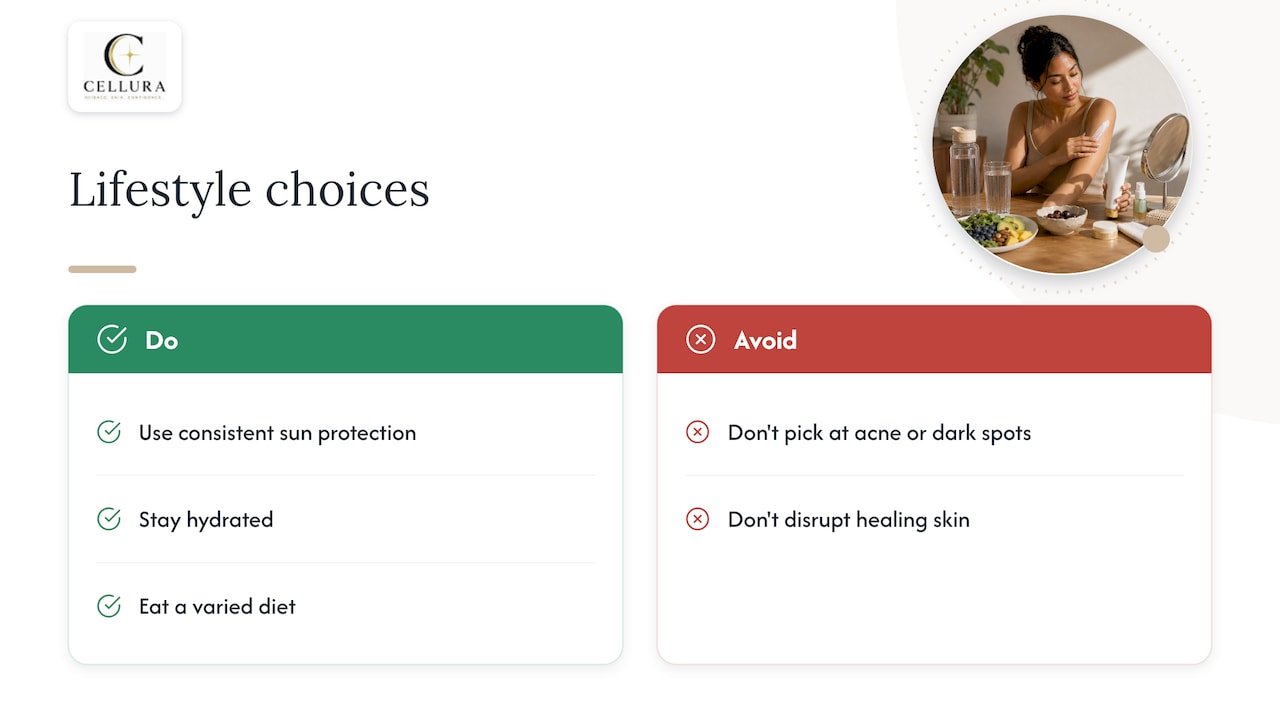
Skin does not exist separately from the rest of the body, and a few daily habits beyond skincare products shape how pigment behaves. Chronic sun exposure remains the single biggest external driver of new and worsening discoloration, which is why sunscreen gets repeated emphasis throughout any dark spot routine.
Sleep and stress affect skin indirectly by influencing inflammation, and inflamed skin is more prone to post-inflammatory pigment than calm skin. Picking at acne or dark spots, even lightly, reintroduces trauma that restarts the pigmentation cycle, so hands-off is a genuinely useful rule.
Hormonal shifts from pregnancy, certain medications, or hormonal birth control can trigger or worsen melasma, a condition that behaves differently from acne-related PIH and often needs its own management approach. Staying hydrated and eating a varied diet support overall skin barrier function, though no food or supplement reverses existing dark spots on its own. The most reliable lifestyle lever remains consistent sun avoidance and protection, paired with not disrupting healing skin.
Common Myths About Hyperpigmentation Treatment
A few persistent myths slow people down or lead them toward routines that backfire.
Myth: dark spots are permanent. Most post-acne and post-inflammatory marks fade over time with consistent care; genuinely permanent pigment is less common than people assume. See a realistic breakdown of how long dark spots take to fade for what the evidence actually shows.
Myth: harsher products work faster. Strong acids and aggressive scrubbing often cause more irritation, which creates new pigment faster than it fades old pigment.
Myth: sunscreen is only for sunny days. Visible light and daily incidental UV exposure both contribute to pigment, regardless of cloud cover.
Myth: you need hydroquinone to see results. Tranexamic acid, azelaic acid, and niacinamide all have supporting evidence and work without the supervision requirements hydroquinone carries.
Myth: more products equal faster fading. Layering five actives at once usually causes irritation before it causes improvement; a focused routine applied consistently can be more useful than a crowded one applied inconsistently.
Skin Types and How to Adjust Your Routine
Oily and acne-prone skin generally tolerates azelaic acid and salicylic acid cleansers well, since both help manage breakouts while addressing pigment, but retinoids may need a slower introduction to avoid excess dryness fighting with excess oil.
Dry and sensitive skin benefits from gentler actives like niacinamide and tranexamic acid, introduced one at a time, with a richer barrier-repair moisturizer carrying more weight in the evening routine than any single treatment step.
Combination skin often does best with targeted application: lighter gel textures on the oilier T-zone and richer barrier creams on drier cheeks, rather than one product applied uniformly across the face.
Darker skin tones face a higher baseline risk of post-inflammatory hyperpigmentation from any irritation, which makes gradual introduction of actives and consistent tinted sunscreen use especially important rather than optional.
What Actually Moves the Needle on Dark Spots
The skincare industry oversells speed and undersells consistency. A serum promising visible results almost immediately may set unrealistic expectations, since pigment changes take time.
The bigger mistake we see is treating pigment before treating the acne causing it. Piling on brightening serums while breakouts continue is like repainting a wall with active leaks behind it. Calm the inflammation first, then bring in pigment-targeting actives.
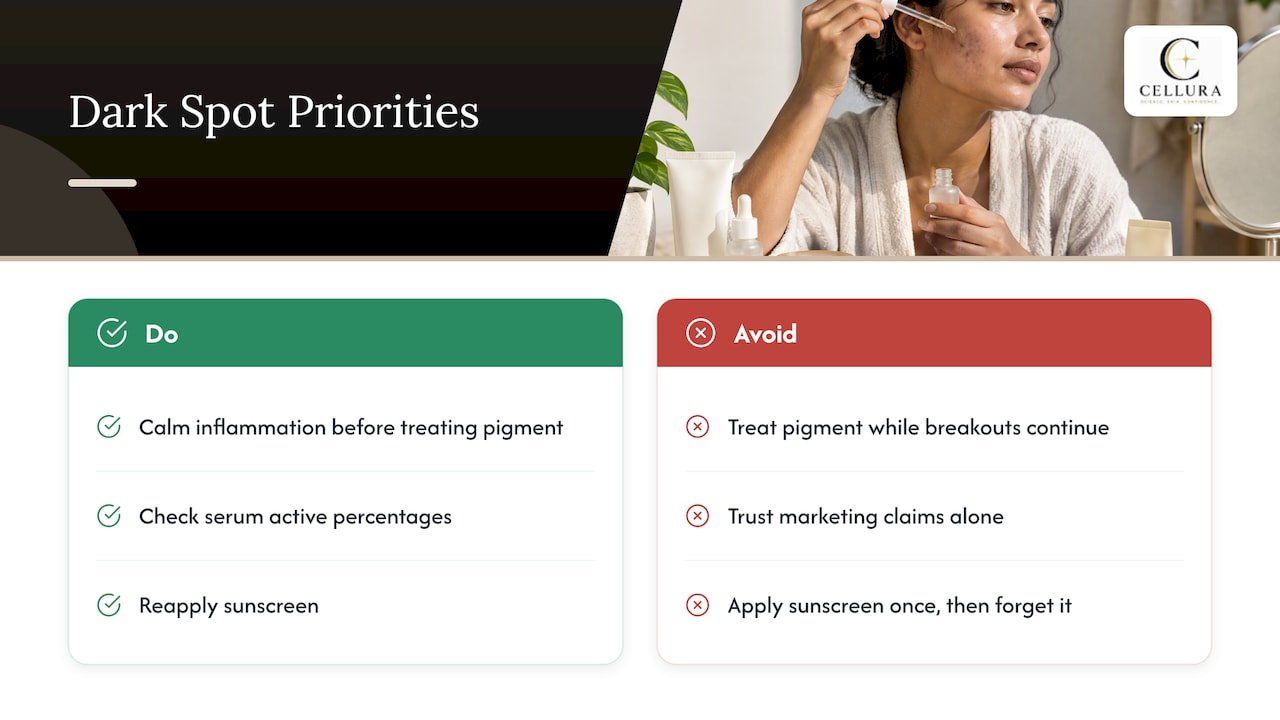
Ingredient transparency matters more than marketing claims. A serum that lists its tranexamic acid or niacinamide percentage lets you judge whether it matches the concentrations used in actual research, rather than trusting a brand’s word for it. That transparency is worth seeking out regardless of which product you choose.
If we had to name one underrated step, it is sunscreen reapplication. Most people apply it once in the morning and forget it exists by noon, undoing hours of treatment in an afternoon of unprotected exposure.
— Beauvex LLC
Getting Started With Cellura Luminé
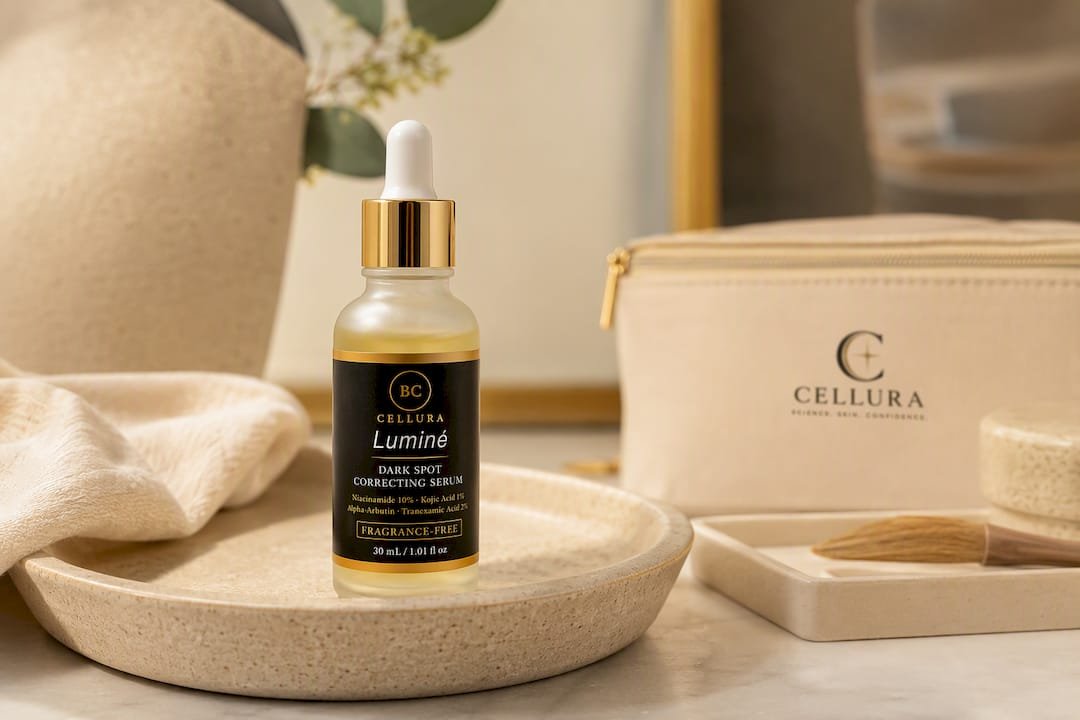
Our Cellura Luminé Brightening Serum combines niacinamide, tranexamic acid, kojic acid, and alpha-arbutin in one formula, built to slot into your morning or evening routine.
- Patch-test on your inner forearm for three nights before applying to your face.
- Use it as your morning treatment under sunscreen, or your evening treatment after cleansing.
- Explore the full Cellura line to pair the serum with our cleansing bar and barrier balm for a complete routine.
This article is general information, not a substitute for advice from a qualified doctor. Consult a qualified healthcare professional about your own circumstances before acting on anything here.
FAQ
How Long Does It Take to See Results From a Hyperpigmentation Routine?
The timing of visible fading varies with consistent treatment, and more complete improvement may take longer. Deeper or dermal pigment can take longer and may not fully respond to topical products alone.
Can You Remove Pigmentation in Seven Days?
No topical routine reliably clears pigmentation quickly, since melanocyte activity and skin turnover take time. Consistent use of actives like tranexamic acid or azelaic acid alongside daily sunscreen is what produces visible change over a longer timeline.
How Should Toddlers Be Protected From Sun-Related Skin Concerns?
Toddler skincare should focus on prevention rather than treatment, since young children do not need pigment-correcting actives. Physical sunscreens with titanium dioxide or zinc oxide are one approach to protecting a toddler’s skin outdoors.
What Ingredients Work Best for Acne-Related Dark Spots?
Tranexamic acid and azelaic acid both have support for fading acne-related post-inflammatory marks, often used alongside niacinamide for barrier support. A systematic review on acne-induced pigmentation recommends controlling active acne first, then layering in these pigment-modulating actives.
Is Layering Multiple Actives at Once Safe for Dark Spots?
Layering too many actives at once often causes irritation that worsens pigmentation rather than improving it. A guide to skincare layering order can help you sequence products correctly, and alternating strong actives on different nights is generally safer than combining them.
Sources
- [Tranexamic acid versus kojic acid in facial post-inflammatory hyperpigmentation following acne: a narrative review
| International Journal of Research in Dermatology](https://www.ijord.com/index.php/ijord/article/view/2285) - Sunscreens: A Complete Overview — DermNet