
Most dark spots are not permanent. Shallow pigment from acne or minor injury typically fades on its own within several months, while deeper or chronic pigment, like some forms of melasma or long-untreated sun spots, can persist for years. Whether a spot fades depends heavily on its depth, its cause, and whether you treat the trigger. Sun protection, an accurate diagnosis, and a dermatologist visit for anything unusual all change the outlook.
TL;DR:
- Dark spots caused by dermal pigment or chronic conditions may remain persistent despite treatment, especially without addressing ongoing triggers like sun exposure and inflammation.
- Sun protection and effective diagnosis are crucial, as untreated triggers such as active acne or repeated friction can cause new pigmentation and hinder fading.
- Topical treatments like hydroquinone, azelaic acid, kojic acid, and retinoids are supported by evidence, but deeper dermal pigment often requires procedures such as laser or chemical peels.
- Visible lightening of superficial spots typically occurs within six to twelve months with consistent use of sunscreen, skincare actives, and avoidance of irritation.
- Skin of color and older skin tend to respond more slowly, with darker skin tones more prone to prolonged hyperpigmentation and higher risk of treatment-induced pigmentation.
Table of Contents
- What causes dark spots: PIH, sun spots, and melasma
- Why some dark spots persist: depth, skin type, and triggers
- How long do dark spots take to fade with and without treatment
- Evidence-backed treatments for dark spots: topicals and procedures
- A safe at-home routine and when to see a dermatologist
- Preventing dark spots: sun protection and habits that stop recurrence
- How Beauvex approaches persistent pigment
- What actually moves the needle on stubborn marks
- Try the Cellura Luminé Brightening Serum
- Sources
- FAQ
What causes dark spots: PIH, sun spots, and melasma
Dark spots are not all the same condition, and knowing which type you have changes what to expect. The three most common categories are post-inflammatory hyperpigmentation, solar lentigines, and melasma. They behave differently.
Post-inflammatory hyperpigmentation, often shortened to PIH, shows up after acne, cuts, burns, or eczema flares. It appears where the injury or breakout happened, most often on the cheeks, jawline, and chest, and the pigment forms because inflammation triggers melanin-producing cells to overreact. Solar lentigines, commonly called age spots or sun spots, develop from years of ultraviolet exposure and tend to appear on the face, hands, shoulders, and other areas that get regular sun. They are flat, well-defined, and usually darker and more stable in shape than PIH. Melasma is different again: it is driven largely by hormones and UV exposure together, tends to appear in larger, symmetrical patches on the cheeks, forehead, and upper lip, and is more prone to chronic recurrence than the other two types.
A few diagnostic cues can help you sort out which one you are dealing with:
- Recent inflammation or breakout in the same spot usually points to PIH rather than sun damage or melasma.
- Flat, sharply bordered spots that appeared gradually with sun exposure suggest solar lentigines.
- Symmetrical patches on both cheeks or across the forehead are the hallmark of melasma, especially if they darken with heat, pregnancy, or hormonal birth control.
- Raised, irregular, or rapidly changing spots are not typical hyperpigmentation and warrant medical evaluation.
The American Academy of Dermatology points out that treating the underlying trigger matters as much as treating the mark itself: ongoing acne, friction, or certain medications will keep producing new pigment even while you treat the old spots. If you are dealing specifically with post-acne marks, a condition-specific approach tends to work faster than generic advice.
Why some dark spots persist: depth, skin type, and triggers
The single biggest factor in whether a dark spot fades or sticks around is where the pigment sits in the skin. Epidermal pigment, which lives in the skin’s outer layer, responds relatively well to topical treatment and natural cell turnover because those cells are shed and replaced over weeks. Dermal pigment sits deeper, in a layer that turns over far more slowly, and it is much harder to treat topically. According to the Merck Manual, some hyperpigmentation can be effectively permanent when the pigment lies in the dermis, when inflammation or injury keeps repeating, or when melasma becomes chronic, and prognosis depends on the cause, the depth, skin type, and whether triggers are still active.
Skin tone also changes the odds. Darker skin tones are more prone to noticeable, longer-lasting post-inflammatory hyperpigmentation because melanocytes in richly pigmented skin react more strongly to inflammation. A review on treating hyperpigmentation in skin of color recommends photoprotection and topical therapy as first-line treatment for this reason, reserving more aggressive procedures for cases that do not respond, since those procedures carry a higher risk of triggering new pigmentation in darker skin if not carefully tailored.
Checkpoint at three to six months. Cleveland Clinic notes that measurable lightening within a three to six month window is a practical sign that a spot is responding to conservative treatment, while a spot that shows no change in that time frame may need a different approach or a dermatologist’s input.
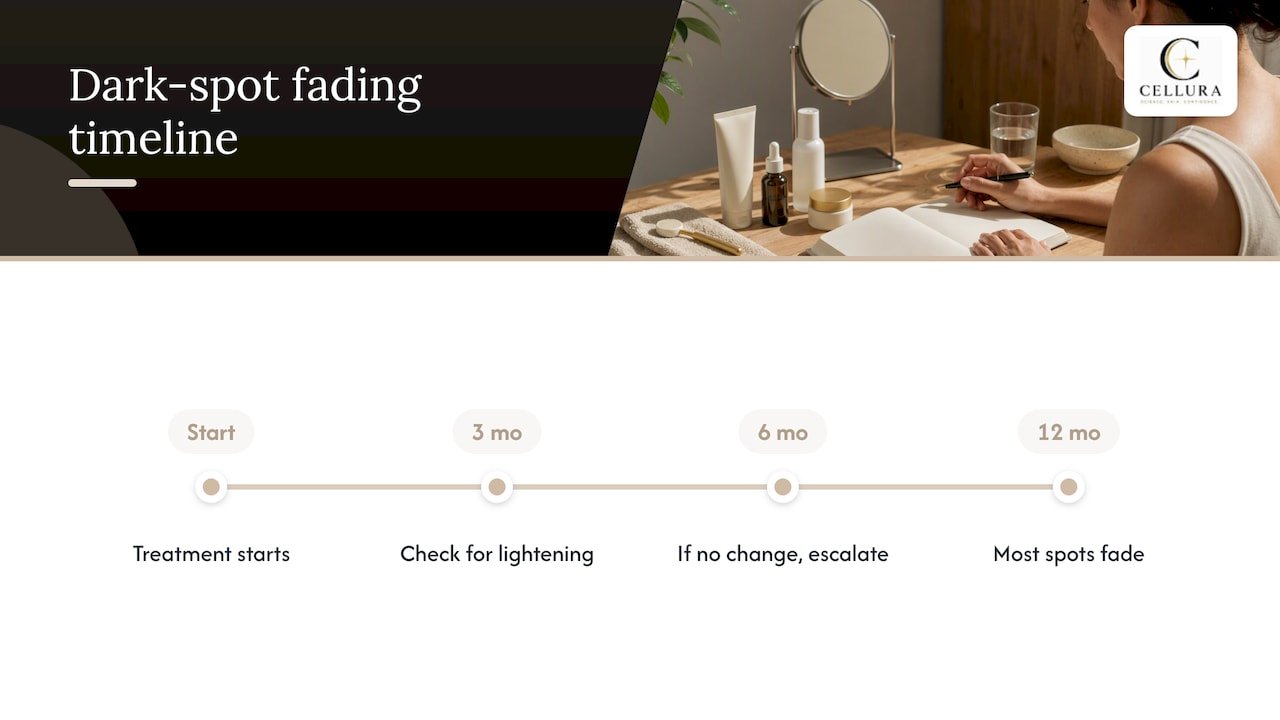
Repetition is the other half of the permanence equation. Picking at a healing blemish, repeated sun exposure on the same patch, or ongoing friction from clothing or equipment all re-trigger the inflammatory response and can push pigment deeper over time, converting what started as a shallow, fadable mark into a more stubborn one.
How long do dark spots take to fade with and without treatment
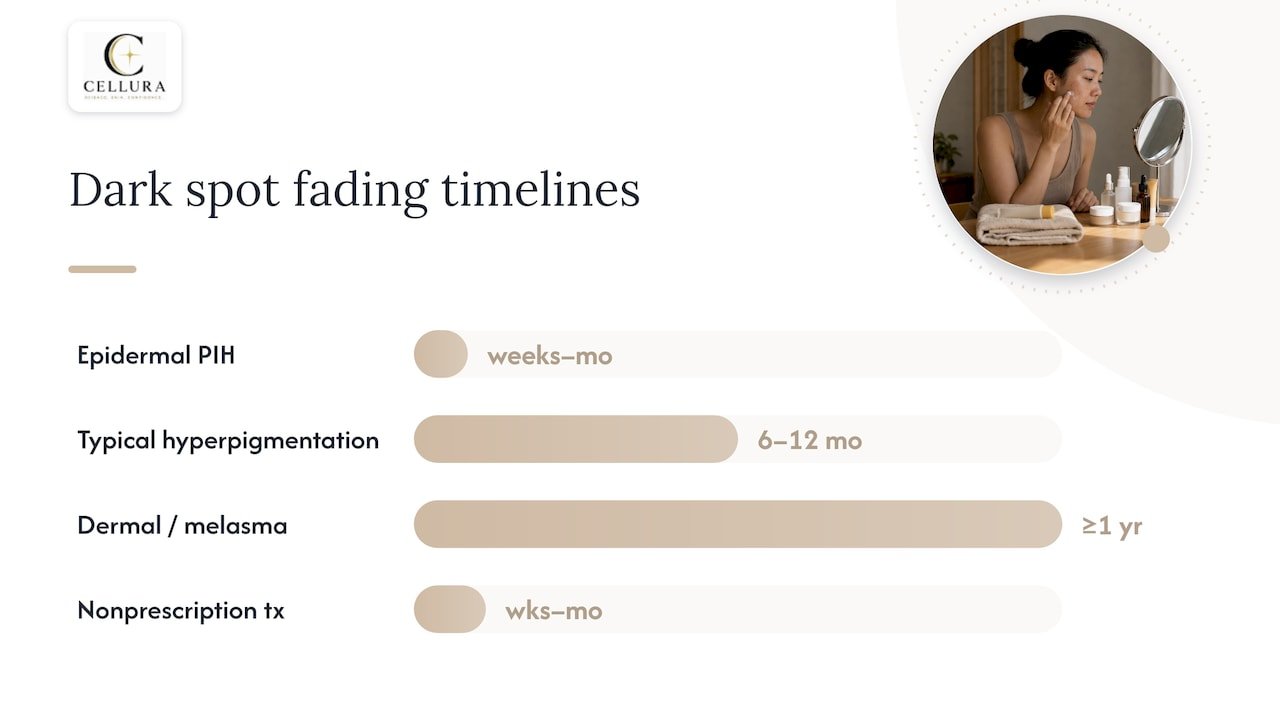
Fading timelines vary enormously depending on depth and consistency of care, but there are useful benchmarks. Mild post-inflammatory pigment often starts visibly lightening within a matter of weeks to a couple of months, especially with consistent sun protection. Cleveland Clinic states that many cases of hyperpigmentation fade with time and protection, though full resolution commonly takes six months to a year, and deeper dermal pigment can take considerably longer or persist indefinitely.
A few practical markers to keep in mind:
- Weeks to a few months: shallow, epidermal PIH from a single breakout, especially with sunscreen and gentle treatment.
- Six to twelve months: the typical window for many cases of hyperpigmentation to substantially fade, per Cleveland Clinic.
- A year or longer, or effectively permanent: dermal pigment, chronic melasma, or spots where the trigger was never resolved.
- No prescription products: Mayo Clinic notes that nonprescription treatments for age spots can take several weeks to months to show a visible difference.
Age plays a role too. Skin cell turnover slows with age, which means the same depth of pigment can take longer to clear in older skin than in younger skin, and this is one reason age spots in particular tend to be more stubborn than a fresh acne mark in a teenager.
Evidence-backed treatments for dark spots: topicals and procedures
Treatment choice should match the type and depth of pigment, and the evidence base is strongest for a handful of specific ingredients and procedures rather than for skincare in general.
On the topical side, a systematic review of melasma treatments gives its strongest recommendations to hydroquinone, triple-combination therapy (a mix of hydroquinone, a retinoid, and a mild steroid), and daily sunscreen, with kojic acid and azelaic acid also carrying supporting evidence. The same review notes that tranexamic acid shows promise but still needs larger trials before its evidence rises to the same level. Retinoids increase cell turnover and are used broadly across PIH, sun spots, and melasma, though they can cause irritation if introduced too quickly. Niacinamide works differently, interfering with the transfer of pigment between skin cells, and is generally well tolerated, which is why it often appears alongside stronger actives rather than replacing them.
- Hydroquinone: a prescription-strength option with strong evidence for melasma and PIH, best used under guidance given its potential for irritation with long-term use.
- Azelaic acid and kojic acid: supported by evidence for melasma, with a gentler side effect profile than hydroquinone, though results build gradually.
- Retinoids: increase turnover and help fade epidermal pigment, but need gradual introduction to avoid irritation-driven rebound pigmentation.
- Niacinamide and tranexamic acid: useful supporting actives that target pigment transfer and production, often combined with stronger agents.
For readers comparing specific actives, a closer look at tranexamic acid versus niacinamide, niacinamide versus vitamin C, or kojic acid’s precautions can help match an ingredient to a specific spot type. Readers who want to avoid hydroquinone entirely have options to weigh in this comparison of hydroquinone alternatives.
Procedures come into play when topicals plateau. Chemical peels and lasers can accelerate fading of stubborn spots, and Mayo Clinic lists cryotherapy, dermabrasion, laser treatment, and chemical peels among the options for age spots that do not respond to creams, while cautioning that these carry risks of irritation, scarring, or the skin becoming lighter or darker than surrounding areas. For darker skin tones specifically, the risk profile shifts: peels and lasers can trigger new post-inflammatory hyperpigmentation if protocols are not adjusted for skin of color, which is why the hyperpigmentation review recommends cautious escalation rather than jumping straight to aggressive procedures. Microneedling is generally gentler but still carries some PIH risk and typically requires multiple sessions spaced weeks apart.
Pro Tip: Introduce one new active at a time and wait several weeks before judging results or adding another, since layering too many actives at once makes it hard to tell what is working and raises irritation risk.
A safe at-home routine and when to see a dermatologist
A consistent, gentle routine outperforms an aggressive one for most people, since irritation itself can trigger more pigment, particularly in darker skin tones.
- Cleanse gently with a non-stripping formula rather than harsh scrubs, which can worsen inflammation.
- Introduce one active ingredient at a time, whether that’s a retinoid, azelaic acid, or a brightening serum, and give it several weeks before adding another.
- Apply broad-spectrum sunscreen every day, since unprotected UV exposure undoes progress and is the single most common reason spots fail to fade.
- Avoid aggressive physical exfoliation and picking at healing skin, both of which re-trigger inflammation and can deepen pigment.
- Reassess at three to six months: if a spot shows no change, that is a signal to adjust your approach rather than keep pushing the same routine.
See a dermatologist if a spot is new and changing shape, color, or size, if it has irregular borders or multiple colors, or if it bleeds, itches, or becomes raised, since these can be signs of something other than ordinary hyperpigmentation, according to DermNet NZ. A dermatologist can also help when a spot has not improved despite months of consistent home treatment, or when the diagnosis itself is unclear. In-office assessment can include a Wood’s lamp exam, dermoscopy, or in some cases a biopsy to determine whether pigment is epidermal or dermal, which then guides whether to escalate to a peel, laser, or prescription-strength topical.
Preventing dark spots: sun protection and habits that stop recurrence
Prevention is the most reliable long-term defense against dark spots, more so than any single treatment, because new UV exposure or repeated inflammation will keep generating pigment regardless of how well you treat existing marks. Mayo Clinic notes that treating existing age spots does not prevent new ones from forming with further sun exposure, which makes daily protection a non-negotiable part of any fading routine.
- Apply broad-spectrum sunscreen daily and reapply through the day, since sunscreen use is directly tied to how well existing spots fade over time.
- Add physical protection: wide-brimmed hats and UV-protective clothing reduce exposure in ways sunscreen alone does not fully cover.
- Treat the root cause, whether that’s active acne, eczema, or friction from equipment or clothing, since AAD guidance notes pigmentation recurs if the trigger is not controlled.
- Keep a light maintenance routine after spots clear, since skin that has pigmented once tends to be more reactive to future irritation.
Readers wanting the mechanics behind why sunscreen matters this much can find more detail in what SPF really does for dark spots.
How Beauvex approaches persistent pigment
A system built around the sequence that pigment biology calls for: cleanse, treat, then support the skin barrier. A cleansing bar with salicylic, azelaic, and kojic acids manages the acne and inflammation that often start the pigmentation cycle in the first place. A serum includes niacinamide, tranexamic acid, kojic acid, and alpha-arbutin, ingredients that interrupt pigment production and transfer at different points rather than relying on a single mechanism. A barrier balm with GHK-Cu copper peptide, tallow, and squalane supports the skin barrier so that active treatment does not become a new source of irritation and, by extension, new pigment.
Exact ingredient concentrations and the research each active is based on are published, so buyers can weigh the formulation against the evidence themselves rather than taking effectiveness on faith. This does not replace medical evaluation for a changing or unusual spot, and results still depend on consistent use alongside daily sun protection.
What actually moves the needle on stubborn marks
The routines that work are almost never the most aggressive ones. Readers chasing fast results tend to layer too many actives, over-exfoliate, and skip sunscreen on cloudy days, all of which extend the very timelines they’re trying to shorten. The people who see real fading are the ones who pick one or two evidence-backed ingredients, give them months rather than days, and treat sun protection as the actual foundation of the routine rather than an afterthought. Persistent marks test patience more than they test any single product.
— Beauvex LLC
Try the Cellura Luminé Brightening Serum
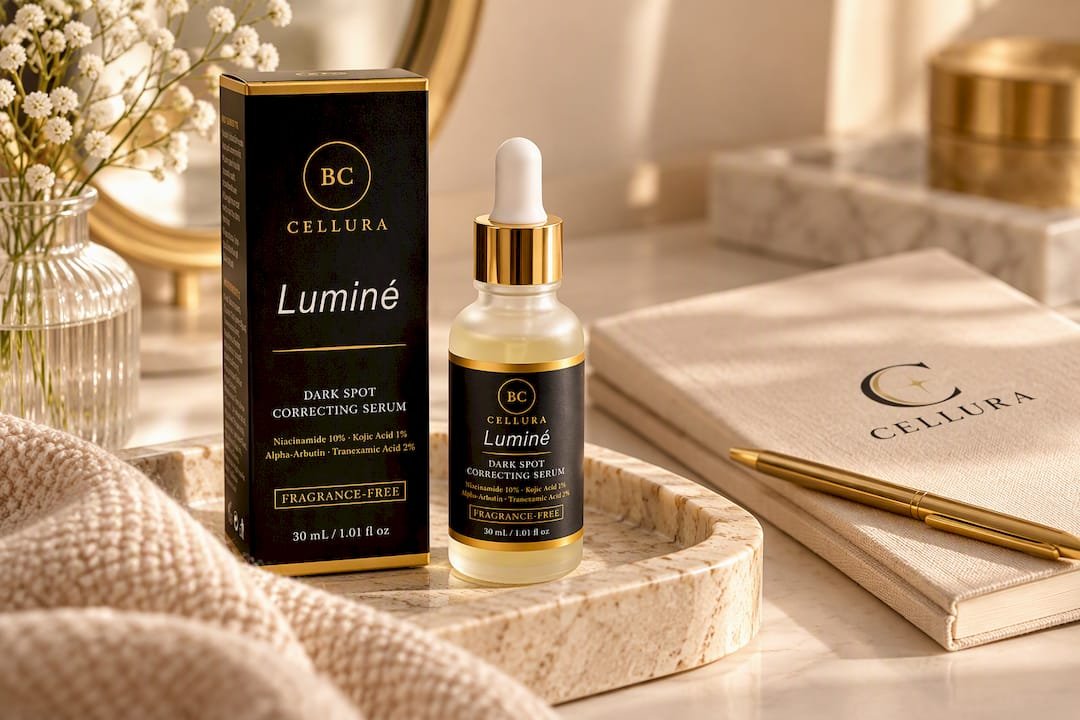
If you’re ready to pair a targeted topical with daily sunscreen, the Cellura Luminé Brightening Serum combines niacinamide, tranexamic acid, kojic acid, and alpha-arbutin to work on pigment at multiple stages, alongside the full Cellura line for cleansing and barrier support.
| Ingredient | Role in fading pigment |
|---|---|
| Niacinamide | Interferes with pigment transfer between skin cells |
| Alpha-arbutin | Slows pigment production at the source |
| Kojic acid | Supports fading with evidence in melasma research |
This article is general information, not a substitute for advice from a qualified doctor. Consult a qualified healthcare professional about your own circumstances before acting on anything here.
Sources
- Age spots: Diagnosis & treatment — Mayo Clinic
- Hyperpigmentation — Merck Manual
- Hyperpigmentation — Cleveland Clinic
- Treating hyperpigmentation in skin of color — PMC
FAQ
How long will dark spots go away?
Mild post-inflammatory spots often start fading within weeks to a couple of months, and Cleveland Clinic notes many cases resolve substantially within six to twelve months with consistent sun protection and treatment. Deeper dermal pigment or chronic melasma can take considerably longer or persist despite treatment.
What’s the difference between dark spots and age spots?
“Dark spots” is a broad term covering several types of hyperpigmentation, while age spots, also called sun or liver spots, are a specific type caused by long-term UV exposure and typically appear on sun-exposed areas like the hands and face. Post-inflammatory hyperpigmentation, by contrast, follows a specific injury or breakout rather than cumulative sun exposure.
Why is my dark spot not going away?
The pigment may sit deeper in the skin, in the dermis rather than the epidermis, which makes it far more resistant to topical treatment, according to the Merck Manual. An unresolved trigger, like ongoing sun exposure, active acne, or repeated friction, can also keep regenerating the pigment even while you treat the visible mark.
Can dark spots be permanently removed?
Many dark spots can be significantly lightened or effectively cleared with consistent treatment and sun protection, though Mayo Clinic notes that treating existing spots does not stop new ones from forming with further sun exposure. Deeper or chronic pigment, such as some melasma cases, may improve substantially but is harder to clear completely.