
Yes, alpha arbutin fades hyperpigmentation, but only within limits worth knowing before you buy anything. It works best on post-inflammatory dark spots and sun damage, typically in leave-on formulas at amounts shown effective in studies, with visible change showing up over weeks, not days. Daily sunscreen is non-negotiable during treatment, and melasma or stubborn, deep pigment usually needs more than arbutin alone.
TL;DR:
- Alpha arbutin effectively reduces post-inflammatory dark spots and sun damage but requires consistent use over at least 8 to 12 weeks with daily sunscreen for visible results.
- Its safety relies on proper formulation, as poor-quality raw materials or unstable pH can lead to trace hydroquinone formation, increasing potential risks.
- Clinical trials show alpha arbutin can rival stronger prescription creams with fewer side effects, especially when combined with ingredients like kojic acid and niacinamide in specific concentrations.
- Using concentrations below 1 mM in formulations is generally safe and prevents cytotoxic effects in skin models, emphasizing the importance of product quality and stability.
- Avoid stacking alpha arbutin with aggressive exfoliants or retinoids in the same routine to prevent irritation that could hinder depigmentation efforts.
Table of Contents
- How Alpha Arbutin Interrupts Melanin Production
- What Clinical Studies Say About Alpha Arbutin’s Effectiveness
- Is Alpha Arbutin Safe? Hydroquinone Risk and Formulation Quality
- How to Use Alpha Arbutin in Your Skincare Routine
- Which Ingredients Pair Well With Alpha Arbutin (and Which Don’t)
- How Long Until You See Results From Alpha Arbutin?
- A Three-Step Approach to Post-Acne Discoloration
- Beauvex’s Take: When Alpha Arbutin Is the Right Move
- Where to Start With Beauvex’s Alpha Arbutin System
- Primary Research Behind This Article
- Sources
- FAQ
How Alpha Arbutin Interrupts Melanin Production
Alpha arbutin works as a competitive tyrosinase inhibitor. Tyrosinase is the enzyme that converts tyrosine into melanin, and alpha arbutin’s molecular structure resembles the enzyme’s natural target closely enough to occupy its active site without triggering the same reaction. Less active tyrosinase means less melanin gets made in the first place, which is a fundamentally different approach from ingredients that just exfoliate pigmented cells off the surface.
A comprehensive review of arbutin’s depigmenting properties found that arbutin and alpha arbutin reduce melanin content and tyrosinase activity in human cell models, with clinical evidence backing real-world skin lightening effects. The same review notes antioxidant activity as a secondary benefit, since oxidative stress in skin cells tends to accelerate melanin overproduction after acne, sun exposure, or irritation.
The mechanism has nuances that matter in practice:
- Alpha arbutin also appears to slow how melanosomes (the pigment-carrying structures inside skin cells) mature and transfer to surrounding cells, which compounds the tyrosinase-blocking effect.
- Beta-arbutin, a related but structurally distinct compound, converts to hydroquinone more readily during metabolism, giving alpha arbutin a cleaner safety profile at comparable strengths.
- Lab results on potency vary study to study because raw material purity, testing concentration, and skin model type all shift the numbers. This is why “how strong is alpha arbutin really” doesn’t have one clean answer.
Alpha arbutin reduces melanin content without cytotoxic effects at concentrations below roughly 1 mM in skin-model studies, according to the same PMC review. That threshold is a lab measurement, not a shelf concentration, but it explains why formulators can push alpha arbutin fairly hard without the tissue damage seen with cruder depigmenting agents.
What Clinical Studies Say About Alpha Arbutin’s Effectiveness
The strongest data point comes from a randomized, split-face trial comparing a cream with alpha arbutin and a cream containing alpha arbutin and kojic acid at concentrations shown effective in clinical study against a standard triple-combination cream (a mix of hydroquinone, tretinoin, and a corticosteroid) for melasma. The split-face study found the arbutin and kojic acid combination produced melasma improvement scores comparable to the triple-combination cream, but with fewer adverse events and lower recurrence in the studied group.
That result matters for two reasons. First, it shows alpha arbutin isn’t just a mild cosmetic ingredient with placebo-level effects. It can go head-to-head with a much harsher prescription-strength regimen on an objective pigmentation scale. Second, the tolerability gap is the real story: triple-combination creams carry real risks of skin thinning and rebound pigmentation with long-term use, while the arbutin-based cream showed less irritation over the trial period.
The broader review of arbutin’s depigmenting properties reinforces this pattern across multiple studies, describing consistent anti-melanogenic effects paired with a low rate of adverse reactions. Rare contact dermatitis cases do show up in the literature, which is why patch testing still matters even for a “gentle” ingredient.
Fewer adverse events and a lower recurrence rate was reported for the alpha arbutin and kojic acid combination compared with the triple-combination cream in the split-face trial were reported for the alpha arbutin and kojic acid combination compared with the triple-combination cream in that split-face trial, a meaningful distinction for anyone weighing a gentler long-term option against a more aggressive short-term one.
Where the evidence gets thinner:
- Sample sizes in split-face and RCT trials on arbutin tend to be modest, often in the dozens rather than hundreds of participants.
- Most published trials skew toward specific skin tone ranges and geographic populations, so results don’t automatically generalize to every skin type or pigmentation pattern.
- Testing protocols vary: some studies measure objective colorimetry, others rely on dermatologist visual scoring, and a few use patient self-report. That inconsistency makes cross-study comparison harder than it should be.
- Long-term studies (beyond six months) on alpha arbutin specifically are sparse, so claims about years-long maintenance benefit lean more on formulation logic than hard trial data.
None of this undermines the core finding. It just means “alpha arbutin works” should come with the honest caveat that the evidence base, while real and clinically grounded, is still smaller than what exists for older ingredients like hydroquinone. A brand that publishes its alpha arbutin benefits alongside actual concentration numbers is giving you more to evaluate than one that just says “clinically proven” and stops there.
Is Alpha Arbutin Safe? Hydroquinone Risk and Formulation Quality
Alpha arbutin’s biggest safety asterisk isn’t the molecule itself, it’s what it can turn into under the wrong conditions. Alpha arbutin is chemically related to hydroquinone, and poor-quality raw material or improper formulation can allow trace hydroquinone to form, especially with heat, UV exposure, or unstable pH over time. This is a real, documented concern, not a scare tactic, and it’s the main reason ingredient sourcing and manufacturing transparency actually matter here.
The fix is mostly a formulation problem, not a “should I use this ingredient” problem. A formulation analysis comparing kojic acid and alpha arbutin found alpha arbutin holds stable across a pH range of roughly 3.5 to 6.5, with accelerated stability testing showing 98 percent or higher recovery in that window. Kojic acid, by comparison, is notoriously touchy: it oxidizes and discolors faster, which is part of why it has a reputation for being harder to keep stable in a finished product.
Compared with kojic acid and hydroquinone directly, alpha arbutin generally sits at the gentler end of the tolerability spectrum. Kojic acid carries a higher irritation rate for sensitive skin and can cause contact dermatitis at higher concentrations. Hydroquinone, while effective, is restricted or banned over certain concentrations in various countries specifically because of long-term safety concerns, including a rare condition called exogenous ochronosis with prolonged use. Alpha arbutin’s gentler standing as a hydroquinone alternative is well documented in dermatologist commentary, though “gentler” doesn’t mean “risk-free.”
Practical formulation and storage guidance, in order of priority:
- Look for products that state their pH range or at least confirm third-party stability testing. Alpha arbutin needs that 3.5 to 6.5 window to stay chemically intact.
- Favor opaque or UV-protective packaging. Light exposure accelerates the same hydrolysis that generates hydroquinone as a breakdown product.
- Store products away from bathroom heat and humidity swings. A cool, dry drawer beats a steamy shower shelf.
- Check for antioxidants like vitamin E or ferulic acid in the ingredient list. These help suppress hydroquinone detection during the product’s shelf life, according to formulation research.
- Patch test on your inner forearm for 48 to 72 hours before applying to your face, especially if you have a history of reacting to brightening actives.
Regulatory guidance from the EU’s Scientific Committee on Consumer Safety supports alpha arbutin use in face products up to 2 percent when manufacturing and storage controls are in place, per the same formulation research. That 2 percent ceiling isn’t arbitrary. It reflects the point where efficacy gains start flattening while irritation risk creeps up, particularly for hydroquinone alternatives marketed toward sensitive skin.
Pro Tip: If a product doesn’t list its alpha arbutin percentage or mention pH stability anywhere, treat that as a red flag rather than an oversight. Brands confident in their formulation usually say so.
How to Use Alpha Arbutin in Your Skincare Routine
Most leave-on formulas use alpha arbutin within concentration ranges considered safe and effective by regulatory guidance. For example, the EU permits up to a certain percentage in face products under current guidance, while body applications generally use lower concentrations due to skin differences. Serums generally deliver the ingredient more directly than creams, since a lighter base lets the active penetrate rather than sitting on top of heavier emollients.
Here’s a workable sequence for building alpha arbutin into your routine:
- Cleanse first. Use a gentle cleanser that won’t strip your barrier before applying anything active. A cleansing bar formulated with mild exfoliating acids can help clear surface buildup so brightening actives absorb better.
- Apply on clean, slightly damp skin. Alpha arbutin serums generally go on after cleansing and before heavier creams or oils, while skin is still a little damp to help with absorption.
- Layer lighter to heavier. Follow with a moisturizer to lock in hydration, since alpha arbutin itself doesn’t add much moisture on its own.
- Use morning or night, consistently. Alpha arbutin doesn’t carry the same photosensitivity warnings as retinoids, so it works in either slot. Many people prefer AM for the antioxidant support alongside sunscreen, saving stronger actives like retinoids for PM.
- Never skip sunscreen. This is the step people cut corners on, and it’s the one that undoes the most progress. New pigment forms fastest under UV exposure, so daily SPF isn’t optional support, it’s half the treatment.
A few extra guardrails worth flagging:
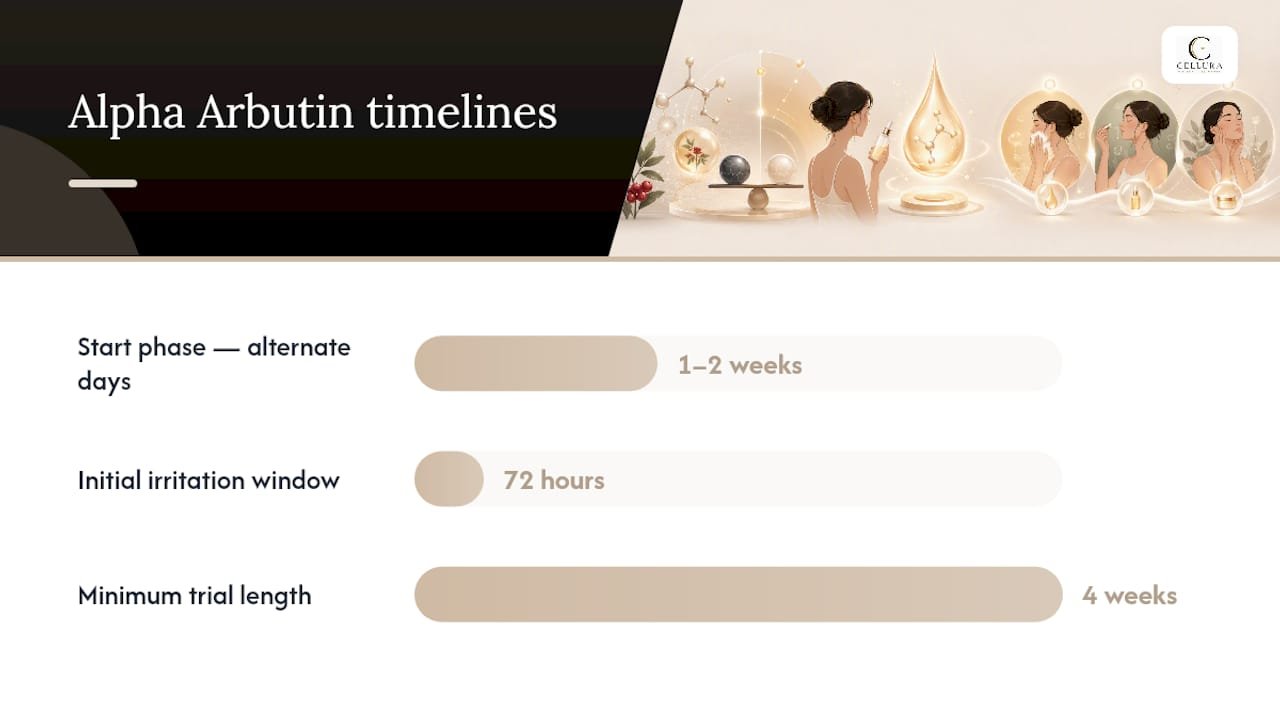
- Start with alternate-day use for the first one to two weeks if you have reactive or eczema-prone skin, then build to daily application.
- Watch for tightness, redness, or stinging in the first 72 hours. Mild tingling that fades within minutes is generally normal; anything that lingers or worsens is not.
- If irritation shows up, drop back to every other day rather than stopping outright, unless the reaction is significant, in which case discontinue and patch test again later.
- Pair alpha arbutin with in-clinic treatments like light chemical peels only under professional guidance, since stacking exfoliation with an active tyrosinase inhibitor can either work well or backfire depending on your skin’s tolerance.
- Give any new product at least four weeks before judging it. Skin cell turnover takes time, and pigment doesn’t fade overnight even when the ingredient is doing its job.
Which Ingredients Pair Well With Alpha Arbutin (and Which Don’t)
Alpha arbutin plays well with several other brightening actives because it works through a different mechanism than most of them, which means combining ingredients often targets pigmentation from multiple angles at once rather than just piling on redundant effects.
Niacinamide is one of the safest and most common pairings. It supports barrier function and has its own mild effect on melanosome transfer, complementing alpha arbutin’s tyrosinase-blocking action without raising irritation. Tranexamic acid is another strong match, since it interrupts pigmentation through a completely separate pathway (inflammation-driven melanin triggers) rather than competing for the same enzyme site. A combination of arbutin, kojic acid, and tranexamic acid shows additive depigmenting benefits in the clinical literature, particularly when pH and concentrations are managed carefully in the same formula.
Vitamin C can work alongside alpha arbutin too, but formulation matters more here. Ascorbic acid needs a low pH to stay stable, which can clash with alpha arbutin’s preferred 3.5 to 6.5 range. Products that combine both successfully usually use a more stable vitamin C derivative rather than pure ascorbic acid. Mild AHAs or BHAs at low strengths can also help by improving penetration and turnover, as long as you’re not stacking multiple exfoliants in the same routine.
What to avoid or use with caution:
- Strong physical or chemical exfoliants used back-to-back with alpha arbutin, since compromised skin barrier function raises both irritation and post-inflammatory pigmentation risk, which is the opposite of what you’re trying to fix.
- High-strength retinoids applied in the same session. Both can be drying, and combining them without a buffer period often leads to redness that outlasts any brightening benefit.
- Unbuffered acid stacking, meaning multiple low-pH actives layered without spacing, which destabilizes formulations and increases the odds of a reaction.
The kojic acid and alpha arbutin combination deserves a specific note: the two work through complementary mechanisms, and the split-face trial mentioned earlier used exactly this pairing at 2 percent kojic acid and 5 percent alpha arbutin with strong tolerability results. The key is staying within tested concentration windows rather than assuming more of each ingredient means faster results.
Pro Tip: If you’re layering three or more actives, introduce them one at a time, spaced a week apart, so you can actually identify which ingredient caused a reaction if one shows up.
How Long Until You See Results From Alpha Arbutin?
Early signs of fading typically show up around four to eight weeks of consistent use, with more meaningful, visible improvement often landing in the eight to 12 week range. This timeline shows up repeatedly across consumer health reporting and dermatologist guidance, and it aligns with how long skin cell turnover actually takes to surface pigment changes to the visible layer.
Results vary by pigmentation type:
- Post-inflammatory hyperpigmentation (PIH) from acne tends to respond fastest, especially in lighter marks that haven’t set for years.
- Sunspots respond well but often need the full 12-week window or longer, particularly on areas with cumulative sun exposure like the cheeks and forehead.
- Melasma is the outlier. It’s hormonally driven and notoriously stubborn, so alpha arbutin alone rarely clears it completely. It works better as part of a broader plan, and the split-face trial data suggests it can rival stronger prescription creams when paired with kojic acid.
- Darker skin tones benefit from alpha arbutin’s lower irritation profile specifically because irritation itself can trigger new PIH, creating a frustrating cycle where aggressive treatments cause the very problem they’re meant to fix.
If you’ve used a well-formulated alpha arbutin product consistently, with daily sunscreen, for 12 full weeks without meaningful change, that’s the point to bring in a dermatologist. Escalation options include prescription-strength hydroquinone, chemical peels, or laser treatments, and a professional can also rule out melasma or another condition that needs a different approach entirely.
A Three-Step Approach to Post-Acne Discoloration
Post-acne dark spots don’t respond to a single ingredient the way an infomercial might suggest. They respond to a routine that cleans without stripping, treats with real active concentrations, and protects the skin barrier so new pigment doesn’t just replace the old spots you’re trying to fade. That’s the logic behind a three-step ritual: cleanse, treat, support.
The first step involves a multi-active facial cleansing bar formulated with salicylic acid, azelaic acid, and kojic acid, three ingredients that each address a piece of the post-acne puzzle: salicylic acid clears pore congestion, azelaic acid calms residual inflammation, and kojic acid adds a mild brightening effect before treatment actives even go on. Starting with a clean, non-irritated base matters more than most routines give it credit for, since applying alpha arbutin over compromised or inflamed skin blunts its effectiveness.
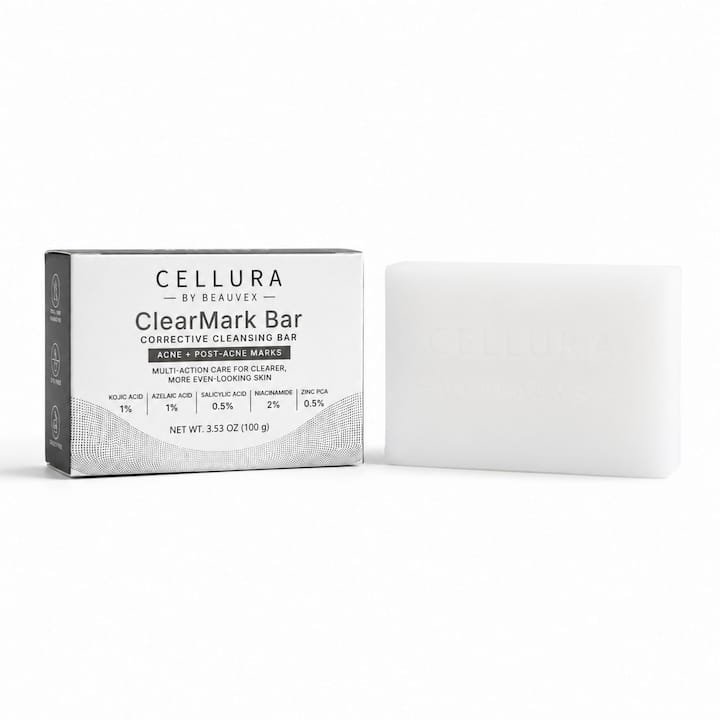
The Cellura Luminé Brightening Serum is where alpha arbutin does its main work, formulated alongside niacinamide, tranexamic acid, and kojic acid. That combination isn’t random. It reflects the same multi-mechanism logic backed by the split-face clinical trial and the broader review on arbutin’s depigmenting properties, targeting melanin production, inflammation-driven pigment triggers, and melanosome transfer at the same time rather than relying on one pathway to do all the work. Beauvex LLC publishes exact concentration ranges for the Luminé serum’s actives rather than hiding behind vague marketing language like “clinically proven blend.”
What the three-step system is built to do:
- Clear pore-clogging debris and calm inflammation before treatment actives are introduced.
- Deliver alpha arbutin, niacinamide, tranexamic acid, and kojic acid together at transparent, published concentrations.
- Support the skin barrier afterward so it can tolerate consistent daily use without the irritation that often triggers new dark spots.
Ingredient transparency isn’t a marketing angle, it’s a diagnostic tool. When you know the exact percentage of alpha arbutin in a serum, you can compare it against the clinical concentration ranges that actually showed results in trials, instead of guessing whether a product will work based on the brand’s confidence alone.
Independent trial results specific to the Luminé serum formula, along with formulator credentials and verified customer outcomes, are available on request through Beauvex LLC’s product documentation.
Beauvex’s Take: When Alpha Arbutin Is the Right Move
Alpha arbutin earns its place as a first-line brightening ingredient precisely because it doesn’t ask sensitive skin to gamble. The conventional wisdom pushes people toward the strongest active they can tolerate, but the split-face trial data tells a different story: a gentler combination matched a triple-combination cream’s results with fewer side effects. That’s not a consolation prize, that’s the better outcome for most people managing everyday post-acne marks rather than severe, treatment-resistant pigmentation.
Where this gets misused is in product selection. People chase percentage numbers without checking formulation quality, then wonder why results stall or skin reacts. Purity of raw material and pH-aware formulation matter as much as the percentage on the label, sometimes more. Look for brands that publish both.
Alpha arbutin also earns a second role: maintenance after something stronger, whether that’s a peel, a prescription cream, or a laser session. It keeps pigment suppressed without the ongoing irritation risk that made the stronger option necessary in the first place.
One line worth remembering: if pigment is spreading, darkening rapidly, or shows the classic mask-like pattern of melasma, see a clinician before building an at-home routine around any single ingredient.
— Beauvex LLC
Where to Start With Beauvex’s Alpha Arbutin System
If your dark spots trace back to acne, the combination of a gentle multi-active cleanse and a transparently formulated brightening serum solves a problem most single-ingredient products can’t: keeping irritation low enough that your skin doesn’t generate new pigment while you’re trying to fade the old marks.
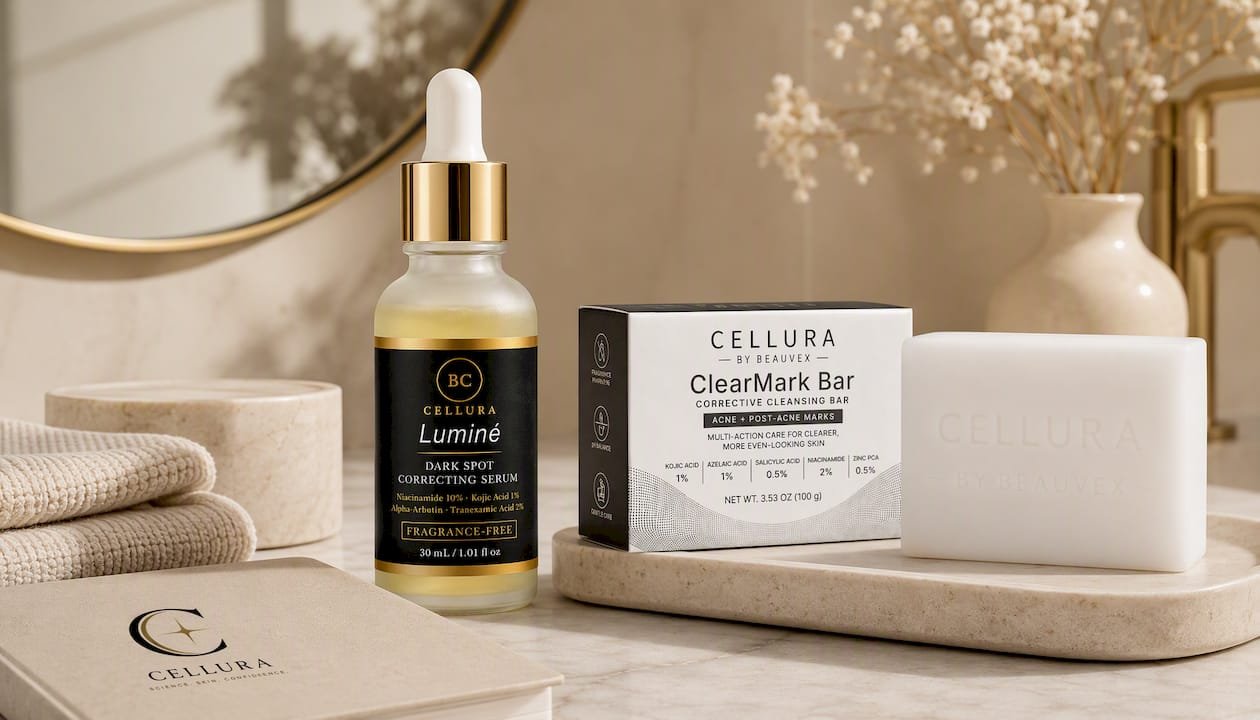
Start with the Cellura ClearMark Bar to clear congestion and calm inflammation, then move into the Cellura Luminé Brightening Serum for the alpha arbutin, niacinamide, tranexamic acid, and kojic acid blend that targets pigment through multiple pathways at once. Patch test both products first, especially if you’ve reacted to brightening actives before. Introduce the serum gradually over the first two weeks, pair it with daily sunscreen without exception, and track your skin at the four-week and 12-week marks, since that’s the window where most people start seeing whether a routine is working. Detailed concentration breakdowns and formulation notes for both products are available on their respective product pages, so you can compare what you’re using against the clinical ranges that actually showed results.
Primary Research Behind This Article
- The PMC review on arbutin as a depigmenting agent supports the mechanism-of-action explanation, safety notes on rare dermatitis risk, and the case for combination therapy.
- The split-face RCT comparing alpha arbutin and kojic acid to triple-combination cream backs the clinical efficacy and tolerability comparisons throughout the evidence and combinations sections.
- The Women’s Health dermatologist-backed overview informs the practical usage guidance and the four-to-12-week results timeline.
- The formulation and stability analysis comparing kojic acid and alpha arbutin supports the pH stability, hydroquinone risk, and regulatory concentration guidance.
Sources
- Arbutin as a Skin Depigmenting Agent with Antimelanogenic and Antioxidant Properties
- Alpha Arbutin: The gentle skin brightener dermatologists recommend
- Kojic Acid vs Alpha-Arbutin: Stability & Formulation
FAQ
Can alpha arbutin remove hyperpigmentation completely?
Alpha arbutin fades hyperpigmentation rather than removing it outright, working best on post-inflammatory dark spots and sunspots over 8 to 12 weeks of consistent use with daily sunscreen. Melasma and deeply set pigment usually need additional treatment beyond alpha arbutin alone.
What serum is best for hyperpigmentation?
The most effective serums combine alpha arbutin with complementary actives like niacinamide and tranexamic acid rather than relying on a single ingredient, since clinical data shows multi-mechanism formulas outperform monotherapy. The Cellura Luminé Brightening Serum uses this exact combination at published concentrations for post-acne dark spots.
What do dermatologists commonly recommend for hyperpigmentation?
Dermatologists frequently recommend gentler alternatives to hydroquinone, including alpha arbutin, kojic acid, niacinamide, and tranexamic acid, often layered together for additive brightening effects. Consistent sunscreen use is considered essential alongside any of these actives.
What cannot mix with alpha arbutin?
Avoid stacking alpha arbutin with strong exfoliants or high-strength retinoids in the same session, since the combined irritation raises the risk of new post-inflammatory pigmentation. Pure ascorbic acid vitamin C can also clash with alpha arbutin’s ideal pH range unless the formula is specifically designed to stabilize both.
Is alpha arbutin better than kojic acid for dark spots?
Alpha arbutin generally carries a lower irritation risk and wider pH stability than kojic acid, making it a better fit for sensitive or reactive skin, while kojic acid can offer slightly faster brightening for those who tolerate it well. Many formulas, including the alpha arbutin and kojic acid comparison, use both together since they work through complementary mechanisms.
Should I use alpha arbutin in the morning or at night?
Alpha arbutin works in either slot since it doesn’t increase sun sensitivity the way retinoids do, so morning or night both work as long as you use it consistently. Many people apply it in the morning alongside antioxidants and sunscreen, saving stronger actives for nighttime use.