
Topical tranexamic acid serums are generally safe for most skin types, and the side effects people actually experience are usually mild and local: dryness, flaking, or brief redness. The systemic risks tied to oral tranexamic acid, like clotting concerns, almost never apply to a serum you apply to your face. The main things to watch for are eye irritation, unclear safety data during pregnancy or breastfeeding, and a talk with your doctor if you have a personal history of clotting problems.
TL;DR:
- Topical tranexamic acid serums generally cause only mild, local side effects like dryness, flaking, and brief redness, usually resolving within a few weeks.
- Systemic risks such as clotting concerns are negligible with topical use, but never crush oral tablets for skin application, as they are formulated for bloodstream absorption.
- Individuals with a personal or family history of blood clots, pregnant or breastfeeding women, and those with inflammatory skin conditions should consult a doctor before use.
- Introducing the serum gradually with patch tests and considering barrier-supporting ingredients can help minimize irritation during initial use.
- Most formulations disclose active ingredient percentages, and combining tranexamic acid with niacinamide or alpha-arbutin can enhance results while reducing the risk of irritation.
Table of Contents
- Common Topical Side Effects of Tranexamic Acid Serum
- Why Topical Use Doesn’t Carry the Same Risks as Oral Tranexamic Acid
- Who Should Talk to a Doctor Before Starting a Tranexamic Acid Serum
- How to Introduce a Tranexamic Acid Serum Without Wrecking Your Skin Barrier
- What the Clinical Research Actually Shows
- Our Approach to Formulating With Tranexamic Acid
- A Transparent Three-Step Option Worth Considering
- Sources
- FAQ
Common Topical Side Effects of Tranexamic Acid Serum
Most people who try a tranexamic acid serum notice nothing dramatic. The side effects that do show up tend to be the kind you’d expect from any active skincare ingredient introduced too fast or layered too aggressively.
The most frequently reported reactions include:
- Mild dryness or a tight feeling, especially in the first two to three weeks
- Flaking or light scaling around the application area
- A brief stinging or warm sensation right after application
- Temporary redness that fades within an hour or two
- Occasional mild irritation if the skin barrier is already compromised
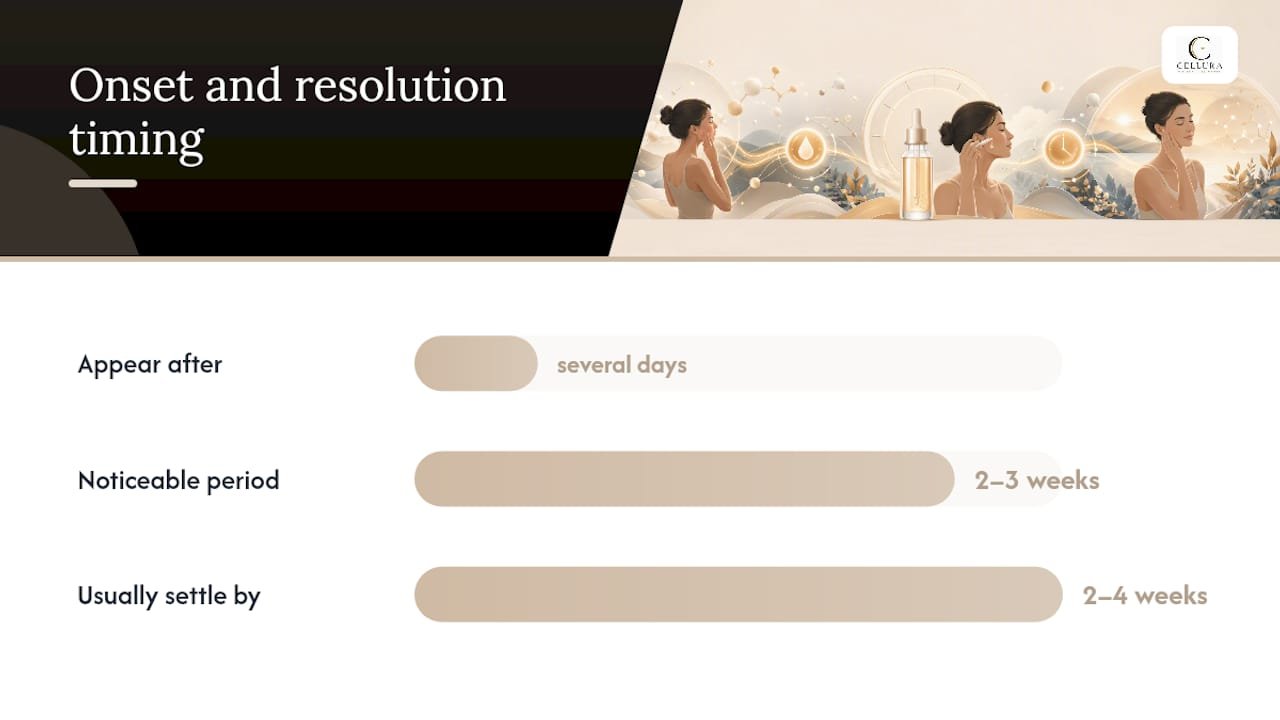
These symptoms usually appear within the first several days of use and settle down once your skin adjusts, often within two to four weeks. Switching to a heavier moisturizer or applying the serum every other day instead of daily typically resolves the issue without stopping treatment altogether.
Less common reactions include allergic contact dermatitis, where the skin reacts to a specific ingredient in the formula rather than the tranexamic acid itself, and in rare cases, a paradoxical darkening of skin instead of the brightening effect people are seeking. People with active eczema, psoriasis, or another inflammatory skin condition sometimes see their condition flare rather than improve, since tranexamic acid can occasionally worsen inflammatory dermatoses in sensitive individuals.
Statistic Callout: Clinical summaries of topical tranexamic acid trials consistently describe side effects as mild, local, and self-resolving rather than systemic. Transient irritation, not anything more serious, is the outcome researchers report most often.
If irritation lingers past the two-week mark instead of easing, practitioners generally advise cutting back the frequency or pausing use for a few days before restarting slowly. That single adjustment resolves most complaints people brings to their dermatologist about a new brightening serum.
Why Topical Use Doesn’t Carry the Same Risks as Oral Tranexamic Acid
A lot of the anxiety around tranexamic acid comes from confusing two very different delivery methods. Oral tranexamic acid is a prescription medication used to control heavy bleeding, and it works by circulating through your bloodstream at doses high enough to affect your body’s clotting mechanism. A serum sitting on top of your skin is an entirely different exposure profile.
Well-formulated topical products are built so the active penetrates the outer skin layers without flooding your bloodstream. The concentration matters just as much as the delivery method: cosmetic serums typically use tranexamic acid, while oral dosing in clinical settings runs 250 to 500 milligrams taken twice daily, a completely different scale of systemic exposure.
That distinction explains the side-effect gap between routes:
- Oral and injectable tranexamic acid are linked to documented risks like blood clot formation and changes in menstrual bleeding patterns.
- Topical serums show none of that systemic signature in the research because so little of the ingredient reaches general circulation.
- Formulation vehicle, whether it’s a lightweight serum or a heavier cream, also affects how much active actually penetrates.
One warning bears repeating because people occasionally try it: never crush an oral tranexamic acid tablet and apply it to your skin as a homemade treatment. Prescription tablets are formulated for absorption into the bloodstream, not for topical use, and doing this bypasses every safety consideration a proper cosmetic formula is built around.
Who Should Talk to a Doctor Before Starting a Tranexamic Acid Serum
Most people can use a tranexamic acid serum without any medical consultation. But certain health histories and life stages call for a conversation with a clinician first, since caution here costs you nothing and protects against real, if uncommon, risk.
- You have a personal or family history of blood clots, pulmonary embolism, ischemic heart disease, or stroke. These conditions are established contraindications for systemic tranexamic acid use, and while topical absorption is minimal, checking with a doctor first is the responsible move if this describes you.
- You’re currently taking anticoagulant medication, hormone therapy, or you have severe kidney impairment. Drug interactions and clotting risk are worth discussing with whoever prescribes your medication before adding any active ingredient that touches the same biological pathway, even topically.
- You’re pregnant or breastfeeding. Safety data on topical tranexamic acid during pregnancy is limited, since most research focuses on the oral and injectable forms used for postpartum bleeding control. The NHS notes that evidence for topical use during pregnancy and breastfeeding remains insufficient to make a firm safety call, so ask your provider before starting.
- You have active eczema, psoriasis, or notably reactive skin. Adding an active ingredient during a flare can occasionally aggravate inflammatory skin conditions rather than help them, so dermatologist supervision makes sense if your skin is already under stress.
None of this means tranexamic acid is dangerous for these groups. It means the research hasn’t fully closed the loop on these specific populations, and a five-minute conversation with a doctor is cheaper than guessing.
How to Introduce a Tranexamic Acid Serum Without Wrecking Your Skin Barrier
Getting good results from a tranexamic acid serum has almost as much to do with how you introduce it as which formula you buy. Skipping the ramp-up period is the single most common reason people report irritation.
- Patch test first. Apply a small amount to your inner forearm once daily for seven days. If you see persistent redness or swelling, don’t move it to your face.
- Start slow. Use the serum once daily, or every other day if your skin runs sensitive, for the first two to four weeks before increasing frequency.
- Watch what you pair it with. Avoid applying tranexamic acid on freshly exfoliated skin or stacking it with strong AHAs, BHAs, or prescription retinoids in the same routine. Pairing it instead with barrier-supporting ingredients like niacinamide and ceramides tends to reduce irritation while still supporting the brightening goal.
- Keep it away from your eyes. Topical tranexamic acid formulations carry a GHS H319 hazard classification for eye irritation. Apply carefully around the orbital area, and rinse thoroughly with water immediately if the product gets into your eyes.
- Know when to stop. Irritation that persists beyond two weeks, any swelling or hives, or new darkening of the skin are all signals to discontinue and check in with a dermatologist.
Pro Tip: Apply your tranexamic acid serum to fully dry skin rather than damp skin. Water on the surface can increase penetration of active ingredients too quickly, which is often what turns a normally well-tolerated serum into an irritating one.
What the Clinical Research Actually Shows
The strongest available evidence comes from a mix of randomized controlled trials and dermatology reviews comparing oral, topical, and intradermal tranexamic acid for melasma and post-inflammatory hyperpigmentation.
- Topical formulations tested in trials, generally in the 2% to 10% concentration range, show measurable pigment reduction with side effects limited mostly to erythema and scaling.
- Oral tranexamic acid trials report greater efficacy for recalcitrant melasma but a noticeably higher rate of systemic side effects, including gastrointestinal upset and menstrual changes.
- Intradermal or mesotherapy delivery, often using concentrations around 4 milligrams per milliliter, shows fast pigment reduction in some trials but comes with more local discomfort: injection-site pain, redness, and occasionally transient lightening of the treated area.
Statistic Callout: Across the reviewed literature, topical and intradermal routes cluster around mild, local side effects, while oral dosing trades a stronger safety margin for meaningfully better outcomes in stubborn cases. That trade-off is exactly why most dermatology guidance treats topical serums as the reasonable first step before considering oral therapy.
It’s worth noting that topical tranexamic acid remains, in many places, an off-label use for pigmentation rather than a formally approved indication. That doesn’t make it unsafe. It means long-term daily-use data is still accumulating, and clinicians recommend treating it the way you’d treat any active ingredient: with a reasonable ramp-up period and ongoing attention to how your skin responses.
Our Approach to Formulating With Tranexamic Acid

We build every formula around one idea: you should never have to guess what you’re putting on your skin. That’s why We disclose the exact concentration of tranexamic acid in the serum instead of hiding behind a vague ingredient list, and pair it with niacinamide and alpha-arbutin rather than relying on tranexamic acid alone to do all the work.
Our recommended approach follows a simple sequence: patch test first, introduce the serum gradually, wear SPF every single day, and lean on barrier-supporting actives to keep irritation low while pigmentation improves. A three-step ritual built around cleansing, treatment, and barrier support gives tranexamic acid the best possible environment to work without overwhelming the skin.
— Beauvex LLC
A Transparent Three-Step Option Worth Considering
Most tranexamic acid serums on the market don’t tell you what percentage of the active you’re actually getting, which makes it hard to know if irritation is a dosing issue or a formulation issue. One approach to transparency is publishing full ingredient concentrations upfront, alongside the research each one is based on.

The regimen starts with the Cellura ClearMark Bar, a facial cleansing bar formulated with salicylic, azelaic, and kojic acids to prep skin without stripping it. From there, the Cellura Luminé Brightening Serum combines niacinamide, tranexamic acid, kojic acid, and alpha-arbutin in a single 30 mL formula designed to interrupt pigmentation at multiple points in the process rather than relying on one active alone. Every concentration is disclosed on the product page, so you can evaluate the formula against the same clinical research cited throughout this article instead of taking a marketing claim at face value.
If you want the full three-step system, the Cellura line is available to browse now, with ingredient details and research references listed for each product.
Sources
- Tranexamic Acid for Skin: Benefits, Safety, How to Use
- THE USE OF TRANEXAMIC ACID IN DERMATOLOGY – PMC
- Tranexamic acid – DermNet NZ
- Tranexamic acid: pregnancy, breastfeeding and fertility — NHS
- Tranexamic acid — Medical News Today
This article is general information, not a substitute for advice from a qualified doctor. Consult a qualified healthcare professional about your own circumstances before acting on anything here.
FAQ
Is Tranexamic Acid Safe for the Face?
Yes, for most people topical tranexamic acid is considered safe and generally well-tolerated for facial use. The side effects reported in clinical summaries are typically mild and local, like dryness or brief redness, rather than anything systemic.
What Are the Negative Effects of Tranexamic Acid?
The most common negative effects from topical use are dryness, flaking, and transient redness or stinging, usually in the first few weeks of use. Systemic effects like clotting risk or menstrual changes are associated with oral and injectable tranexamic acid, not with a properly formulated topical serum.
Can Tranexamic Acid Cause Skin Darkening?
Paradoxical darkening is a rare but documented reaction, occurring in a small subset of users rather than as an expected outcome. If you notice new dark patches instead of fading after starting a serum, stop use and consult a dermatologist rather than continuing to apply it.
Is It Safe to Use Tranexamic Acid Serum Every Day?
Many formulas are designed for daily use once your skin has adjusted, but starting once daily or every other day for the first two to four weeks reduces the odds of irritation. Formulations that pair tranexamic acid with niacinamide and other barrier-supporting actives tend to be better tolerated for daily use than single-ingredient serums.
What Does Beauvex LLC’s Tranexamic Acid Serum Cost?
Pricing for the Cellura Luminé Brightening Serum and the full Cellura line is available directly on the client website, where current prices are listed alongside full ingredient concentrations.