
Yes, you can use copper peptides and acids in the same routine, but not in the same application. Low-pH acids like vitamin C and strong AHAs/BHAs can destabilize copper peptide complexes, so the safest approach is time separation: acids in the morning, copper peptides at night, or alternating nights entirely.
TL;DR:
- Use vitamin C in the morning and copper peptides at night; after AHAs or BHAs, alternate nights because skin pH recovery can take two hours.
- Niacinamide, hyaluronic acid, ceramides, and neutral antioxidants pair more easily with copper peptides; azelaic acid is milder, but sensitive skin may benefit from spacing.
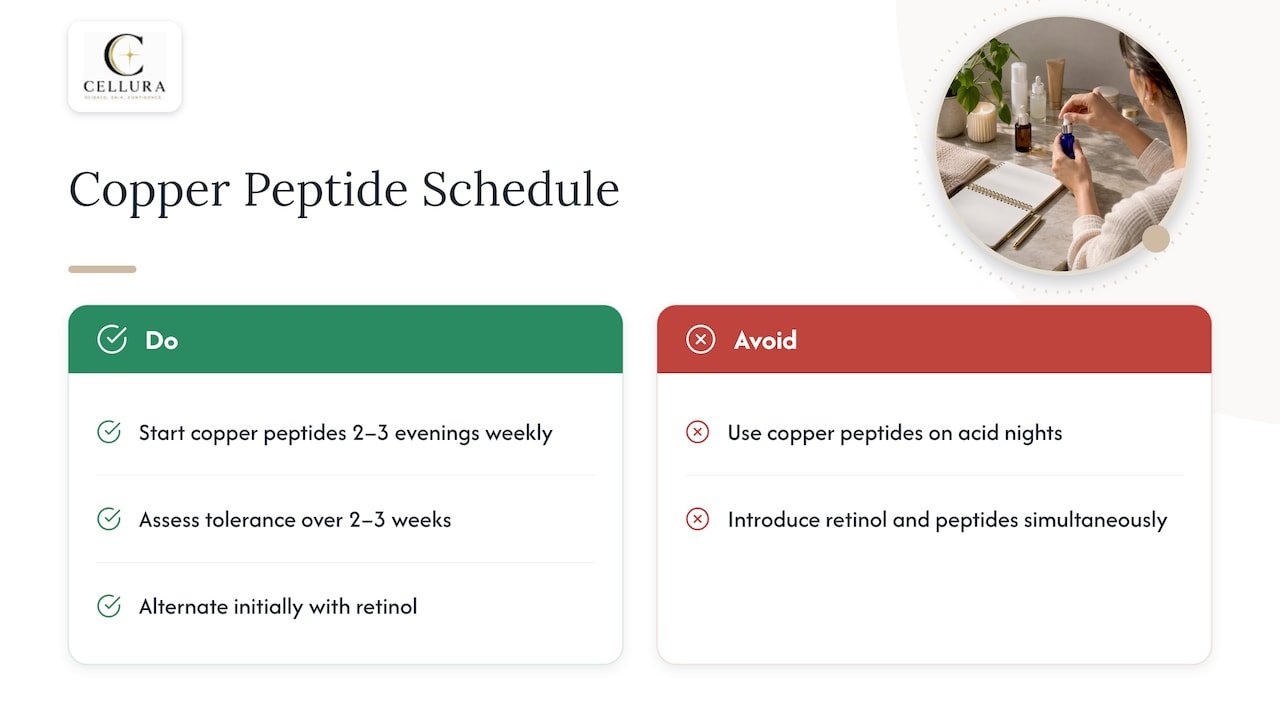
- Begin copper peptides two to three nights weekly when you skip exfoliating acids; assess your skin for two to three weeks and alternate them with retinol.
- Use sunscreen every day while using AHAs or BHAs and for about a week afterward, because exfoliating acids can increase sensitivity to ultraviolet exposure.
- If redness, persistent stinging, or bumps develop, pause both actives for a few nights, restore the barrier, and reintroduce each ingredient separately.
Table of Contents
- Why pH Matters for Copper Peptides
- Compatibility by Ingredient: What Pairs Well and What Doesn’t
- Building a Weekly Schedule Around Acids and Peptides
- Sun Safety While Using Exfoliating Acids
- How We Put This Evidence Into Practice
- How Copper Peptides Support Repair and Pigmentation
- Where Copper Peptides Fit Beyond Stability Concerns
- How Copper Peptides Interact With Antioxidants and Other Actives
- Adding Copper Peptides to a Routine That Targets Dark Spots
- Spotting and Managing Irritation From Acid and Peptide Combinations
- Our Take on Separating Acids From Copper Peptides
- Using Cellura Balm as Your PM Repair Step
- FAQ
- Sources
Why pH Matters for Copper Peptides
GHK-Cu is a naturally occurring tripeptide bound to a copper ion, and that copper binding is what gives it a signaling role in dermal repair. Research on GHK peptide biology shows it supports collagen and glycosaminoglycan synthesis and helps modulate the enzymes involved in tissue remodeling. That function depends on the peptide and copper staying bound together.
Copper peptide complexes tend to hold together best near skin’s natural pH, and chemistry-focused guidance on copper peptides puts that stable range around 5.5 to 6.5. Drop the pH much lower, which is exactly what vitamin C and many AHAs/BHAs do on contact, and the copper ion can separate from the peptide. Free copper in that state can behave as a pro-oxidant rather than a repair signal.
Skin’s own buffering capacity can soften this effect, but it does not erase it. Much of the supporting evidence here is chemistry-based rather than drawn from long-term skin trials, which is exactly why scheduling matters more than panic.
- Copper peptides work through a bound copper-tripeptide complex, not free copper.
- That complex is most stable near normal skin pH.
- Low-pH acids can pull the copper and peptide apart, reducing the intended benefit.
Compatibility by Ingredient: What Pairs Well and What Doesn’t
Not every acid or active behaves the same way around copper peptides. Here’s how the common ones stack up:
- Vitamin C (L-ascorbic acid): Both ingredients can degrade each other at low pH, so the cleanest fix is vitamin C in the morning and copper peptides at night, or alternating them by day.
- AHAs and BHAs (glycolic, lactic, salicylic): These work in a notably acidic range, and applying them the same night as copper peptides risks destabilizing the complex before it can do its job. Save copper peptides for nights you skip exfoliation.
- Azelaic acid: Its pH sits closer to neutral than most exfoliating acids, which is why several sources treat it as an easier ingredient to combine, though separating by a few hours is still a reasonable precaution for sensitive skin. Our azelaic acid comparison covers how it behaves alongside other actives.
- Retinol: Compatibility here is conditional. Some retinol formulations are buffered and gentler on skin pH, so applying retinol first, waiting 15 to 20 minutes, or alternating nights all work depending on your skin’s tolerance. Our retinol and copper peptide guide walks through this pairing in more detail.
- Niacinamide, hyaluronic acid, ceramides: These are compatible with copper peptides and actually reinforce the same goal, supporting the skin barrier while repair signaling takes place.
Pro Tip: When in doubt about an acid’s pH, treat it like vitamin C: separate by time of day rather than guessing how your skin will react.
Building a Weekly Schedule Around Acids and Peptides
Once you know which ingredients clash, the easiest fix is a schedule rather than constant substitution.
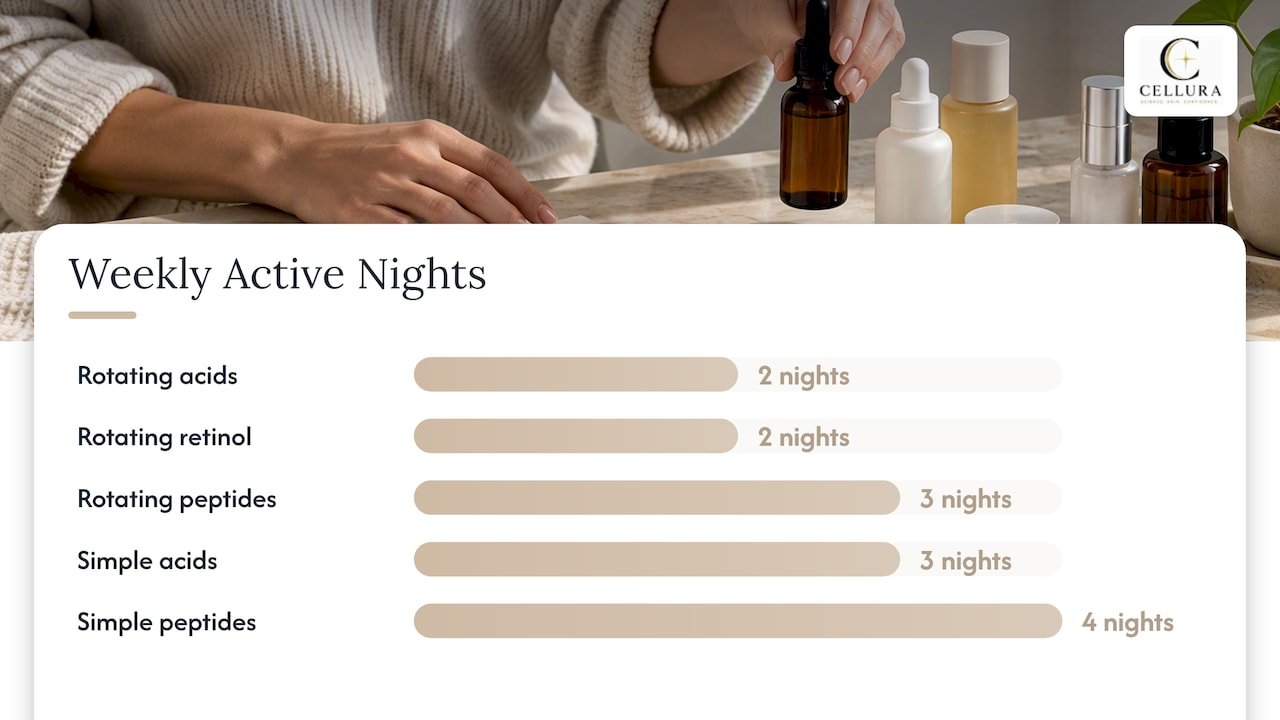
A simple daily rule: use vitamin C in the morning, followed by moisturizer and sunscreen, and save copper peptides for the evening after cleansing. If you use AHAs or BHAs at night, skip copper peptides that same evening. Skin surface pH recovery can take one to two hours after acid use, so a quick 20-minute wait is not always enough; alternating nights entirely is the more conservative choice for sensitive or reactive skin.
Two sample weeks for someone using AHA/BHA, retinol, and copper peptides:
- Rotating week: Monday and Thursday for AHA/BHA exfoliation, Tuesday and Friday for retinol, Wednesday and weekends for copper peptide repair nights.
- Simpler week: Acids three nights a week, copper peptides the other four, with vitamin C reserved for mornings only.
- Apply products in sequence on skin rather than mixing them in your palm beforehand.
- Let each layer absorb for a minute or two before the next.
- When unsure of the order, our guide on applying skincare products in order breaks down a standard sequence step by step.
Layering this way keeps the chemistry where it belongs, on your skin in sequence, rather than reacting in a bottle or on your hand.
Sun Safety While Using Exfoliating Acids
Acids and sun exposure deserve equal attention when you’re building this kind of routine. FDA guidance on alpha hydroxy acids recommends sunburn-alert labeling for AHA products because they can increase skin sensitivity to UV exposure.
- Use sunscreen daily while using AHAs or BHAs, and continue for about a week after stopping, per FDA-referenced safety guidance.
- Reserve copper peptide application for nights without acid use so the skin barrier has a chance to recover before repair signaling begins.
- Treat sunscreen as part of the acid step, not an optional add-on.
Daily sunscreen use is one of the most consistent protective measures tied to acid use, according to FDA labeling guidance for AHAs, and it pairs naturally with a schedule that already separates acids from copper peptides.
How We Put This Evidence Into Practice
We built our three-step ritual, cleansing, treatment, and barrier support, around the idea that pigmentation care works best when each active gets a clear role in a routine. Our serum combines multiple actives to interrupt pigment formation at several points, and we provide ingredient information so you can judge the formula on its own terms.
- We provide detailed ingredient information.
- We reference scientific research related to the ingredients used.
- Our educational content, including our guide to GHK-Cu, is built to explain mechanisms, not just sell a product.
Within that structure, we offer a balm intended as a PM repair step to follow treatment serums once acids aren’t in play for the night, pairing copper peptide signaling with emollients that reinforce the skin barrier.
Pro Tip: Before combining any new active with copper peptides, check the product page for both the concentration and the research link, not just the ingredient name on the label.
How Copper Peptides Support Repair and Pigmentation
GHK-Cu’s role in skin comes down to signaling rather than direct exfoliation or bleaching. Research on GHK peptide biology describes it as a modulator of multiple cellular pathways involved in skin regeneration, including collagen and glycosaminoglycan production and the activity of matrix metalloproteinases, the enzymes that break down and remodel skin tissue.
That dual action matters for post-acne skin specifically. Repair signaling helps rebuild structural proteins in areas affected by inflammation, while modulation of matrix enzymes can influence how old, damaged tissue is cleared and replaced. Neither effect works instantly, and neither is a direct substitute for ingredients built to target melanin production.
Formulation and delivery matter here too. A study on microneedle-mediated delivery of copper peptide found that pretreatment dramatically increased GHK-Cu permeation through skin in laboratory models, with no obvious irritation observed. That’s a reminder that how a copper peptide product is formulated, not just whether copper peptides are present, affects how much of the active actually reaches living skin layers. Separately, research on liposomal delivery systems for GHK-Cu found that encapsulation methods changed measured effects in enzyme assays tied to skin aging and pigmentation, reinforcing that delivery system is part of the efficacy story.
Where Copper Peptides Fit Beyond Stability Concerns
Stability questions tend to dominate the conversation around copper peptides and acids, but the ingredient’s value in a post-acne routine goes beyond simply avoiding conflicts. Its core function, supporting structural repair in skin, is particularly relevant for the kind of lingering discoloration that follows inflammation.
Post-acne marks often involve a mix of residual pigment and disrupted skin texture, not pigment alone. Copper peptides address the structural side of that equation by supporting the collagen and glycosaminoglycan synthesis documented in GHK peptide research, which can help skin texture normalize over time as the barrier rebuilds.
That’s a different job than what brightening actives like niacinamide, tranexamic acid, or alpha-arbutin do, which work more directly on melanin production and transfer. Using copper peptides alongside those brightening ingredients, on a schedule that respects pH differences, treats discoloration as the combined texture-and-pigment issue it usually is rather than a single problem with one fix.
How Copper Peptides Interact With Antioxidants and Other Actives
Acids and retinol get most of the attention in copper peptide discussions, but antioxidants deserve a closer look too. Vitamin C is both an acid and an antioxidant, which is why it gets singled out, but other antioxidants behave differently depending on their own pH and stability profile.
Many antioxidants used in moisturizers and serums, like certain vitamin E derivatives or green tea extracts, sit closer to neutral pH and don’t carry the same destabilizing risk that pure L-ascorbic acid does. That makes them easier to layer with copper peptides without the same scheduling concerns that apply to vitamin C or exfoliating acids.
Niacinamide falls into a similar low-risk category. It’s generally formulated at a pH that doesn’t threaten the copper-peptide complex, and it supports the same barrier-focused goal that copper peptides are often used for. Ceramides and hyaluronic acid round this out as ingredients that work with copper peptides rather than against them, reinforcing hydration and barrier integrity while repair signaling happens underneath. The practical takeaway is that the acid conversation is really about pH, not about every active in a routine being equally risky.
Adding Copper Peptides to a Routine That Targets Dark Spots
Introducing copper peptides into an existing dark-spot routine works best as a gradual addition rather than a wholesale change. Start by identifying which nights already include acids or retinol, since those are the nights copper peptides should sit out.
A practical starting point is adding copper peptides two to three nights a week, on evenings free of exfoliating acids, while keeping your existing brightening actives on their usual schedule. This avoids overloading skin with too many new variables at once and makes it easier to tell what’s working.
Pay attention to how your skin responds over the first two to three weeks before increasing frequency. If your routine already includes retinol, treat that as its own variable: alternate copper peptides and retinol initially rather than introducing both as new additions simultaneously. Once your skin tolerates the schedule, you can adjust frequency based on how your barrier feels and how your discoloration responds, keeping acids and copper peptides on separate nights as the one fixed rule throughout.
Spotting and Managing Irritation From Acid and Peptide Combinations
Even with careful scheduling, some skin types react to the cumulative effect of acids and active ingredients layered too closely together. Watch for redness that lingers past the usual post-acid flush, a tight or stinging sensation that doesn’t resolve within a few minutes, or small bumps and texture changes that show up a day or two after a mixed-active night.
These signs usually point to one of two issues: the acid and copper peptide were applied too close together in time, or the acid concentration itself is too strong for how often it’s being used. The fix in either case starts with pulling back frequency rather than eliminating ingredients outright.
If irritation appears, skip both acids and copper peptides for a few nights and stick to gentle cleansing, a barrier moisturizer, and sunscreen during the day. Once skin calms down, reintroduce one active at a time, acids first on their own schedule, then copper peptides a few nights later, so you can identify which pairing or product was responsible. Persistent irritation that doesn’t improve within a week or two is worth discussing with a dermatologist rather than continuing to adjust the routine alone.
Our Take on Separating Acids From Copper Peptides
We treat the acid and copper peptide conflict as a scheduling problem, not a reason to avoid either ingredient. The evidence here is largely chemistry-based, so we favor conservative separation, alternate nights over same-night layering, especially for anyone with reactive or compromised skin. Check product concentrations, keep sunscreen on acid nights, and let your skin’s response guide frequency from there.
— Beauvex LLC
Using Cellura Balm as Your PM Repair Step
One product combines GHK-Cu copper peptide with tallow and squalane, built as a barrier-supporting step rather than an exfoliant or brightening treatment. That makes it a natural fit for the nights your routine isn’t centered on acids.
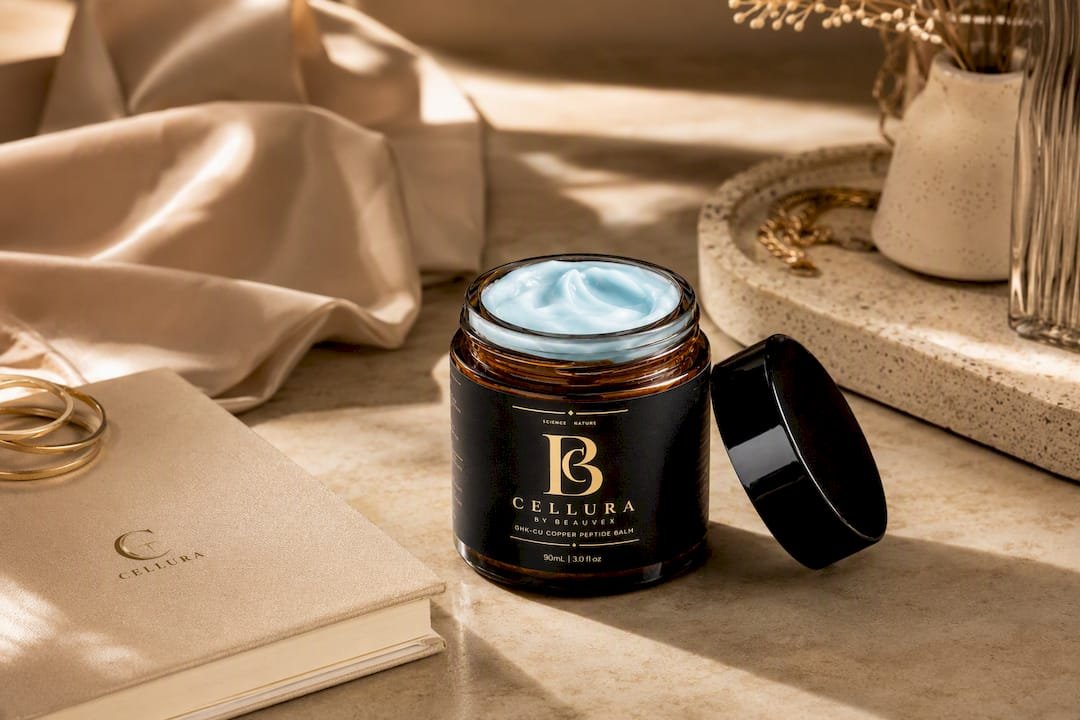
The simplest way to use it: cleanse, apply your treatment serum on nights that don’t involve acids, then follow with Cellura Balm to lock in moisture and support repair while copper peptide signaling does its work overnight.
- Apply after treatment serums, never mixed into the same layer as an acid product.
- Use on alternate nights if you’re also running an AHA, BHA, or vitamin C step.
- Check the Cellura Balm product page for exact ingredient concentrations before adding it to a routine with other actives.
If you want to see how it fits within our broader skincare line, the Cellura collection page lays out how the balm connects to our other repair-focused products.
FAQ
What can you pair copper peptides with?
Copper peptides pair well with niacinamide, hyaluronic acid, and ceramides, since none of these significantly disrupt the pH the copper-peptide complex needs to stay stable. They’re best kept apart from vitamin C and strong AHAs/BHAs by time of day or by alternating nights.
Should you use copper peptides in your routine?
Copper peptides can be a useful addition if you’re looking for barrier support and repair signaling alongside a pigment-focused routine, based on their documented role in collagen and tissue repair. They work best as a complement to brightening actives rather than a replacement for them.
Does copper peptide help with acne-related dark spots?
Copper peptides don’t target melanin production directly, so they’re not a stand-alone treatment for discoloration. Their documented support for collagen and tissue remodeling can help skin texture and resilience as part of a broader routine that also includes pigment-focused ingredients like niacinamide or tranexamic acid.
Is copper peptide better than retinol?
They serve different purposes rather than competing directly: retinol works on cell turnover and texture, while copper peptides support structural repair and barrier function. Many routines use both on a rotating schedule rather than choosing one over the other.
Sources
- GHK Peptide as a Natural Modulator of Multiple Cellular Pathways in Skin Regeneration
- Microneedle-mediated delivery of copper peptide through skin
- Copper Peptides: Why They Don’t Mix With Acids (pH Science Explained)
- Guidance for Industry: Labeling for Cosmetics Containing Alpha Hydroxy Acids | FDA