
Hyperpigmentation on dark skin is treatable, but the plan matters more than the product. Start by protecting skin from sun and visible light with a tinted mineral sunscreen, identify what triggered the dark marks (often acne, eczema, or a skin injury), and stop that trigger before layering on brightening actives. Most spots fade over 3 to 12 months, while melasma tends to run a longer, more relapsing course.
TL;DR:
- Choose a tinted SPF 30+ sunscreen containing iron oxide, since ordinary formulas may block ultraviolet rays without visible light; reapply every two hours outdoors.
- Flat marks where acne or irritation occurred suggest PIH, while symmetrical cheek or forehead patches may indicate melasma, which often returns.
- Most post inflammatory marks take 3 to 12 months to fade after the trigger is controlled; melasma often relapses and needs ongoing maintenance.
- Introduce actives one at a time, start retinoids two or three nights weekly, and use hydroquinone only under clinician supervision.
- For procedures, superficial salicylic acid peels are generally preferred; lasers and deeper peels can trigger new pigmentation, so choose an experienced clinician using conservative settings.
Table of Contents
- What hyperpigmentation is and how darker skin differs biologically
- Common types of hyperpigmentation: PIH, melasma, and sunspots
- How dermatologists assess pigment depth before choosing treatment
- Why tinted sunscreen is a treatment, not just prevention
- Topical treatments dermatologists recommend, and how to layer them
- How our three-step ritual supports a dermatologist-aligned routine
- Procedural options for darker skin: peels, lasers, and microneedling
- Timeline and realistic expectations for fading dark spots
- When to see a dermatologist and what to bring
- Lifestyle and environmental factors that influence dark spots
- Prevention strategies beyond sunscreen
- Why barrier support matters for preventing new dark spots
- Staying consistent when results take months to show
- A note on patience and persistence with dark spots
- Our Cellura ritual for stubborn post-acne dark spots
- FAQ
- Sources
What hyperpigmentation is and how darker skin differs biologically
Hyperpigmentation happens when melanocytes, the cells that produce melanin, go into overdrive after inflammation, injury, or ultraviolet exposure. In darker skin, melanocytes tend to respond more aggressively to triggers, and the melanosomes (the structures that package and distribute melanin) are larger and more widely dispersed throughout the epidermis than in lighter skin. That difference helps explain why a minor blemish or scratch can leave behind a mark that lingers for months in deeper skin tones.
Inflammation is the usual spark. When skin is injured, whether by a popped pimple, an eczema flare, a cut, or even friction, melanocytes nearby ramp up pigment production as part of the healing response. The result is a flat, darkened patch where the injury used to be, a process dermatologists call post-inflammatory hyperpigmentation.
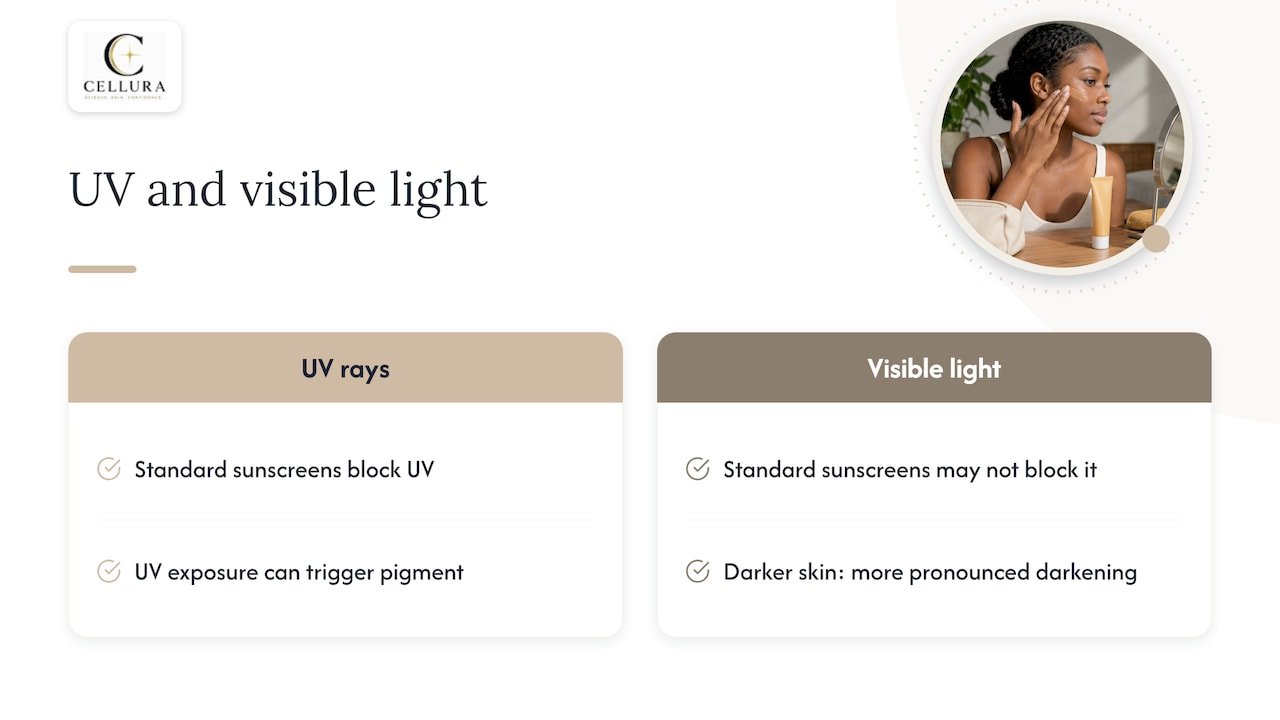
Visible light adds another layer specific to richly pigmented skin. Unlike ultraviolet rays, visible light (the kind coming through windows or from ambient daylight) has been shown to provoke more pronounced darkening in people with darker skin tones than in those with lighter skin, according to the American Academy of Dermatology. That is one reason standard sunscreens, which block UV but not necessarily visible light, sometimes fall short for this population.
Where the pigment sits also shapes how it behaves. Epidermal pigment, sitting in the skin’s outer layer, tends to respond faster to topical treatment and sun protection. Dermal pigment, deposited deeper in the skin, is more stubborn and often needs longer timelines or procedural support to budge. Knowing which type you are dealing with, or having a clinician confirm it, changes what a realistic treatment plan looks like from the start.
Common types of hyperpigmentation: PIH, melasma, and sunspots
Not all dark spots are the same condition, and telling them apart helps you choose the right approach instead of guessing.
Post-inflammatory hyperpigmentation, or PIH, is the most common type in people with acne-prone or eczema-prone skin. It shows up as a flat, brown to dark brown mark exactly where a pimple, scratch, or irritated patch used to be. PIH is more pronounced and slower to resolve in darker skin tones, and treating the underlying inflammatory condition early is one of the most effective ways to shorten its course, according to a review of postinflammatory hyperpigmentation.
Melasma looks different. It tends to appear as larger, symmetrical patches across the cheeks, forehead, upper lip, or chin, and it is driven heavily by hormonal shifts, including pregnancy and hormonal contraceptives, along with sun exposure. Melasma is widely described as chronic and relapsing, meaning it can fade with treatment and then return, particularly with sun exposure or hormonal changes, as outlined in a clinical review of melasma diagnosis and treatment. For a deeper look at how melasma’s timeline and management differ from general hyperpigmentation, our comparison of melasma and hyperpigmentation breaks down what to expect from each.
Sun-induced and visible-light-induced spots form more gradually, often as small, scattered patches on areas with cumulative sun exposure like the cheeks and forehead. A smaller subset of cases trace back to specific medications or skincare products that trigger pigment changes, sometimes called drug- or product-induced hyperpigmentation, which is worth mentioning to a clinician if a new spot appeared shortly after starting a medication.
How dermatologists assess pigment depth before choosing treatment
Figuring out whether pigment sits in the epidermis or deeper in the dermis changes what treatment will actually work, and that is where in-office tools come in.
A Wood’s lamp, which shines long-wave ultraviolet light on the skin, helps highlight epidermal pigment more clearly, making it easier to map where a mark sits. It has real limits in darker skin, though: the higher baseline melanin content can make the contrast harder to read, so clinicians often lean on the tool alongside clinical judgment rather than as a stand-alone answer.
Dermatoscopy, a handheld magnification tool, adds detail about pigment pattern and can help rule out other causes of discoloration. Clinical history carries significant weight too: when the mark appeared, what preceded it (a breakout, an injury, a new product), and whether it has changed shape or color all factor into the diagnosis.
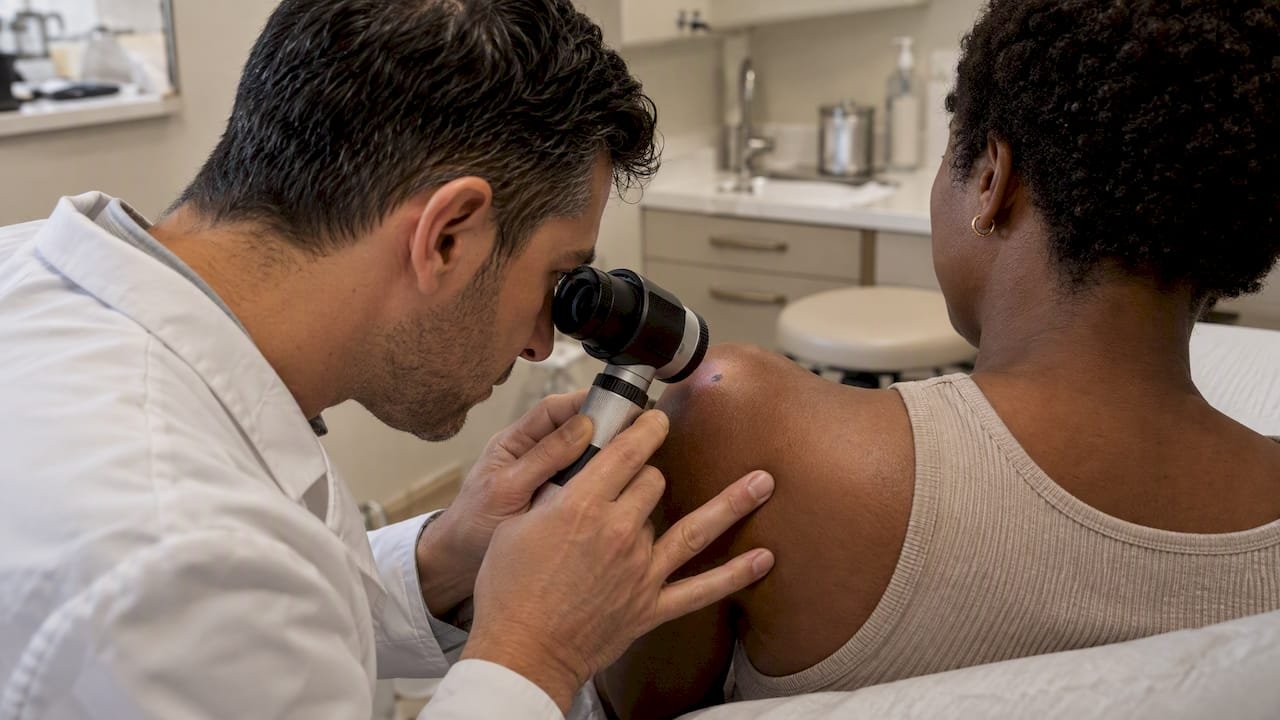
Why this matters practically: epidermal pigment generally responds faster to topical treatment and consistent sun protection, while dermal pigment is slower to shift and may call for a longer timeline or a procedural adjunct under professional supervision, as described in guidance on managing facial hyperpigmentation in skin of color. Getting this assessment right before starting treatment saves months of using the wrong approach.
Why tinted sunscreen is a treatment, not just prevention
Sun protection is the foundation of any hyperpigmentation plan, and for darker skin it means something more specific than a standard sunscreen. Broad-spectrum SPF 30+ formulas that contain iron oxide are the ones that actually block visible light, the wavelength shown to trigger or worsen darkening in richly pigmented skin, according to the AAD’s guidance on fading dark spots. Iron oxide is sometimes buried in the ingredient list as an “inactive ingredient,” so checking for a tinted formula or an explicit mention of iron oxide matters more than checking the SPF number alone.
A few habits make the difference between a sunscreen that sits in a drawer and one that actually protects:
- Apply a tinted, broad-spectrum SPF 30+ sunscreen to all exposed skin every morning, including ears and neck.
- Reapply every two hours when outdoors, and more often after sweating or swimming.
- Pair sunscreen with a wide-brimmed hat and seek shade during peak midday sun.
- Choose water-resistant, non-comedogenic formulas if you are also managing acne.
Tinted sunscreens solve a real adherence problem for darker skin tones, since traditional mineral sunscreens often leave a visible white or gray cast that discourages daily use. A tinted formula blends in rather than sitting on top, which makes the two-hour reapplication habit realistic instead of something you skip to avoid looking ashy.
Pro Tip: Keep a travel-size tinted SPF in your bag or car so reapplication doesn’t depend on being near your bathroom mirror.
Topical treatments dermatologists recommend, and how to layer them
Topical therapy is considered first-line treatment for hyperpigmentation, and several actives have real evidence behind them. Knowing what each one does, and how to combine them without irritating the skin, is the difference between a routine that fades spots and one that creates new ones.
Azelaic acid, kojic acid, and alpha-arbutin all work primarily as tyrosinase inhibitors, meaning they interfere with the enzyme that drives melanin production, slowing new pigment formation rather than stripping out existing color instantly. These three are commonly recommended because they tend to be gentler than older options, which matters in skin that is already prone to irritation-triggered PIH, per Harvard Health’s overview of hyperpigmentation treatments.
Retinoids, including adapalene and tretinoin, speed up cell turnover and help existing pigment clear faster, but they need a slow introduction. Starting two to three nights a week and building up tolerance avoids the irritation that can itself trigger new PIH, which defeats the purpose.
Niacinamide and vitamin C play more of a supportive role. Niacinamide helps calm inflammation and supports the skin barrier, while vitamin C formulations with supporting data can help fade hyperpigmentation within about 8 to 12 weeks in controlled studies, a timeline worth knowing before assuming a product “isn’t working” at week three.
Hydroquinone remains a traditional gold-standard option for stubborn pigmentation, but it needs to be used under a clinician’s supervision. Overuse or unsupervised long-term use carries a risk of exogenous ochronosis, a paradoxical darkening of the skin, which is why it is not a product to self-prescribe indefinitely.
Tranexamic acid, used both topically and in some cases orally under medical guidance, has evidence specifically for melasma management, often as part of a combination approach rather than a stand-alone fix. A closer look at how it stacks up against a gentler option is covered in our comparison of tranexamic acid and niacinamide for dark spots.
Building a combination routine without provoking irritation comes down to a few practices:
- Introduce one new active at a time, waiting one to two weeks before adding another.
- Use stronger actives like retinoids or hydroquinone at night, and gentler ones like vitamin C in the morning.
- Always follow with a moisturizer and never skip sunscreen the next day.
How our three-step ritual supports a dermatologist-aligned routine
The clinical guidance above points to a pattern: calm inflammation, interrupt pigment production at more than one stage, and protect the barrier so new marks do not form. Our three-step ritual, cleanse, treat, and support, is built around that same logic.
Our cleansing bar combines salicylic, azelaic, and kojic acids to clear pore-clogging buildup while starting to slow pigment production, so the treatment step is not fighting fresh breakouts. Our Cellura Luminé Brightening Serum layers niacinamide, tranexamic acid, kojic acid, and alpha-arbutin, targeting the pigmentation process at multiple points rather than relying on a single active. The final step, a barrier-support balm with GHK-Cu copper peptide and squalane, helps repair the skin barrier, which matters because a compromised barrier makes skin more reactive and more prone to new PIH.
We publish the ingredient concentrations and research references behind each formula, so you can see where the ratios align with published studies rather than taking a marketing claim on faith. Based on that evidence, most users should expect visible improvement in dark spots over 3 to 12 months, consistent with the timelines seen across topical regimens generally.
This regimen is designed to sit alongside daily tinted sunscreen, not replace it, and it works well in combination with anything a dermatologist prescribes for an underlying condition like active acne.
Procedural options for darker skin: peels, lasers, and microneedling
Procedures can speed up results, but they also carry more risk in darker skin, which is why the choice of modality and provider experience matters as much as the treatment itself. Topical therapy remains first-line, and procedures are generally considered an addition rather than a replacement, since peels and lasers can help but carry a heightened risk of triggering new post-inflammatory hyperpigmentation in richly pigmented skin, according to clinical guidance on managing hyperpigmentation in skin of color.
A few principles guide safer procedural choices:
- Superficial peels using salicylic acid are generally preferred over deeper peels, since depth control reduces PIH risk.
- Laser and light-based devices carry a higher risk of triggering new pigmentation in darker skin, so conservative settings and an experienced operator matter more than the specific device brand.
- Microneedling can support overall skin texture and product penetration but should be paired with careful pre- and post-care to avoid new inflammation.
- Aggressive settings or inexperienced providers can make hyperpigmentation worse rather than better.
Aggressive laser therapies and high-concentration peels are more likely to provoke inflammation and new pigmentation in darker skin tones, which is why conservative approaches paired with an experienced clinician reduce that risk significantly, per DermNet NZ’s review of laser therapy in skin of color. If you are considering an in-office route, a consultation at a med spa or dermatology practice, such as the dark spot removal services offered at Sudbury Med Spa, can help you understand which modality fits your skin type and goals before committing to a procedure.
Timeline and realistic expectations for fading dark spots
Patience is part of the treatment plan, not a sign that something is not working. Most post-inflammatory hyperpigmentation fades over 3 to 12 months once the underlying trigger, like active acne, is controlled, though deeper dermal pigment can take longer.
Melasma runs on a different clock. Because it is driven by hormonal factors and is prone to relapse, it often requires ongoing maintenance rather than a one-time fix, with triple combination creams and agents like tranexamic acid showing evidence for managing flares over time, per the melasma treatment review.
Within that broader timeline, individual actives have their own pace. Vitamin C formulations with supporting evidence can show visible fading within 8 to 12 weeks in controlled studies, which is a useful early checkpoint. Procedural adjuncts, when used conservatively, can shorten the overall timeline but do not replace the months-long topical foundation.
Maintenance after visible improvement matters just as much as the active treatment phase: daily sunscreen, a gentle non-irritating skincare routine, and periodic check-ins with a clinician help keep new marks from forming and catch a relapse early.
When to see a dermatologist and what to bring
Persistent, widespread, or rapidly changing pigmentation is worth a professional opinion rather than months of guessing with over-the-counter products. A dermatologist can confirm what type of hyperpigmentation you are dealing with and whether it is responding to treatment as expected.
Bring a list of current products and medications, along with photos showing how the pigmentation has changed over time. This history helps a clinician spot patterns, like a connection between a new medication and a new patch of discoloration, that might otherwise be missed.
Useful questions to ask include whether pigment depth testing is warranted, what a stepwise treatment plan would look like, what timeline is realistic for your specific case, and what safety precautions apply given the higher PIH risk in darker skin.
Lifestyle and environmental factors that influence dark spots
Heat and friction deserve more attention than they usually get. Prolonged heat exposure, whether from hot showers, saunas, or hot yoga, can aggravate inflammation-prone skin and contribute to darkening in some people, while repeated friction from tight clothing, bag straps, or habitually rubbing the face can trigger the same inflammatory cascade that leads to PIH elsewhere on the body.
Hormonal fluctuations are a major driver, particularly for melasma. Pregnancy, hormonal contraceptives, and hormone therapy can all shift pigment production, which is part of why melasma tends to appear or worsen during these periods and why it often requires a different management approach than acne-related PIH.
Everyday habits compound these effects. Picking at acne, scrubbing irritated skin too aggressively, or using a harsh exfoliant on inflamed areas all add mechanical or chemical stress on top of whatever triggered the original mark. None of these factors act alone. Heat, friction, and hormones layer on top of the inflammatory response already discussed, which is why a treatment plan that only addresses topical actives while ignoring these everyday triggers tends to stall.
Prevention strategies beyond sunscreen
Photoprotection gets most of the attention, but a few other habits meaningfully lower the odds of new dark spots forming.
Avoiding mechanical irritation tops the list. That means resisting the urge to pick at acne or scabs, being gentle when toweling off the face, and skipping physical scrubs with rough exfoliating beads on skin that is already inflamed or acne-prone.
Chemical irritants deserve the same caution. Introducing too many active ingredients at once, using products with high alcohol content, or over-exfoliating with acids can inflame the skin barrier and set off the exact inflammatory response that leads to PIH. Patch-testing new products on a small area before applying them to the whole face is a simple habit that catches a reaction before it becomes a visible mark.
Treating the underlying condition early is a prevention strategy in itself. Addressing active acne or an eczema flare as soon as it appears, rather than waiting it out, limits how much inflammation has a chance to trigger new pigment. Combined with daily tinted sunscreen, these habits form a more complete prevention plan than sun protection alone.
Why barrier support matters for preventing new dark spots
A compromised skin barrier is more reactive to every trigger already covered, from sun exposure to friction to active ingredients, which is why barrier support deserves its own place in a hyperpigmentation routine rather than being treated as an afterthought.
When the barrier is intact, skin holds onto hydration better and tolerates active ingredients like retinoids or acids with less irritation. When it is compromised, often from over-exfoliation, harsh cleansers, or long-term use of strong actives without enough recovery, inflammation becomes more likely, and inflammation is the direct trigger for new post-inflammatory hyperpigmentation.
Ingredients like squalane and copper peptides (GHK-Cu) support barrier repair by helping lock in moisture and support the skin’s natural recovery processes. Pairing a barrier-focused moisturizer or balm with active treatment steps, rather than skipping moisturizer to “let the actives work,” tends to produce steadier progress with fewer setbacks. Well-hydrated, barrier-intact skin simply tolerates a consistent routine better over the months a hyperpigmentation treatment plan typically requires.
Staying consistent when results take months to show
The biggest reason hyperpigmentation treatment plans fail is not the wrong product, it is stopping too soon. Because most topical regimens take 3 to 12 months to show their full effect, it is easy to assume a routine “isn’t working” at the six-week mark and switch to something new, which resets the clock entirely.
Setting a realistic checkpoint, like the 8 to 12 week mark vitamin C formulations typically need to show initial fading, helps distinguish between a routine that needs more time and one that genuinely is not working. Taking photos in the same lighting every few weeks makes gradual progress visible in a way that daily mirror checks cannot.
Melasma in particular calls for managing expectations around relapse rather than expecting a permanent cure after one course of treatment. Building sunscreen and gentle skincare into a long-term habit, rather than a temporary fix, is what keeps results from sliding backward once active treatment tapers off.
A note on patience and persistence with dark spots
Dealing with visible dark spots can affect how you feel about your skin day to day, and that impact is real, not something to brush past. The most useful mindset is also the most practical one: protect your skin from sun and visible light daily, identify and address whatever triggered the mark in the first place, and treat it with ingredients that have evidence behind them.
None of this moves quickly, and that is normal rather than a sign of failure. If spots are spreading, changing, or not responding after a reasonable stretch of consistent treatment, a dermatologist can confirm what is actually happening beneath the surface and adjust the plan accordingly.
— Beauvex LLC
Our Cellura ritual for stubborn post-acne dark spots
If post-acne dark spots are the main concern, our Cellura line builds on the same evidence-based actives covered throughout this guide, cleansing acids, tyrosinase inhibitors, and barrier-repair ingredients, into one coordinated routine instead of a shelf of separate products guessing at compatibility.
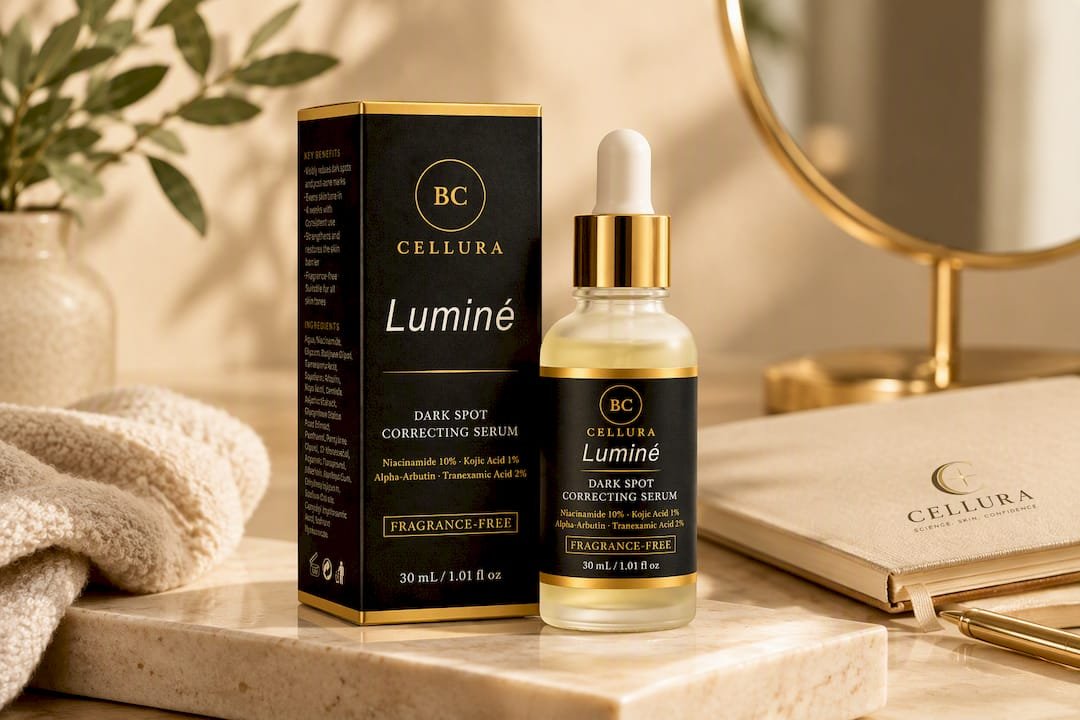
The centerpiece, our Cellura Luminé Brightening Serum, combines niacinamide, tranexamic acid, kojic acid, and alpha-arbutin, the same categories of actives dermatology guidance points to for interrupting pigment production at multiple stages. We publish the exact concentration of every active alongside the research it is based on, so you can compare our formula against the studies yourself rather than relying on a label alone.
Here is what the full ritual covers:
- A cleansing bar with salicylic, azelaic, and kojic acids to clear buildup and begin slowing pigment production.
- The Luminé Serum to target existing dark spots with multiple tyrosinase-inhibiting actives.
- A barrier-support balm with GHK-Cu and squalane to help skin recover between treatment steps.
| Step | Key ingredients | Main role |
|---|---|---|
| Cleanse | Salicylic, azelaic, kojic acids | Clear buildup, begin slowing pigment production |
| Treat | Niacinamide, tranexamic acid, kojic acid, alpha-arbutin | Target pigment at multiple stages |
| Support | GHK-Cu, squalane | Repair barrier, reduce relapse risk |
Used daily alongside tinted sunscreen, most people following this routine can expect visible fading within 3 to 12 months, consistent with timelines seen across topical regimens. Explore the Cellura line to find the ritual that matches your skin’s needs.
This article is general information, not a substitute for advice from a qualified doctor. Consult a qualified healthcare professional about your own circumstances before acting on anything here.
FAQ
How can hyperpigmentation go away?
Hyperpigmentation fades through a combination of daily sun protection, removing the original trigger (like active acne), and consistent use of topical actives such as azelaic acid, vitamin C, or retinoids. Most improvement in post-inflammatory marks appears gradually over 3 to 12 months rather than within days or weeks.
What race has the most hyperpigmentation?
Hyperpigmentation disorders, including post-inflammatory hyperpigmentation and melasma, are more commonly reported in people with darker skin tones because their melanocytes tend to respond more strongly to inflammation and injury. This is a difference in skin biology and melanin response rather than a single population being uniquely affected, per clinical guidance on managing hyperpigmentation in skin of color.
How long will hyperpigmentation go away?
Most post-inflammatory hyperpigmentation fades within 3 to 12 months once the triggering condition is controlled and a consistent topical routine is followed. Melasma tends to take longer and often requires ongoing maintenance since it can relapse with sun exposure or hormonal changes.
Can I remove pigmentation permanently?
Post-inflammatory marks typically resolve with consistent treatment and sun protection, though deeper dermal pigment can take longer to fade fully. Melasma is considered chronic and relapsing, so it is managed over time with maintenance rather than eliminated with a single treatment course.
What helps fade dark spots from acne specifically?
Treating active acne first prevents new marks from forming while topical actives like azelaic acid, niacinamide, and alpha-arbutin work on existing discoloration. For a full routine built around this approach, our guide to fading dark spots after acne walks through a realistic step-by-step plan.