Melasma is a specific, chronic form of hyperpigmentation that needs maintenance-focused care, not a quick fix. Hyperpigmentation, by contrast, is the broader category that includes sun spots and post-acne marks, many of which fade on their own with time and sun protection. The distinction matters because treating melasma like a temporary dark spot almost guarantees frustration, and a correct diagnosis is what determines whether photoprotection alone will do the job.
TL;DR:
- Melasma is a chronic condition that requires ongoing management, as it commonly recurs after treatment and sun protection lapses.
- Diagnosis relies heavily on pattern recognition and non-invasive tools, with a focus on symmetry and depth assessment to distinguish it from other hyperpigmentation.
- Topical therapies for melasma now favor gentler agents like tranexamic acid, azelaic acid, and niacinamide, combined with strict photoprotection, especially visible light shielding.
- Procedures like lasers and peels pose a high risk of worsening melasma or causing rebound in darker skin types, making conservative treatment the safer choice.
- A long-term maintenance routine using clinically dosed serums, such as niacinamide, tranexamic acid, and alpha-arbutin, supports control but does not cure melasma.
Table of Contents
- What Is Hyperpigmentation? Umbrella Term, Common Types and Triggers
- What Is Melasma? Presentation, Risk Factors, and Why It Behaves Differently
- How Clinicians Tell Melasma From Other Hyperpigmentation
- Treatment and Management: What Actually Differs Between the Two
- Prevention and Photoprotection That Actually Moves the Needle
- When to See a Dermatologist and What to Expect
- What an Ingredient-Focused Serum Can and Can’t Do for Maintenance
- The Gap Between How Melasma Is Marketed and How It Actually Behaves
- Where the Luminé Serum Fits Into Your Routine
- Sources
What Is Hyperpigmentation? Umbrella Term, Common Types and Triggers
Hyperpigmentation describes any patch of skin that has turned darker than the surrounding tissue because melanocytes are producing too much pigment. It is not a diagnosis on its own. It is a category, the way “headache” covers everything from dehydration to migraine. Harvard Health’s overview of hyperpigmentation frames melasma as one type nested inside this larger umbrella, which is exactly why the causes and treatment plans differ so much from case to case.
The most common subtypes each behave differently:
- Post-inflammatory hyperpigmentation (PIH): dark marks left behind after acne, eczema, a cut, or any skin injury. It tends to sit right where the original inflammation occurred.
- Solar lentigines (sun spots): flat brown spots from cumulative UV exposure, usually on the hands, chest, and face, and typically sharply defined rather than blended into the surrounding skin.
- Drug-induced pigmentation: discoloration triggered by certain medications, including some antibiotics, chemotherapy agents, and anti-seizure drugs.
- Melasma: a distinct, symmetric, chronic subtype covered in detail below.
Triggers overlap but aren’t identical across types. UV and visible light drive nearly all of them. Inflammation and physical injury explain PIH specifically. Certain medications and endocrine shifts, like thyroid disease or hormonal changes, can push melanocytes into overdrive independent of sun exposure.
Prognosis is where the real split happens. PIH and sun spots often fade with consistent sunscreen use and time, sometimes within months, according to the StatPearls clinical overview of melasma, which contrasts PIH’s typical course with melasma’s tendency to persist and recur. Melasma rarely follows that same path. It’s chronic by nature, which is the whole reason it needs its own conversation.
What Is Melasma? Presentation, Risk Factors, and Why It Behaves Differently
Melasma shows up in a pattern that’s almost diagnostic on sight: symmetric brown to gray-brown patches across the cheeks, forehead, upper lip, and sometimes the nose, arranged in a near-mirror image on both sides of the face. That symmetry is the first clue clinicians look for, because most other hyperpigmentation is scattered or one-sided depending on where the original irritation happened.
The condition clusters around a specific set of risk factors:
- Pregnancy (often called “the mask of pregnancy,” though it happens outside pregnancy too)
- Oral contraceptive use and other hormonal exposures
- Family history, since genetic predisposition plays a real role
- Darker skin phototypes, which show melasma more visibly and more often
- Thyroid dysfunction and other hormonal shifts
Melasma’s biology is genuinely more complicated than a simple sunspot. UV exposure matters, but so does visible light, hormonal signaling, and changes in the blood vessels beneath the pigmented patches. That last piece, dermal vascular involvement, is part of why melasma resists treatments that work fine on ordinary sun damage. The StatPearls review describes it as a genuinely multifactorial disorder, not a single-cause pigment problem.
There’s also a cost to melasma that doesn’t show up in a biopsy. Because it sits on the face, is symmetric, and is often mistaken by others for uneven tanning or poor skin care, patients frequently report real self-consciousness around it, and that psychosocial weight is part of why dermatologists treat melasma as a long-term management problem rather than a cosmetic annoyance.
Pro Tip: If your dark patches showed up or worsened during pregnancy, started or increased after beginning birth control, and sit symmetrically on both cheeks, that combination is a strong signal it’s melasma rather than sun damage or acne marks, even before you see a dermatologist.
Even with successful treatment, melasma has a documented habit of returning. Pigment often creeps back months after maintenance therapy and sun protection lapse, per the same StatPearls reference. That relapse pattern is the single biggest thing that separates melasma from a sun spot that, once treated, generally stays gone.
How Clinicians Tell Melasma From Other Hyperpigmentation
Diagnosis usually starts with the eyes, not a lab test. A dermatologist looks at where the discoloration sits, how it’s shaped, and how symmetric it is before reaching for any device.
- Check the pattern first. Melasma clusters symmetrically on the centrofacial zone, cheeks, forehead, upper lip, and chin. PIH tends to sit exactly where an old blemish or wound was, and sun spots appear as discrete, irregularly scattered dots, often on sun-exposed areas beyond the face.
- Use a Wood’s lamp for depth. This ultraviolet light tool helps separate epidermal pigment (which fluoresces more distinctly) from mixed or dermal pigment (which shows up more subtly), and melasma frequently has a mixed or dermal component that limits how much surface treatment alone can achieve.
- Add dermoscopy or reflectance confocal microscopy where available. These tools give a closer look at pigment distribution and vascular changes under the skin, useful when the pattern alone doesn’t settle the question.
- Watch for red flags that override a routine pigment workup. Any patch that’s rapidly changing shape or color, developing asymmetric borders, bleeding, or ulcerating needs prompt evaluation to rule out a pigmented skin cancer, not a pigmentation cream.
- Reserve labs or biopsy for atypical cases. Most melasma and PIH diagnoses never need a biopsy. It gets pulled out only when the presentation doesn’t fit the standard picture, or when an underlying endocrine cause is suspected.
Guideline frameworks increasingly formalize this process. Clinical guidance referenced by Medscape uses the modified MASI (mMASI) scoring system to grade melasma severity, which then steers whether a patient starts on topical therapy alone or moves to combination treatment with procedural support.
Treatment and Management: What Actually Differs Between the Two
The treatment gap between melasma and other hyperpigmentation starts with a philosophy shift. PIH and sun spots are generally treated to clear. Melasma is treated to control.
For melasma, first-line topical strategies now lean toward gentler tyrosinase inhibitors rather than the harsher agents dermatology used a decade ago. Tranexamic acid, azelaic acid, and niacinamide have become preferred building blocks because they interrupt pigment production at different points without the irritation that can itself trigger more pigment. A 2024 review in Springer backs a stepwise, multimodal approach: photoprotection as the foundation, topical tyrosinase inhibitors layered on top, and procedures reserved for cases that don’t respond.
PIH generally follows a shorter timeline. Retinoids, azelaic acid, and niacinamide remain the standard topical toolkit, and because PIH lacks melasma’s hormonal and vascular drivers, dark spots from acne often lighten meaningfully within a few months once the original inflammation is controlled and sun protection is consistent.
Procedures are where the two conditions diverge most sharply:
- Chemical peels, lasers, and microneedling can accelerate results for stubborn PIH or resistant sun spots when performed conservatively.
- In melasma, those same procedures carry a real risk of triggering a rebound or new PIH, especially in darker phototypes, because the heat and inflammation they generate can stimulate the very melanocytes you’re trying to calm.
- Research on laser and procedural risk in pigmented skin points to superficial peels and conservative laser settings as the safer path when procedures are used on melasma at all.
- IPL and some laser platforms can lighten melasma initially, but the Springer review notes the evidence is mixed and relapse is common without disciplined maintenance afterward.
For persistent, treatment-resistant melasma, some clinicians add oral tranexamic acid under medical supervision, since it works systemically rather than only at the skin’s surface. This isn’t a decision to make without a physician, given the drug’s contraindications around clotting risk.
The honest framing dermatology has settled on: melasma is managed, not cured. Expect a maintenance phase that outlasts the initial clearing phase, often by years, and treat any relapse as normal rather than a treatment failure.
Prevention and Photoprotection That Actually Moves the Needle
Sunscreen is the floor, not the ceiling, for anyone dealing with either condition, but melasma raises the bar in one specific way: visible light. Standard UVA/UVB filters don’t block the visible light spectrum that’s been shown to aggravate melasma, and StatPearls specifically recommends iron-oxide tinted sunscreens to close that gap.
- Apply broad-spectrum sunscreen daily, reapplying roughly every two hours outdoors, and choose an iron-oxide tinted formula if melasma is your concern.
- Add physical barriers. A wide-brimmed hat and UPF clothing cut exposure that sunscreen alone can miss, particularly during peak midday hours.
- Time your outdoor exposure. Avoiding direct sun during the strongest UV hours reduces cumulative triggers for both melasma and sun spots.
- Skip harsh exfoliants and aggressive treatments that inflame the skin, since that inflammation is a direct pathway to new PIH or a melasma flare.
- Build a gentle daily routine around a mild cleanser, barrier support, and non-irritating brightening actives, keeping the skin calm enough that treatment doesn’t backfire into more pigment.
A minimalist, low-irritation routine tends to outperform an aggressive multi-step regimen here, since fewer active ingredients means fewer chances to provoke the inflammation that darkens skin further. Pairing that with a soothing, repair-focused sunscreen gives sensitive or reactive skin the protection it needs without adding new irritation to the mix.
When to See a Dermatologist and What to Expect
See a dermatologist if the diagnosis feels uncertain, the pigment is spreading or changing quickly, over-the-counter products aren’t budging it after several months, or the discoloration is affecting your confidence day to day.
A typical visit includes a history focused on hormonal triggers and medication use, a visual exam of the pattern, and often a Wood’s lamp check to gauge how deep the pigment sits.
- Ask directly whether your case fits melasma or another hyperpigmentation type.
- Ask what maintenance will look like after initial improvement, not just what clears it first.
- Ask about realistic timelines. Melasma improvement is measured in months, and relapse is common enough to plan for rather than fear.
What an Ingredient-Focused Serum Can and Can’t Do for Maintenance
Once photoprotection and clinical guidance are in place, the daily maintenance layer is where a well-formulated serum earns its keep. Beauvex LLC builds its Luminé Serum around published concentrations of niacinamide, tranexamic acid, and alpha-arbutin specifically because these three actives interrupt melanin production at different points in the pathway rather than relying on one mechanism alone.
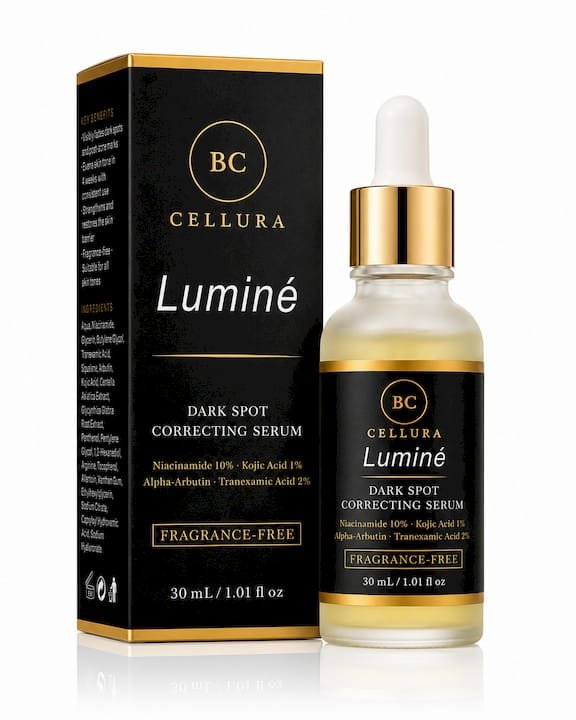
Niacinamide slows the transfer of pigment granules to skin cells. Tranexamic acid dampens the signaling pathway that overactive melanocytes rely on. Alpha-arbutin inhibits tyrosinase, the enzyme that kicks off pigment production in the first place. Used together, they work as a maintenance layer, not a replacement for the diagnosis and photoprotection strategy discussed above.
For anyone comparing which of these actives to lean on, a closer look at tranexamic acid against niacinamide breaks down where each pulls its weight. The formulation publishes its concentrations and research references specifically so readers can weigh the formulation against the clinical literature rather than take a marketing claim at face value.
The Gap Between How Melasma Is Marketed and How It Actually Behaves
Most skincare marketing treats melasma and hyperpigmentation as interchangeable, and that’s the single biggest disservice done to people trying to fix their skin. Calling melasma a “dark spot” sets an expectation of a fix in weeks, when the honest timeline runs in months and the honest outcome is control with occasional relapse, not permanent erasure.
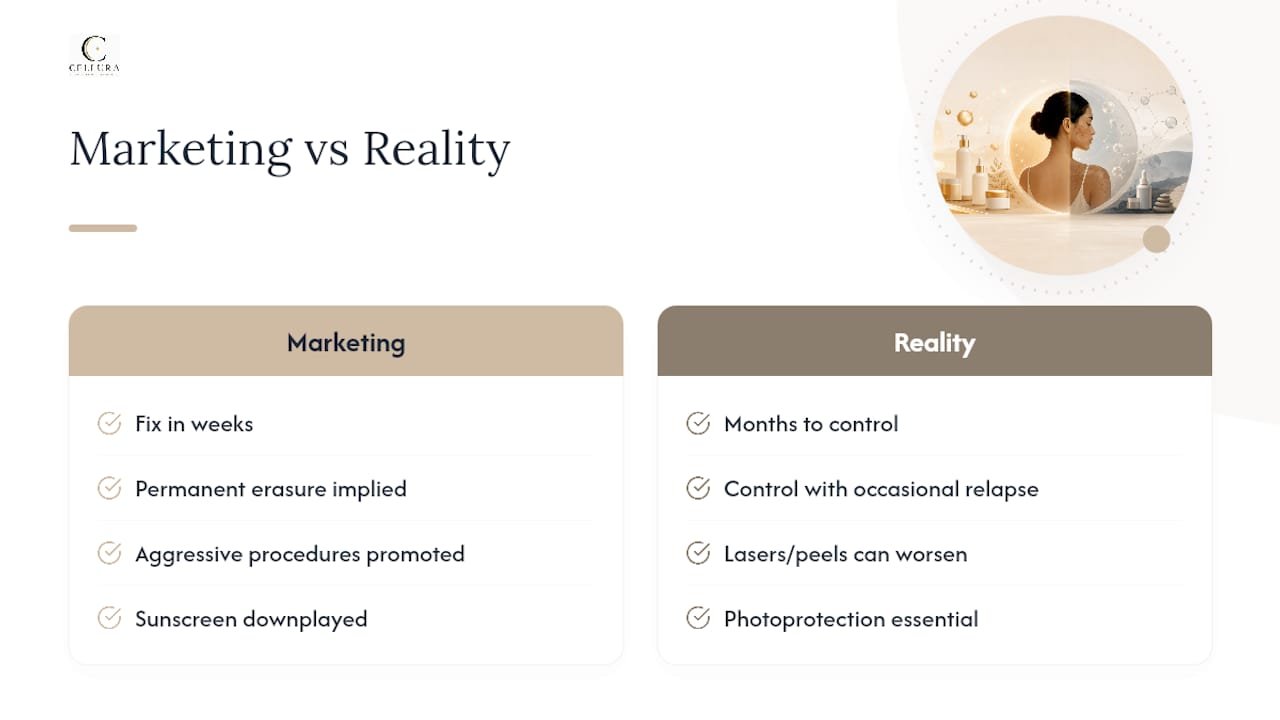
The overrated fix, in our view, is the aggressive procedure pitched as a shortcut. Lasers and peels have a real place in dermatology, but the evidence on melasma specifically shows they carry a meaningful chance of making things worse before they make things better, particularly in darker skin tones. Photoprotection, including visible-light protection that ordinary sunscreen skips, does more quiet, unglamorous work than any single procedure.
If there’s one thing readers should prioritize first, it’s diagnosis over product selection. Know what you’re treating before you decide how to treat it. Everything downstream, from ingredient choice to whether a laser is even appropriate, depends on getting that first step right.
**
Where the Luminé Serum Fits Into Your Routine
If you’ve read this far because your pigment isn’t behaving the way generic dark-spot advice promised, the fix usually isn’t a stronger treatment. It’s a maintenance layer built for the long haul, formulated with published concentrations instead of a vague ingredient list buried on the back of the box.
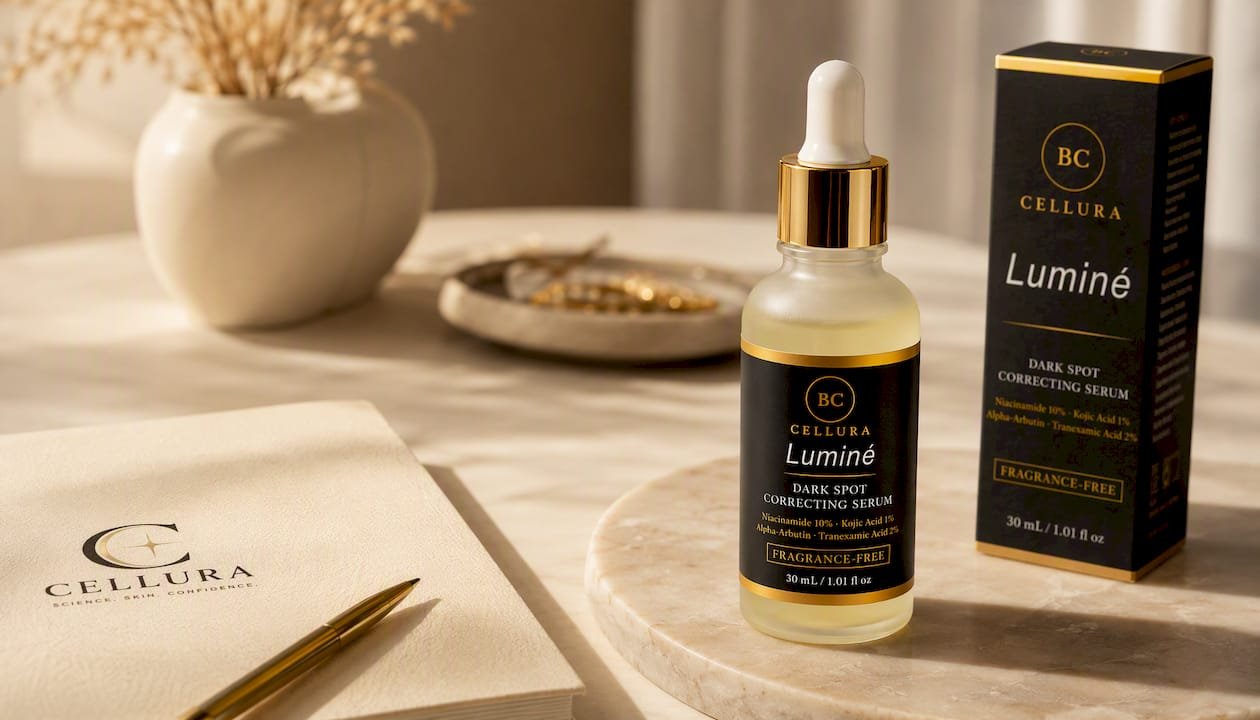
The Luminé Brightening Serum pairs niacinamide, tranexamic acid, and alpha-arbutin at documented concentrations, giving you a way to compare what you’re applying against the actual research rather than trusting a brand’s word for it. It’s built for people managing post-acne discoloration and general dark spots as part of a daily routine, sitting alongside sunscreen and a gentle cleanser rather than promising to replace either one. If melasma is confirmed, this serum supports the maintenance phase your dermatologist will likely recommend anyway, not the diagnosis or the prescription-strength intervention that comes first. Check the product page for current concentrations and the published research behind each active, then decide if it fits the routine you’re already building.
This article is general information, not a substitute for advice from a qualified doctor. Consult a qualified healthcare professional about your own circumstances before acting on anything here.
Sources
- Melasma – StatPearls – NCBI Bookshelf
- An Update on New and Existing Treatments for the Management of Melasma | Springer (2024)