
Both mineral and chemical sunscreens protect your skin well when they’re broad-spectrum SPF 30+ and applied generously. For most people, the choice comes down to skin type and finish: pick tinted mineral sunscreen if you have sensitive skin or visible dark spots, and pick chemical if you want an invisible, lightweight daily formula. The sunscreen you’ll actually wear every day beats the “better” one sitting in a drawer.
TL;DR:
- Mineral sunscreens act immediately upon application and are better suited for sensitive or reactive skin types, especially during pregnancy.
- Chemical sunscreens require 15 to 20 minutes to become effective and tend to feel lighter and blend in more discreetly.
- Tinted mineral formulas are essential for blocking visible light, which can worsen hyperpigmentation and dark spots in medium to dark skin tones.
- Proper application involves using enough, reapplying every two hours, and applying sunscreen last in your skincare routine for maximum protection.
- Reef-safe formulas are generally mineral-based, but checking individual ingredients is necessary, especially for reef exposure or environmental concerns.
Table of Contents
- Mineral vs Chemical Sunscreen: How Each One Actually Works
- Pros and Cons: What You’ll Actually Notice Day to Day
- How to Choose Between Mineral and Chemical Sunscreen
- Why Tinted Mineral Sunscreen Matters for Dark Spots
- Application Rules That Actually Change Your Protection Level
- Beauvex’s View: Pairing Sunscreen With a Brightening Routine
- Coral Reefs, Oceans, and the Sunscreen You Choose
- Sunscreen Myths Worth Retiring
- Allergies, Irritation, and Layering With Other Products
- A Beauvex Perspective on Choosing Sunscreen for Dark Spots
- Cellura Luminé Serum: A Sunscreen-First Approach to Fading Dark Spots
- Sources
Mineral vs Chemical Sunscreen: How Each One Actually Works
Mineral sunscreens rely on zinc oxide or titanium dioxide, mineral particles that sit on the skin’s surface and go to work the moment you apply them. The common idea that they simply “reflect” UV rays like tiny mirrors isn’t quite right. Photobiology research shows mineral filters mainly absorb UV energy too, with only a small fraction scattered away. The real distinction is particle chemistry and how the formula suspends those particles, not a clean reflect-versus-absorb split.
Chemical sunscreens use organic filters like avobenzone, octisalate, and homosalate. These molecules absorb UV rays and convert that energy into a small amount of heat, but they need roughly 15 to 20 minutes to bind properly to the skin before they’re fully effective.
Neither camp is static, either. Many mineral formulas now blend in chemical stabilizers or solvents that improve spreadability and cut down on the chalky white finish older mineral products were known for.
Pros and Cons: What You’ll Actually Notice Day to Day
The ingredient list matters less than how a sunscreen feels on your face, because that’s what determines whether you’ll reapply it or skip it by noon.
Mineral sunscreen strengths:
- Works immediately after application, with no waiting period.
- Tends to cause less irritation, which is why dermatologists often recommend it for sensitive, acne-prone, or reactive skin, and for use during pregnancy.
- Sits on top of skin rather than absorbing into it.
Mineral sunscreen drawbacks:
- Can feel thicker and leave a white or gray cast, especially on deeper skin tones, unless it’s tinted.
Chemical sunscreen strengths:
- Feels lighter and blends in without a visible cast.
- Scored higher in Good Housekeeping Institute testing for texture and absorption, and often holds up better during heavy sweating or swimming.
Chemical sunscreen drawbacks:
- Requires a wait after application, and some formulas can sting eyes or irritate reactive skin.
How to Choose Between Mineral and Chemical Sunscreen
Run through your own profile before you buy anything:
- Sensitive or reactive skin. Mineral or tinted mineral formulas cause the fewest flare-ups.
- Acne-prone skin. Look for “non-comedogenic” mineral or chemical formulas in a gel or fluid texture, not a heavy cream.
- Darker skin tones. Tinted mineral sunscreen avoids the white cast, or choose a chemical formula built for a clear finish.
- Active hyperpigmentation or dark spots. Tinted mineral, specifically.
- Swimmers and athletes. Prioritize a labeled water-resistance rating over the ingredient class.
- Pregnancy. Mineral sunscreen is the conventional first choice, though this is worth a quick conversation with your OB or dermatologist.
Pro Tip: If you’ve been burned by chalky mineral sunscreen in the past, try a tinted version before writing off the whole category. Iron oxide tints do double duty: they cut the white cast and add a layer of visible-light protection you don’t get from an untinted formula.
See a board-certified dermatologist before choosing either type if you have a history of severe eczema, a documented sunscreen allergy, or persistent breakouts that store-brand formulas haven’t solved.
Why Tinted Mineral Sunscreen Matters for Dark Spots
Standard SPF ratings only measure protection against UVB and UVA rays. They say nothing about visible light, the portion of the sun’s spectrum your eyes actually see, which has been shown to worsen melasma and post-acne hyperpigmentation in people with medium to deep skin tones. Iron oxides, the pigments that give tinted mineral sunscreen its color, block visible light in a way that clear formulas, mineral or chemical, simply don’t.
That’s the practical reason tinted mineral sunscreen keeps coming up in dermatology guidance for anyone actively treating dark spots. Skip daily sunscreen while you’re using a brightening serum, and UV plus visible light can undo weeks of progress overnight.
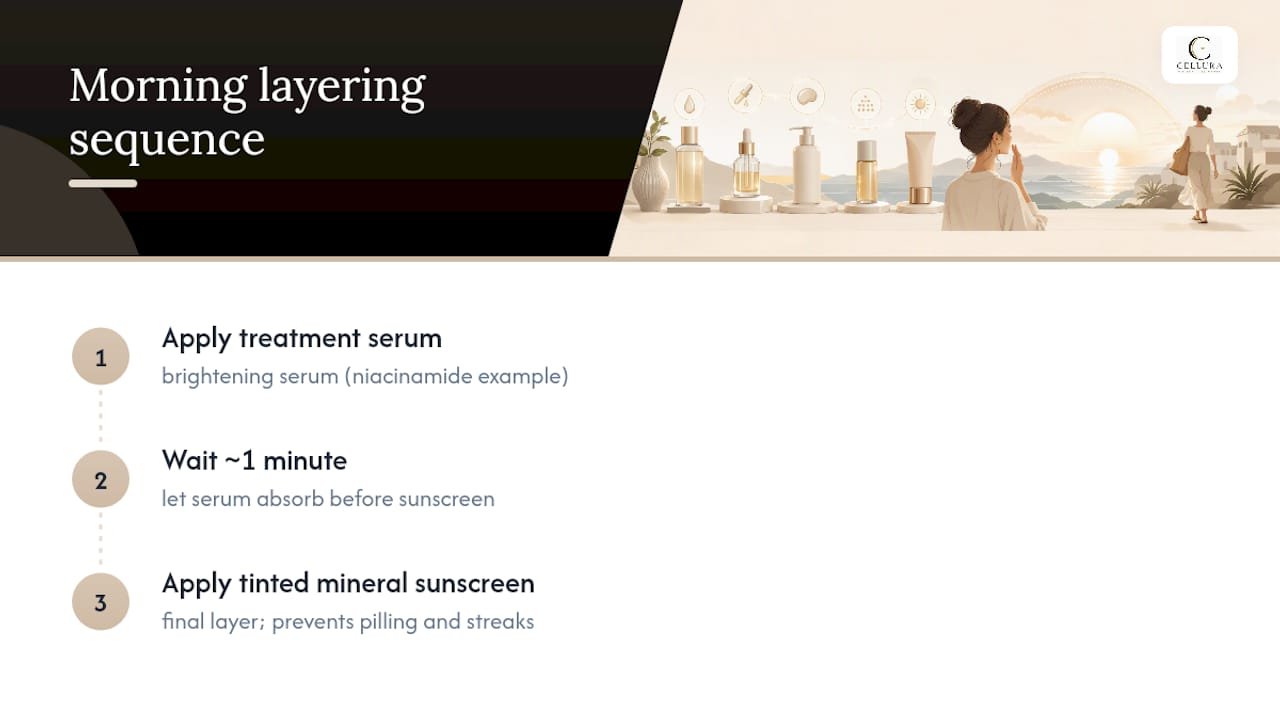
The layering order is simple: apply your treatment serum first, give it a minute to absorb, then finish with sunscreen as your last step. Piling sunscreen on top of a still-wet serum is the most common reason people get a pilling, streaky mess instead of even coverage. If you want the full layering sequence for actives like niacinamide serum, it’s worth reviewing once and then never thinking about again.
Application Rules That Actually Change Your Protection Level
Most people apply less than half the sunscreen used to earn that SPF number on the label, which quietly cuts their real protection far below what’s printed on the bottle.
- Use enough. The FDA’s guidance calls for a generous, even layer across all exposed skin, not a thin swipe.
- Respect the timing. Mineral sunscreen works on application. Chemical sunscreen needs 15 to 20 minutes before sun exposure to reach full strength.
- Reapply every two hours. Sooner if you’re swimming or sweating heavily, and only rely on the water-resistance window listed on the label.
- Apply it last. After serums and moisturizers, sunscreen goes on as the final step, always.
Beauvex’s View: Pairing Sunscreen With a Brightening Routine
Post-acne dark spots don’t fade on their own timeline if UV and visible light keep re-triggering pigment production. That’s the logic behind the three-step ritual we built at Beauvex LLC: a cleansing bar, a treatment serum, and a barrier-supporting balm, each designed to work alongside daily sun protection rather than instead of it.
Our brightening serum combines niacinamide, tranexamic acid, and alpha-arbutin to interrupt pigment production at several points in the process. None of that matters much if a reader skips sunscreen. Layer a tinted mineral formula over Luminé each morning, and you’re addressing the spots you already have while blocking the light that creates new ones. We publish ingredient concentrations and cite the research behind each active so readers can judge the approach on evidence, not marketing language, and read more on how sunscreen fades dark spots if you want the deeper mechanism.
Coral Reefs, Oceans, and the Sunscreen You Choose
Chemical filters, particularly oxybenzone and octinoxate, have drawn attention for their potential effect on coral reef health, which is why Hawaii, Key West, and Palau have restricted or banned sunscreens containing them in certain protected waters. The concern centers on coral bleaching and disruption of coral reproduction at concentrations found near heavily trafficked reef areas.
Mineral sunscreens built on non-nano zinc oxide are generally considered the safer choice for reef-adjacent swimming and snorkeling, since the particles are less prone to the chemical runoff linked to reef stress. That said, “reef-safe” is not a regulated or standardized term in the United States, so a label claiming it doesn’t guarantee a formula is free of every ingredient under scrutiny.
If you’re planning a trip to a marine reserve, check the specific mineral formula for its filter list rather than trusting a reef-safe claim at face value. Nano-sized zinc oxide particles are still being studied for their own environmental footprint, so “mineral” alone isn’t an automatic pass. For everyday use away from coral ecosystems, environmental impact is a much smaller factor in your decision than skin type, comfort, and whether you’ll actually reapply on schedule. Save the reef-specific research for beach and dive trips, and let skin needs drive your daily choice.
Sunscreen Myths Worth Retiring
“Mineral sunscreen doesn’t absorb into skin at all.” It sits closer to the surface than chemical filters, but calling it a total barrier oversimplifies the physics, since some particle interaction with skin still occurs.
“Chemical sunscreen is dangerous because studies found it in the bloodstream.” Research has found that some chemical filters are absorbed into the body, and the FDA continues reviewing that data. Absorption alone doesn’t mean harm. Current findings in the peer-reviewed literature haven’t established danger at typical use levels, and the FDA’s consistent position is that unprotected UV exposure carries the far greater, well-documented risk.
“A high SPF number means you can apply less or reapply less often.” SPF measures protection strength at a full, generous application, not a license to skip reapplication.
“Darker skin doesn’t need sunscreen.” Melanin offers some natural UV defense, but it doesn’t prevent hyperpigmentation or eliminate skin cancer risk, and visible light exposure remains a real driver of dark spots regardless of skin tone.
“Natural or organic automatically means gentler.” Formulation quality, not the natural label, determines how a sunscreen performs on sensitive skin.
Allergies, Irritation, and Layering With Other Products
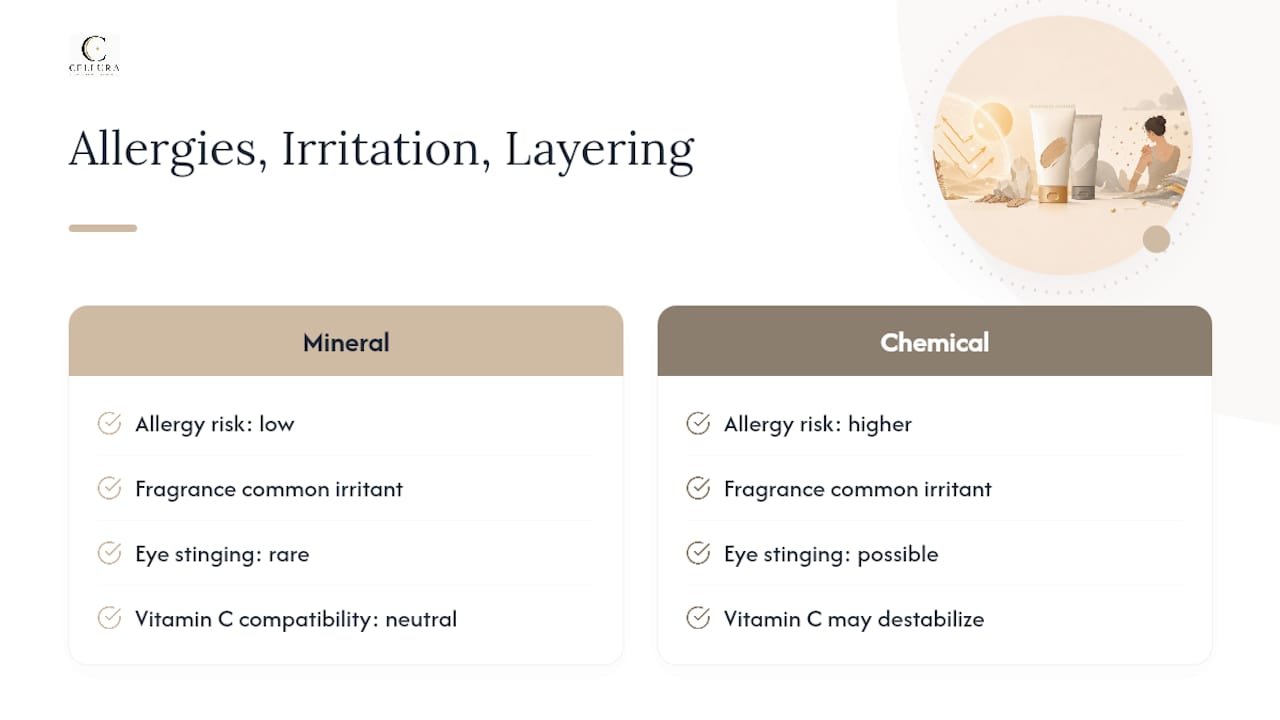
Mineral sunscreen’s biggest advantage for reactive skin is chemistry: zinc oxide and titanium dioxide rarely trigger allergic contact dermatitis, which is why they show up so often in formulas for eczema, rosacea, and post-procedure skin. Chemical filters, especially older ones like oxybenzone and PABA derivatives (now largely phased out), have a longer history of causing contact allergies and stinging around the eyes.
Fragrance, not the UV filter itself, is the most common irritant in either sunscreen category, so a fragrance-free label matters more than the mineral-versus-chemical line for anyone with a history of reactive skin.
Layering sunscreen with active ingredients has its own quirks. Sunscreen applied over exfoliating acids like salicylic or azelaic acid can sting briefly if the skin barrier is already compromised, so give active treatments a few minutes to settle before sunscreen goes on. Vitamin C serums can occasionally destabilize when layered under certain chemical filters, showing up as a slight color shift or grainy texture; mineral sunscreen tends to sit more neutrally on top of vitamin C. If you’re combining sunscreen with a brightening routine that includes niacinamide and retinol, stick to a consistent order: treatment actives first, moisturizer if needed, sunscreen last. Patch-test any new sunscreen for a few days before committing to daily use, particularly if you’ve reacted to fragranced skincare before.
A Beauvex Perspective on Choosing Sunscreen for Dark Spots
The ingredient class matters less than people assume. What actually moves the needle on post-acne discoloration is wearing sunscreen every single day, and choosing a tinted mineral formula when visible light is working against you. Pair that habit with a targeted brightening active, and consistency does more than any single ingredient ever will.
— Beauvex LLC
Cellura Luminé Serum: A Sunscreen-First Approach to Fading Dark Spots
Sunscreen protects the progress you’re making. It doesn’t create it. That’s where a targeted active does the heavier lifting, and our Cellura Luminé Brightening Serum was built specifically for post-acne dark spots, combining niacinamide, tranexamic acid, and alpha-arbutin at published concentrations you can check against the research yourself.

Use it as the treatment step in a morning routine, then finish with tinted mineral sunscreen to guard against both UV and the visible light that keeps reactivating pigment. It’s a straightforward pairing: one product fades what’s already there, the other keeps new spots from forming. If your discoloration is severe, widespread, or tied to a diagnosed skin condition, talk to a board-certified dermatologist before starting any new active. For everyone else, the Luminé Serum product page has full ingredient concentrations and the research behind them, so you can decide based on evidence rather than a marketing claim.
This article is general information, not a substitute for advice from a qualified doctor. Consult a qualified healthcare professional about your own circumstances before acting on anything here.
Sources
- Is Chemical or Mineral Sunscreen Better? Our Tests Found a Winner
- Mineral vs. Chemical Sunscreen: Which Is Better?
- Sunscreen: How to help protect your skin from the sun
- Which kind of sunscreen should you use?
- PubMed literature on sunscreen safety and absorption