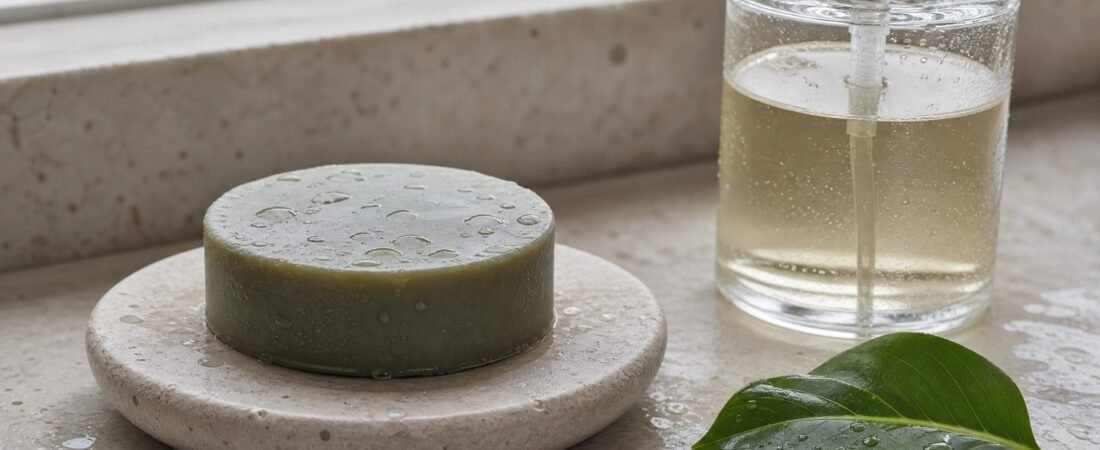
We built our line on a simple idea: effective skincare should be simple, transparent, and honest. The skincare bar vs liquid cleanser debate often misses that point. Most comparisons still lean on outdated assumptions about alkaline soap stripping the skin, and ignore how far solid cleansing has come as a treatment step. We want to clarify what actually matters when you choose between formats.
Why the Skincare Bar vs Liquid Cleanser Debate Persists
The stigma against bar cleansers has real history behind it. Traditional soap is made through saponification, a chemical reaction that produces an alkaline product with a pH far above the skin’s natural acid mantle. That high pH disrupts barrier function and strips essential lipids. Skin ends up feeling tight and compromised after every wash.
Modern multi-active bars have nothing in common with those harsh predecessors. Formulation science now lets us build solid cleansers that respect your skin’s biology while carrying concentrated treatment ingredients, without the fillers liquid products need to stay stable. You deserve a cleanser that works with your barrier rather than against it, whatever its physical format.
That distinction changes how we should evaluate efficacy and gentleness.
How Multi-Active Cleansing Bars Differ from Traditional Soap
Understanding the difference means looking past the shape and into the chemistry. A true multi-active bar is a targeted treatment vehicle first and a cleansing agent second. That separates it from both traditional soap and diluted liquid washes.
Syndet and pH-Balanced Formulations
Dermatologists increasingly recommend syndet bars over traditional soap, because their acidic pH aligns with the skin’s natural acid mantle. Syndet stands for synthetic detergent, but don’t let the term mislead you into thinking these are harsh or unnatural. These surfactant systems are built to cleanse effectively at a pH between 4.5 and 5.5, the range healthy barrier function and microbiome balance need.
Traditional soap can’t hit that range. Its chemistry won’t allow it. Even “moisturizing” soap bars stay alkaline at their core, and rely on added fats or oils to mask the stripping effect rather than prevent it. A properly formulated syndet bar skips that compromise by working within your skin’s preferred pH range from the start.
Incorporating Treatment Actives in Solid Form
Liquid cleansers typically run 70-80% water. Solid cleansing bars concentrate active ingredients and surfactants into a waterless format instead. That concentration means a bar can carry meaningful doses of ingredients like niacinamide, kojic acid, or tranexamic acid without the stability problems that plague water-based formulas.
The ClearMark multi-active facial cleansing bar shows how a solid format can pair cleansing with brightening actives like kojic acid and tranexamic acid. Water-based liquids need preservatives, stabilizers, and solubilizers to keep actives suspended and safe from microbial growth, and that dilutes the formula further. A solid bar skips those additives, putting more of what your skin needs directly onto your face with every wash.
Does a Cleansing Bar Dry Out Skin Compared to Gel?
Dryness comes from harsh surfactants and the wrong pH, never from whether a product is solid or liquid. Many gel cleansers disrupt the barrier more than a well-formulated bar does, because gels often lean on aggressive foaming agents to deliver the lather people expect from liquid products.
The Role of Surfactants Over Format
Sodium lauryl sulfate and similar strong anionic surfactants show up often in gel washes because they foam heavily at low cost. These ingredients strip proteins and lipids from the stratum corneum whether they come from a pump bottle or a bar wrapper. Your skin responds to the molecule, not the packaging.
A gentle facial cleansing bar for sensitive skin uses milder amphoteric or non-ionic surfactants that clean without denaturing skin proteins. The solid format actually makes this gentler approach easier, since it doesn’t need to stay suspended in water. Formulators can pick surfactants for skin compatibility instead of solubility.
Maintaining Barrier Integrity During Cleansing
Water-based gels need broad-spectrum preservative systems to keep bacteria and fungus out over their shelf life. Some of those preservatives irritate compromised barriers or sensitize reactive skin over time, adding a layer of potential disruption on top of the surfactants themselves.
Solid bars skip that preservation burden almost entirely. Without free water in the formula, microbes have nowhere to grow, so the product stays stable and safe through simpler means. Fewer auxiliary ingredients means fewer chances for irritation, and a cleaner interaction with your skin at every cleanse.
Face Cleansing Bar Pros and Cons for Minimalist Routines
Choosing a solid format means real trade-offs. We’d rather lay out both sides plainly than sell you on one.
Concentration and Stability of Ingredients
Anhydrous formulas offer better stability for oxidation-prone actives like vitamin C derivatives and certain botanical extracts. Water speeds up degradation, which forces liquid products toward encapsulation or derivative forms that can be less bioavailable than the pure compound. A solid bar carries these ingredients in their most stable, most potent state.
That concentration also supports a real minimalist skincare routine, by folding cleansing and treatment into one step. You get active delivery during your wash, which can cut the number of separate serums or toners you need for concerns like hyperpigmentation or uneven texture.
Reducing Plastic Waste with Solid Formats
Sustainable skincare packaging is a real benefit of switching to concentrated solids, not an abstract talking point. Liquid cleansers ship mostly water in plastic bottles that rarely get recycled well, and that keeps waste streams running even when brands use post-consumer resin.
Solid bars ship in paperboard or minimal wraps that biodegrade or compost easily. One bar replaces several bottles of liquid wash, which cuts packaging volume and transportation emissions per use. Beauvex formulates without harsh chemicals or wasteful packaging, and that thinking shapes the whole Cellura debut line, because we believe sustainability and efficacy belong together.
Bars aren’t better for everyone, in every circumstance.
Solid Cleanser vs Gel Cleanser: Texture and User Experience
Gels feel familiar because decades of marketing trained us to link liquid lather with cleanliness. Bars ask for a brief adjustment period, where you learn to build foam through technique rather than relying on pre-dissolved surfactants.
The lather from a well-formulated syndet bar feels denser and creamier than typical gel foam, because it holds less air and more actual cleansing molecules. Work the bar between wet hands or directly on damp skin for fifteen to twenty seconds to build that microfoam, then spread it evenly across the face without dripping. This small ritual swaps the passive pump-and-rub habit for intentional contact, which improves distribution and, honestly, mindfulness too.
Some people will always prefer the slip and convenience of liquid textures, and that preference is valid. Sensory satisfaction matters for long-term use. No format wins if you resent reaching for it twice daily.
Is a Cleansing Bar Better Than Face Wash for Active Delivery?
Short contact time limits what any rinse-off product can do compared to leave-on treatments. Still, consistent daily exposure to well-formulated actives during cleansing adds up over weeks and months.
The benefits of a multi-active cleansing bar come from that regularity, not from extended dwell time. Kojic acid and tranexamic acid start interacting with surface pigmentation and inflammation markers as soon as they touch skin, even though most of the dose rinses away. What stays absorbed in the upper stratum corneum contributes to gradual brightening and tone evening, when you repeat it morning and night without fail.
Treating your cleanser as a real treatment step, not just a hygiene one, turns a routine chore into active skincare. That simplifies your routine without giving up progress on specific concerns, especially alongside leave-on products that target deeper layers.
Choosing the Right Format for Your Skin Goals
Your decision should reflect your skin type, your lifestyle, and your own priorities, not a generic recommendation. Oily or acne-prone skin often does well with the thorough, gentle cleansing a syndet bar provides. Very dry or eczema-prone skin may still prefer oil-rich liquid milks for the extra emollient cushion.
Travel and storage matter in practice. Bars work well in carry-on luggage and gym bags, where liquid restrictions and spill risk complicate things, but they need proper drainage so they don’t soften between uses. If your bathroom lacks ventilation or counter space for a soap dish, a liquid might suit you better despite the other advantages of solids.
Ingredient transparency should drive your final choice, regardless of format. Read labels critically. Check pH claims when you can, and pick products whose formulas match your barrier health priorities. Look honestly at your current cleanser’s ingredient list, and ask whether a multi-active bar could simplify your routine while doing more for your skin.