
No, niacinamide does not typically cause true skin purging. If you break out after starting it, that reaction is usually irritation, a formulation problem, or another active ingredient in your routine. The fix depends on which one it is, and figuring that out takes about two to four weeks of careful observation, not guesswork.
TL;DR:
- True skin purging occurs mainly with ingredients that accelerate skin cell turnover, such as retinoids, but niacinamide does not influence this process.
- Most breakouts after starting niacinamide result from formulation issues, high concentrations, or reactions to other active ingredients, not the molecule itself.
- Reactions caused by niacinamide typically appear within days if irritation, not weeks like purging, and tend to resolve within two to four weeks with routine adjustments.
- Proper diagnosis involves halting other products, patch testing, and gradually reintroducing niacinamide at lower concentrations to avoid barrier overload or irritation.
- It’s essential to check serum formulation transparency and supporting actives to select low-irritation niacinamide products suitable for sensitive or acne-prone skin.
Table of Contents
- Niacinamide Purge Myths: How Purging Actually Works vs What Niacinamide Does
- How to Tell a Niacinamide Skin Purge From a Regular Breakout
- Common Reasons People Break Out After Starting Niacinamide
- What to Do If You Think Niacinamide Is Causing Breakouts
- Safe Layering: What Not to Mix With Niacinamide
- How Long Reactions Actually Last
- The Beauvex Perspective: Formulation Transparency and Why It Matters Here
- A Practical Take on Niacinamide Reactions
- Choosing a Low-Irritation Niacinamide Serum
- Sources
Niacinamide Purge Myths: How Purging Actually Works vs What Niacinamide Does
True purging has a specific biological trigger, and niacinamide doesn’t pull it. Purging happens when an ingredient speeds up keratinocyte turnover, the rate at which skin cells shed and regenerate. That acceleration pushes microcomedones, the invisible clogged pores already sitting under your skin, to the surface faster than they’d normally emerge on their own. It’s not new damage. It’s existing damage arriving early.
Retinoids and strong chemical exfoliants are the classic purging agents, precisely because they ramp up cell turnover as their core mechanism. Niacinamide works through a completely different pathway. It calms inflammation, helps regulate sebum output, and reinforces the skin barrier, but it doesn’t touch turnover speed at all. That distinction is why dermatology sources consistently note that niacinamide is unlikely to cause true purging, because the mechanism purging depends on simply isn’t part of what niacinamide does.
There’s also solid clinical backing for niacinamide’s role as an acne-calming ingredient rather than an acne-triggering one. In one controlled study cited by dermatology researchers, a 4% niacinamide gel reduced pustules by roughly 84% and overall acne severity by 58% over 12 weeks. That’s not the profile of an ingredient that stirs up new breakouts.
What niacinamide actually does, according to the research:
- Lowers inflammatory markers tied to acne lesions
- Reduces excess sebum production over consistent use
- Strengthens the skin’s barrier function, which limits moisture loss
- Shows no evidence of accelerating cell turnover or triggering microcomedone extrusion
How to Tell a Niacinamide Skin Purge From a Regular Breakout
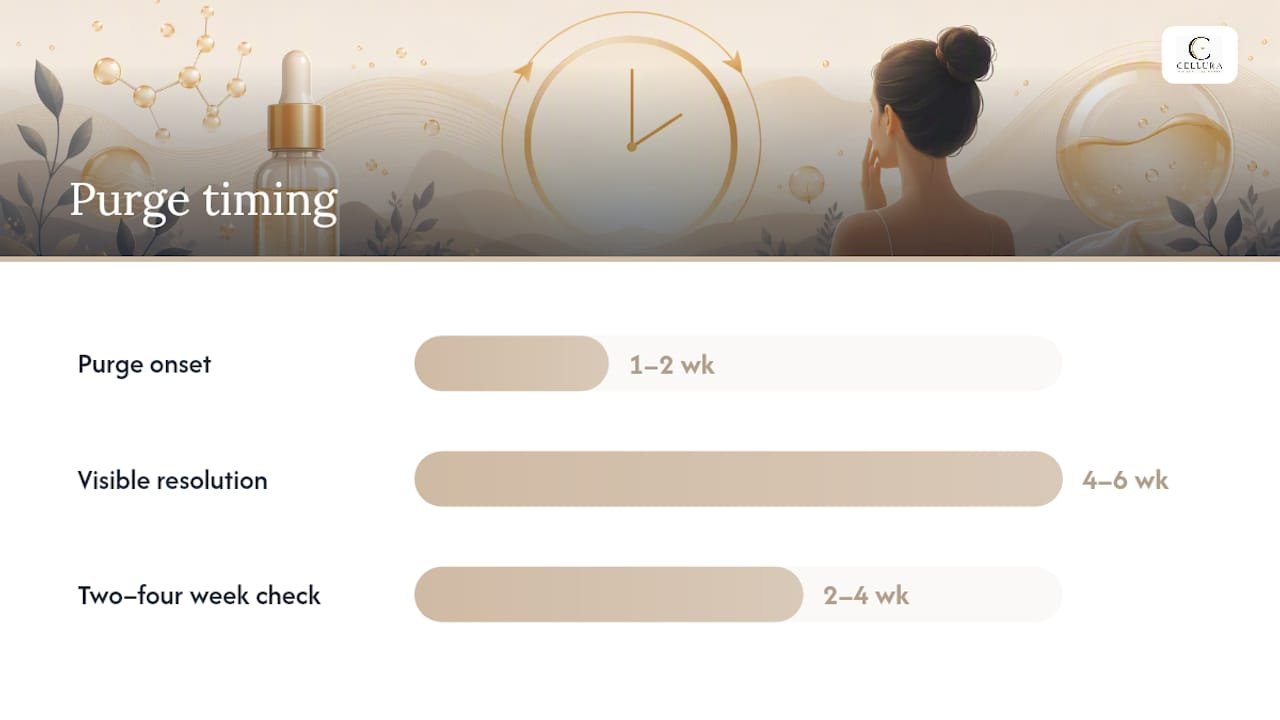
Timing is your best diagnostic tool. A genuine purge, when it happens with a turnover-accelerating ingredient, tends to show up within the first one to two weeks of use and resolves within four to six weeks as the skin’s cycle normalizes. A reaction to niacinamide itself, or to something else in the formula, usually looks different on the clock: irritation-driven breakouts often appear within days rather than weeks, and they don’t follow the same predictable arc toward improvement.
Location and lesion type matter just as much as timing. Here’s how to sort what you’re seeing:
- Check where the bumps are. Purging concentrates in areas where you already tend to break out, since it’s surfacing existing congestion. Irritation-driven breakouts can show up in new spots, including areas you rarely have trouble with.
- Look at the lesion type. Purging tends to produce small, similar-looking whiteheads and blackheads. Irritation often brings redness, itching, stinging, or small inflamed bumps that feel different from your usual acne.
- Track associated symptoms. Tightness, burning, or a rash-like texture point toward irritation or a barrier problem, not purging. True purging is rarely itchy.
- Note the duration. If it’s been more than four weeks with no improvement, purging is an increasingly unlikely explanation.
Pro Tip: Take a dated photo the day you start a new product. Comparing week one to week three side by side removes the guesswork that memory alone can’t handle.
Give any reaction a firm two to four week checkpoint. If it’s a true purge, you should see a visible turn toward improvement by then. If nothing has changed, or things have gotten worse, you’re very likely dealing with irritation, not purging, and it’s time to adjust your approach rather than wait it out.
Common Reasons People Break Out After Starting Niacinamide
Most “niacinamide breakout” complaints trace back to something other than the niacinamide molecule itself. Four culprits show up again and again.
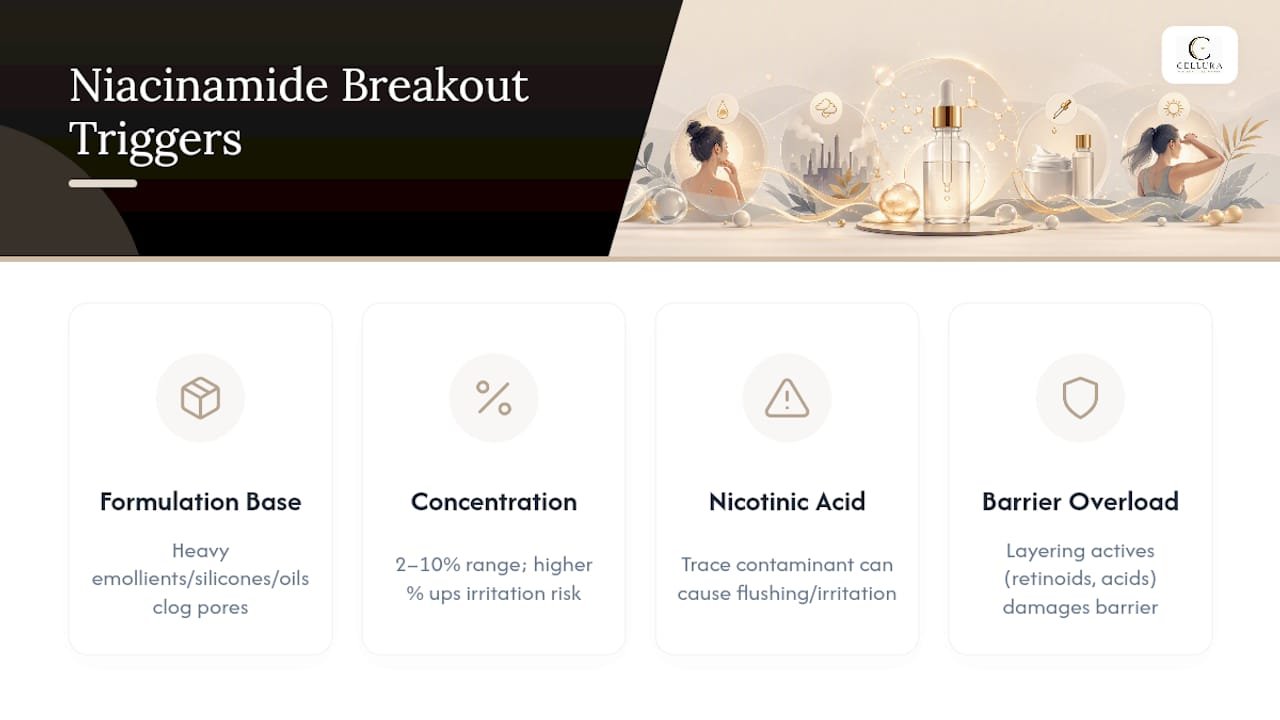
Formulation problems. A serum can list niacinamide on the label and still be built with heavy emollients, silicones, or comedogenic oils that clog pores independently of the active ingredient. If you break out after switching to a new niacinamide product, the base formula deserves as much suspicion as the niacinamide itself. Reading the full ingredient list, not just the marketing claim on the front, is worth the extra minute. Our guide to reading skincare ingredient labels walks through exactly what to flag.
Concentration sensitivity. Niacinamide isn’t dosed the same across every product. Formulas land anywhere between 2% and 10%, and higher concentrations raise the odds of redness, stinging, or breakout-like flares in sensitive skin.
Nicotinic acid contamination. Niacinamide and nicotinic acid are chemically related but behave very differently on skin. Nicotinic acid is known for triggering flushing and irritation, and the NIH Office of Dietary Supplements documents this distinction clearly. Cheaply manufactured serums sometimes carry trace contamination from the manufacturing process, and that contaminant, not the niacinamide, can be behind the burning sensation some users report.
Interaction and barrier overload. Layering niacinamide underneath or alongside retinoids, strong acids, or several other active ingredients at once puts real stress on the skin barrier. Once that barrier is compromised, almost anything applied on top can sting or trigger a reactive breakout.
What to Do If You Think Niacinamide Is Causing Breakouts
Stop stacking new variables before you try to diagnose anything. Here’s the sequence that actually gets you an answer.
- Pause and simplify. Drop every other new product first, and hold off on exfoliating acids, scrubs, or picking at anything. You need a clean signal, and a routine with five active ingredients running at once will never give you one.
- Patch test before reintroducing. Apply a small amount of the niacinamide product to your inner forearm or behind your ear once daily for three days. No reaction there is a reasonable, though not absolute, sign it’s safe to try on your face again.
- Reintroduce slowly and at a lower strength. Start with a 2 to 5% formula, applied every other day rather than twice daily, and give it a full two weeks before increasing frequency. Our daily niacinamide usage guide breaks this reintroduction schedule down step by step.
- Support the barrier while you wait it out. Ceramides, hyaluronic acid, and a gentle occlusive moisturizer help rebuild the barrier’s defenses and make skin less reactive to everything else in your routine.
- Escalate if things worsen. Severe swelling, a rash that spreads beyond the application area, blistering, or any systemic symptom like dizziness or difficulty breathing means you stop everything and see a dermatologist promptly, not after another two weeks of watching.
Pro Tip: If a product burns or stings within seconds of application, that’s not “purging kicking in.” That’s your skin telling you the formula isn’t right for you, and continuing to use it will only extend the irritation.
Most cases resolve once you strip the routine down and rebuild it slowly. According to DermNet NZ, topical niacinamide is generally well tolerated, with mild burning, itching, or redness affecting only a minority of users. If simplifying your routine and lowering concentration doesn’t resolve things within a few weeks, the product or the combination you’re using, rather than niacinamide as an ingredient class, is almost certainly the issue.
Safe Layering: What Not to Mix With Niacinamide
Niacinamide plays well with most other skincare ingredients, but a few combinations raise real risk of irritation, and it’s worth knowing which ones before you build a routine around them.
- Retinoids. Fine to layer with niacinamide, and niacinamide can even buffer some retinoid irritation, but introduce the retinoid gradually and expect that ingredient, not the niacinamide, to be the one causing any turnover-driven purging. Our niacinamide and retinol layering guide covers timing in detail.
- AHAs and BHAs. Salicylic acid pairs reasonably well with niacinamide when concentrations are moderate, though stacking a strong AHA exfoliant on top of both increases the odds of barrier stress. See our specific niacinamide and salicylic acid rules for safe sequencing.
- Vitamin C. Older formulations sometimes destabilized when niacinamide and vitamin C were combined, but most modern, well-formulated products handle this fine. If you’re using older or unstable formulas, apply them at separate times of day.
- Multiple acids at once. The real purging risk in most routines comes from retinoids and exfoliating acids, not niacinamide. If you’re breaking out and running three actives simultaneously, start by removing the acids and retinoid before blaming the niacinamide.
Wait at least 60 seconds between layered products so each has time to absorb, and introduce only one new active every two weeks. That pace feels slow, but it’s the only way to know which ingredient is responsible when something does go wrong.
How Long Reactions Actually Last
A true purge, on the rare occasion niacinamide is layered with an actual turnover-accelerating ingredient, generally resolves within one to six weeks as the skin cycle completes. Irritation-driven breakouts follow a different pattern: once you remove the trigger, whether that’s a heavy formula, too high a concentration, or a conflicting active, visible improvement usually shows up within one to two weeks.
Track these signs rather than relying on a general feeling of “better”:
- Fewer new pustules forming day to day
- Reduced redness around existing lesions
- Skin texture feeling smoother rather than bumpy or tight
- No new lesions appearing in previously unaffected areas
Hold to the same two to four week checkpoint mentioned earlier before deciding anything is a permanent incompatibility. Skin needs time to show its hand, but it doesn’t need indefinite patience either. If four weeks pass with zero improvement, that’s your answer, and it’s time to change the product, not the timeline.
The Beauvex Perspective: Formulation Transparency and Why It Matters Here
Beauvex LLC publishes exact ingredient concentrations and research references for every product, and that transparency exists for a reason directly relevant to this topic: most “niacinamide breakouts” trace back to formulation quality, not the molecule itself. When you can see the actual percentage of niacinamide, alongside supporting actives like tranexamic acid and alpha-arbutin, you’re not guessing whether you’re using a 2% product or a 10% one.
The Luminé Serum combines niacinamide with tranexamic acid and alpha-arbutin specifically to interrupt pigmentation at multiple stages, rather than leaning on a single high-strength active that raises irritation risk on its own. That multi-pathway approach is a deliberate formulation choice, not a marketing angle. Beauvex LLC’s own resources on safe layering, patch testing, and realistic result timelines exist to help readers manage exactly the kind of uncertainty this article addresses. Ingredient transparency doesn’t guarantee zero reactions for every skin type, but it does mean you’re never left wondering what concentration you actually applied to your face.
A Practical Take on Niacinamide Reactions
Stopping a product that’s irritating your skin isn’t overreacting. It’s the responsible move, and it’s the one most people hesitate to make because they’ve been told to “push through the purge.” Pushing through irritation, unlike pushing through an actual purge, tends to make things worse and delays the real fix by weeks.
Start low, go slow, and patch test before you reintroduce anything. That advice sounds basic, but it’s the difference between a manageable two-week adjustment and a month of unnecessary redness. If you’re evaluating a niacinamide product and want to skip the guesswork on concentration and formulation quality, Beauvex LLC’s ingredient breakdowns are built to answer exactly those questions upfront.
— Beauvex LLC
Choosing a Low-Irritation Niacinamide Serum
Formulation transparency is an important factor that can help distinguish niacinamide products that may be more suitable for sensitive or acne-prone skin. Some brightening serums combine niacinamide with tranexamic acid and alpha-arbutin at published, exact concentrations, targeting post-acne dark spots while aiming to maintain a non-comedogenic formulation that is low in heavy emollients potentially linked to breakout-like reactions.

When you’re comparing niacinamide products, four buying cues matter more than the marketing copy on the box. Check that the brand lists exact concentrations rather than vague terms like “infused with.” Look for supporting actives that address your actual concern, not just niacinamide alone padded with filler ingredients. Confirm the vehicle is labeled non-comedogenic if you’re acne-prone. And favor brands that publish research references you can actually verify, rather than taking efficacy claims on faith.
The Cellura Luminé Brightening Serum page lists its full formulation and concentration details, so you can see exactly what you’re applying before you buy. If you’re still narrowing down which actives suit your skin type, the tranexamic acid versus niacinamide comparison is a useful next stop.
Sources
- Niacin (Vitamin B3) – NIH/ODS (health professional fact sheet)
- PubMed reference on exfoliation/retinoid effects (SERP-cited review)
- Can Niacinamide Cause Purging? – Healthline
- Can Niacinamide Cause Acne? What Science Says – Nolla Health
- Nicotinamide – DermNet NZ