
For faster resurfacing and smoother texture, glycolic acid usually wins. For gentler exfoliation with lower risk of dark marks, mandelic acid usually wins. Sensitive skin and deeper skin tones do better starting with mandelic acid, while resilient, non-reactive skin can often handle glycolic acid’s stronger effects on fine lines and acne. Whichever you pick, daily broad-spectrum SPF 30+ is not optional.
TL;DR:
- Glycolic acid provides faster resurfacing and is more effective for textured skin and fine lines, but it increases the risk of irritation and dark spots if overused.
- Mandelic acid offers gentler exfoliation, making it suitable for sensitive skin, deeper skin tones, and those prone to dark hyperpigmentation.
- Molecular size and lipophilicity influence their skin penetration, with glycolic acid acting quickly and mandelic acid diffusing more slowly, reducing irritation.
- Sensitive or darker skin tones should start with mandelic acid, gradually move to glycolic acid once tolerated, and always protect with daily SPF 30+.
- Introducing any acid gradually, patch testing, and avoiding layering with other actives on the same night minimizes skin barrier disruption and irritation.
Table of Contents
- Mandelic Acid vs Glycolic Acid: Potency, Penetration, and Evidence
- Why They Act Differently: Molecular Size, pKa, and Pore Behavior
- Which Acid Fits Your Skin Type and Concern
- How to Introduce Either Acid Without Wrecking Your Barrier
- How Exfoliation and Brightening Actives Work Together
- A Practical Take on Choosing Between These Two Acids
- Where Cellura Fits Once Your Skin Tolerates Exfoliation
- Sources
- FAQ
Mandelic Acid vs Glycolic Acid: Potency, Penetration, and Evidence
Glycolic acid is the smallest common alpha hydroxy acid, with a molecular weight of about 76 daltons. Mandelic acid is roughly double that size, at about 152 daltons, because it carries an extra phenyl ring bolted onto its structure. Size determines speed here. Smaller molecules slip through the skin’s outer layer faster, which is exactly why glycolic acid resurfaces texture and fine lines quickly but also why it irritates more easily when overused.
That size gap shows up clearly in clinical trials. A randomized study of 120 acne patients found that a 10% glycolic acid peel produced significantly better acne improvement than a 10% mandelic acid peel over six weeks. At matched concentrations, glycolic acid simply exfoliates more aggressively. But potency and tolerability are different axes, and other comparative literature tells a more nuanced story. Reviews comparing glycolic acid peels against salicylic-mandelic combinations report similar efficacy on certain endpoints, with consistently better tolerability for the mandelic-containing regimens. In other words: glycolic acid often wins on raw exfoliation speed, mandelic acid often wins on comfort and consistency of use.
Format and concentration matter as much as the acid itself. Here’s how each typically shows up on shelves and in-office:
- Glycolic acid: Over-the-counter toners and serums run 5% to 10%; professional peels may use higher concentrations under supervision.
- Mandelic acid: Common in serums and pads at 5% to 10%, occasionally formulated at higher concentrations for in-office treatments targeting acne and mild pigmentation.
- Best use for glycolic acid: Texture refinement, sun damage, fine lines, and acne in skin that already tolerates exfoliating acids well.
- Best use for mandelic acid: Comedonal acne, early tolerance building, sensitive or reactive skin, and pigmentation concerns in deeper skin tones.
Neither acid is inherently “better.” They’re built for different jobs, and the right choice depends on how much irritation your skin barrier can absorb without staging a protest.
Why They Act Differently: Molecular Size, pKa, and Pore Behavior
The gap between these two acids isn’t just about size. It comes down to how much of each molecule exists in its active, unionized “free acid” form at a given pH, and how that form interacts with skin structures.
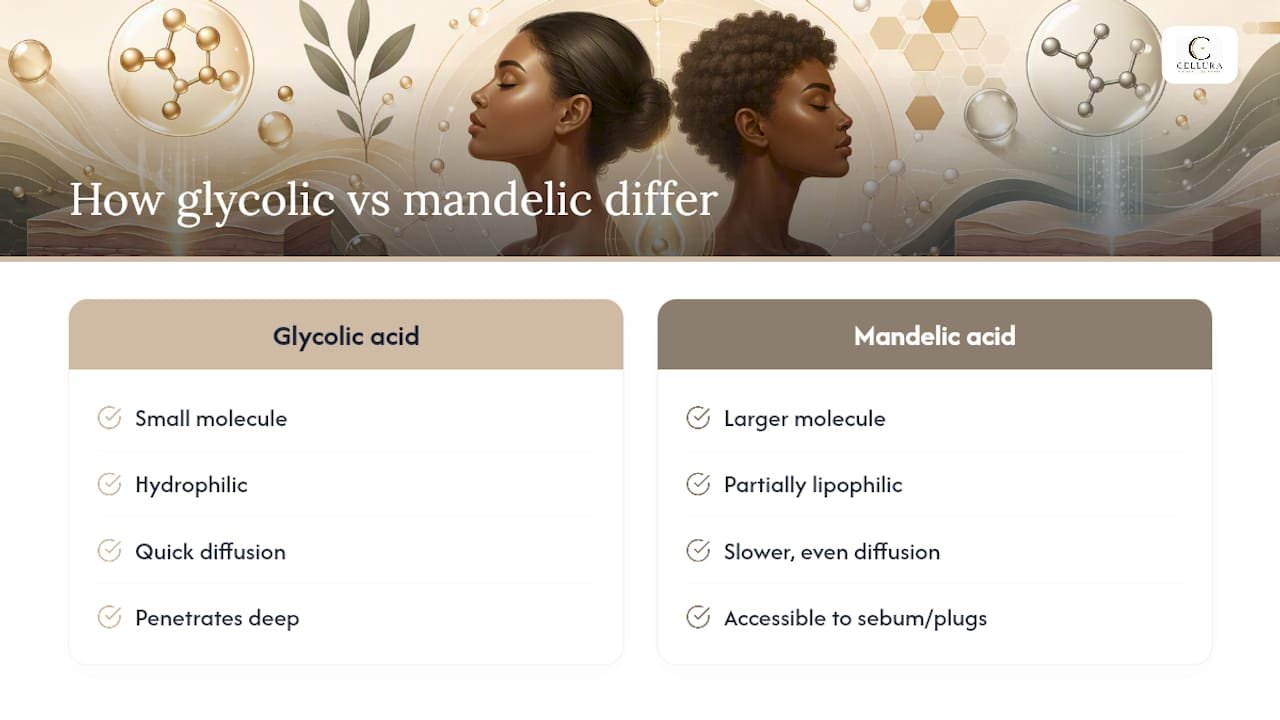
Glycolic acid’s small, water-loving structure lets it move quickly through the intercellular lipid layers of the stratum corneum. That speed translates into a stronger, faster keratolytic effect: it loosens the bonds between dead skin cells efficiently, which is why it resurfaces so effectively but also why it’s the acid most likely to trigger stinging, redness, or post-inflammatory hyperpigmentation (PIH) when introduced too fast.
Mandelic acid’s phenyl ring changes the equation. That aromatic ring makes the molecule partially lipophilic, meaning it has some affinity for oil rather than just water. Sebum-rich environments, like clogged pores, are naturally more accessible to a molecule that isn’t purely hydrophilic. This is part of why mandelic acid has a reputation as a useful option for comedonal and inflammatory acne, particularly for people who can’t tolerate benzoyl peroxide or salicylic acid.
The practical translation of “larger molecule, partial lipophilicity” is this: mandelic acid diffuses into skin more slowly and more evenly, which reduces the sudden irritation spike that triggers PIH in melanin-rich skin. Glycolic acid diffuses fast and deep, which is powerful for resurfacing but leaves less room for error.
Short-term research on mandelic acid also points to real pigment benefits, including reported reductions in melasma-related pigmentation measures in four-week interventions, though study sizes and designs vary enough that this should be read as a promising signal rather than a guarantee.
Which Acid Fits Your Skin Type and Concern
Your skin type and your primary concern should drive this decision more than marketing claims on a bottle. Here’s how the evidence maps out by category:
- Sensitive or reactive skin: Start with mandelic acid. Its slower penetration gives your barrier time to adapt instead of reacting.
- Oily or comedonal acne-prone skin: Mandelic acid is the safer starting point, especially if you’ve reacted badly to other exfoliants before. If your skin already tolerates acids well, glycolic acid can outperform it for stubborn acne, based on the 10% peel comparison trial.
- Photoaging, fine lines, and dullness: Glycolic acid tends to deliver more visible texture and tone improvement over time, provided your skin can handle the exfoliation load.
- Fitzpatrick skin types IV through VI: Begin with mandelic acid. The lower PIH risk matters more here than raw potency, since darker skin tones are more prone to lingering dark marks after irritation.
- Escalating from mandelic to glycolic: Once your skin tolerates mandelic acid two to three times weekly without redness or flaking, you can trial low-concentration glycolic acid, ideally under professional guidance for peels above 10%.
Active inflammatory acne, melasma, and recent isotretinoin use all call for extra caution. Melasma responds unpredictably to aggressive exfoliation and often needs a dedicated pigment-management approach rather than acid alone. Anyone who has used isotretinoin in the past six to twelve months should hold off on either acid until a dermatologist confirms the skin barrier has recovered.
Pro Tip: If you’re not sure which category you fall into, treat yourself as “sensitive” for the first two weeks regardless of your actual skin type. It costs you nothing but time, and it prevents the kind of irritation that turns into weeks of dark spots.
How to Introduce Either Acid Without Wrecking Your Barrier
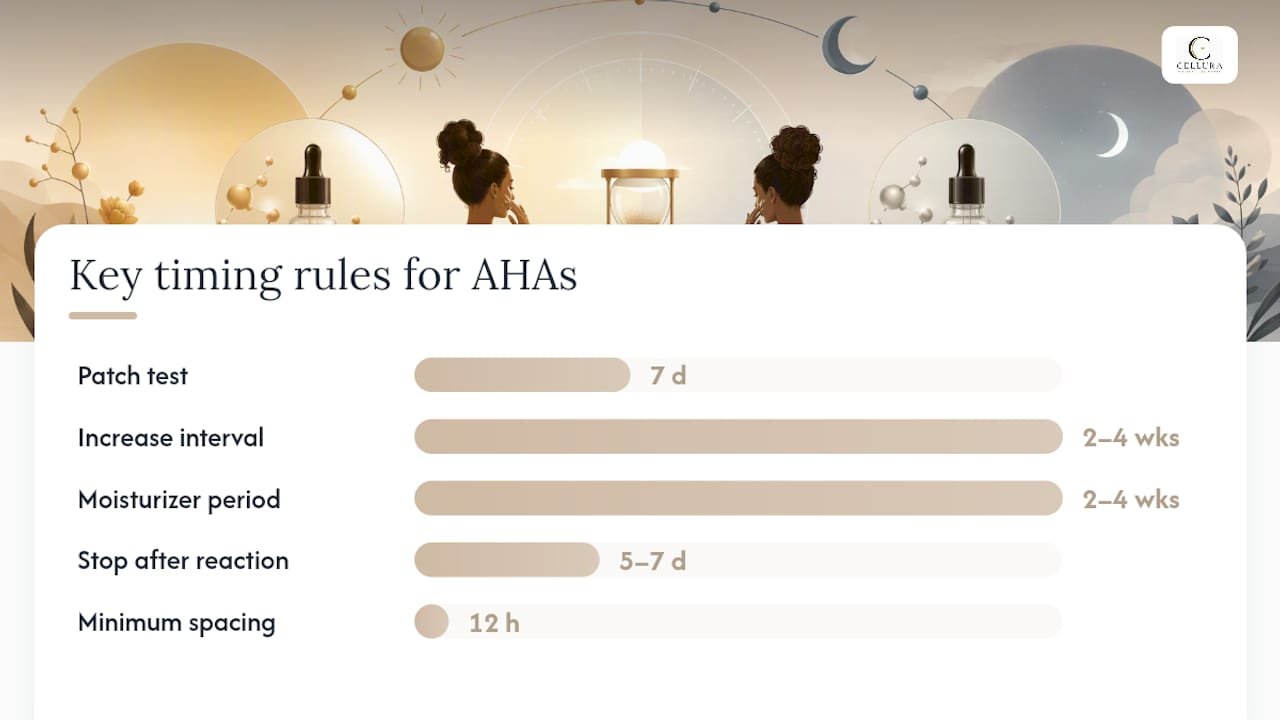
Dermatology guidance is consistent on this point: AHAs should be introduced gradually, not nightly from day one. Cleveland Clinic’s guidance on glycolic acid recommends starting at one to two applications per week and increasing frequency every two to four weeks while watching for barrier compromise. Jumping straight to nightly use is the single most common mistake people make with either acid, and it’s the fastest route to a compromised barrier.
A few rules keep the process safe:
- Start with the lowest concentration available (5% for either acid) before moving up.
- Never layer an AHA with retinoids, other AHAs/BHAs, or prescription actives on the same night. Alternate nights or space applications by at least 12 hours.
- Pair acid use with a barrier-supporting moisturizer, especially in the first two to four weeks.
- Patch test on the inner forearm for seven days before applying to your face.
- Apply broad-spectrum SPF 30+ every morning, without exception, and reapply if you’re outdoors for extended periods.
Sun protection isn’t a footnote here. Using a soothing broad-spectrum SPF daily is essential when incorporating AHAs like glycolic or mandelic acid into your routine. AHAs increase photosensitivity, and skipping SPF while using either acid can undo months of progress on pigmentation by creating new dark marks faster than the acid fades old ones. Consumer safety summaries on glycolic acid list increased sun sensitivity as one of its most common and consistently reported side effects.
Watch for signs of over-exfoliation: persistent redness, tightness, visible flaking, or a burning sensation that lingers after rinsing. If any of these show up, stop the acid for five to seven days, simplify your routine to a gentle cleanser and moisturizer, and reintroduce at a lower frequency once your skin calms down.
How Exfoliation and Brightening Actives Work Together
Choosing the right acid solves half the pigmentation equation. The other half is what you put on skin once tolerance is established. A three-step ritual: cleanse, treat, support, with transparent ingredient concentrations published for products to avoid guessing what is being applied.
Once your skin tolerates an AHA two to three times weekly without irritation, layering in targeted brightening actives can accelerate pigment fading rather than just preventing new marks. Ingredients like niacinamide, tranexamic acid, and alpha-arbutin work on different points of the pigmentation pathway than exfoliation does. That’s a meaningful distinction:
- Exfoliating acids remove pigmented dead skin cells and support faster cell turnover.
- Brightening actives interrupt melanin production itself, which addresses pigment that hasn’t surfaced yet.
- Using both in sequence, rather than one or the other, tends to outperform either approach alone for stubborn post-acne dark spots.
A Practical Take on Choosing Between These Two Acids
Most people overthink this choice. Three rules of thumb: mandelic acid for sensitive or deeper skin tones and comedonal acne, glycolic acid for resilient skin chasing texture and fine lines, and SPF every single day regardless of which one you pick.
Patch test before committing to either, and if your pigmentation or acne is stubborn or widespread, loop in a dermatologist before running an aggressive peeling schedule on your own. Questions about your specific skin situation are worth asking before you buy anything.
— Beauvex LLC
Where Cellura Fits Once Your Skin Tolerates Exfoliation
Beauvex LLC’s Cellura line is built for the phase right after tolerance to an AHA is established, when your barrier can handle daily care without extra irritation. The Cellura ClearMark Bar combines salicylic, azelaic, and kojic acid in a cleanse step that clears pore congestion without stripping skin already adjusting to mandelic or glycolic acid.

The Cellura Luminé Brightening Serum picks up where exfoliation leaves off, pairing niacinamide, tranexamic acid, kojic acid, and alpha-arbutin to target the pigment pathway itself rather than just surface cell turnover. Every concentration is published on the product page, so you can see exactly what you’re applying instead of relying on vague claims. If you’re rebuilding a routine around an AHA, start with a patch test, confirm your skin tolerates it two to three times a week, then add the ClearMark Bar and Luminé Serum to round out your cleanse, treat, and support ritual.
Sources
- COMPARING EFFICACY OF 10% GLYCOLIC ACID VERSUS 10% MANDELIC ACID PEEL IN TREATMENT OF ACNE | Pakistan Armed Forces Medical Journal
- Mandelic acid – Healthline
- Glycolic acid (PubChem compound 757)
- Glycolic acid peels versus salicylic-mandelic … (PubMed indexed article)
FAQ
What Should You Not Mix With Mandelic Acid?
Avoid layering mandelic acid with retinoids, other AHAs or BHAs, or prescription-strength actives on the same night, since stacking exfoliants raises irritation risk without adding benefit. Alternate nights instead.
Can I Use Glycolic Acid and Mandelic Acid Together?
You can alternate them on different nights once your skin tolerates each individually, but applying both in the same session usually overwhelms the barrier. Most people get better results introducing one acid fully before adding the other.
What Does Mandelic Acid Purging Look Like?
True purging shows up as small breakouts in areas you already break out, clearing faster than usual because cell turnover has sped up. It typically resolves within two to four weeks; anything beyond that or accompanied by burning is irritation, not purging.
What Happens If I Use Mandelic Acid Every Day?
Daily use can work for some tolerant skin once you’ve built up gradually, but starting there risks redness, dryness, and flaking. Most dermatology guidance recommends beginning at one to two times weekly and increasing slowly over several weeks.
Is Mandelic Acid Better Than Glycolic Acid for Dark Skin Tones?
Mandelic acid is generally the safer starting point for Fitzpatrick IV through VI skin because its slower penetration lowers the risk of post-inflammatory hyperpigmentation. Glycolic acid can still be used in darker skin tones, but usually with lower concentrations and more gradual introduction.