Choose Aquaphor when your skin needs active repair, extra hydration, or eczema-level dryness, since its humectants pull in moisture on top of a protective seal. Choose Vaseline when you want the plainest, least reactive barrier for sensitive skin or straightforward wound protection. The core split comes down to ingredients: Aquaphor blends petrolatum with humectants and emollients, while Vaseline is 100% petrolatum with nothing else. Watch for lanolin sensitivity in Aquaphor, and never apply either to an unclean open wound.
TL;DR:
- Vaseline is better suited for simple wound protection and large, sensitive areas due to its pure, non-reactive petroleum jelly formula.
- Aquaphor offers extra hydration and faster healing for dry skin or eczema because it contains humectants and emollients alongside petrolatum.
- Both products are safe for most uses but should be avoided on unclean wounds, in nostrils, or if you have lanolin allergies, due to infection risk or allergic reactions.
- Applying occlusives over active actives like acids or retinoids can increase irritation, so they should be used carefully and not immediately after treatments.
- Neither Aquaphor nor Vaseline lightens dark spots or treats hyperpigmentation directly; targeted ingredients are necessary for addressing discoloration.
Table of Contents
- Aquaphor vs. Vaseline: What’s Actually in Each Jar
- Which One Should You Use for Lips, Cuticles, Heels, or Slugging?
- When Should You Avoid Aquaphor or Vaseline?
- What Do Dermatologists Actually Recommend?
- How Barrier Ointments Fit Into a Complete Skincare Routine
- Our Take: Stop Asking Which One Is “Better”
- What to Use When Dark Spots, Not Dryness, Are the Problem
- Sources
Aquaphor vs. Vaseline: What’s Actually in Each Jar
The ingredient list is where the real difference lives, not the marketing.
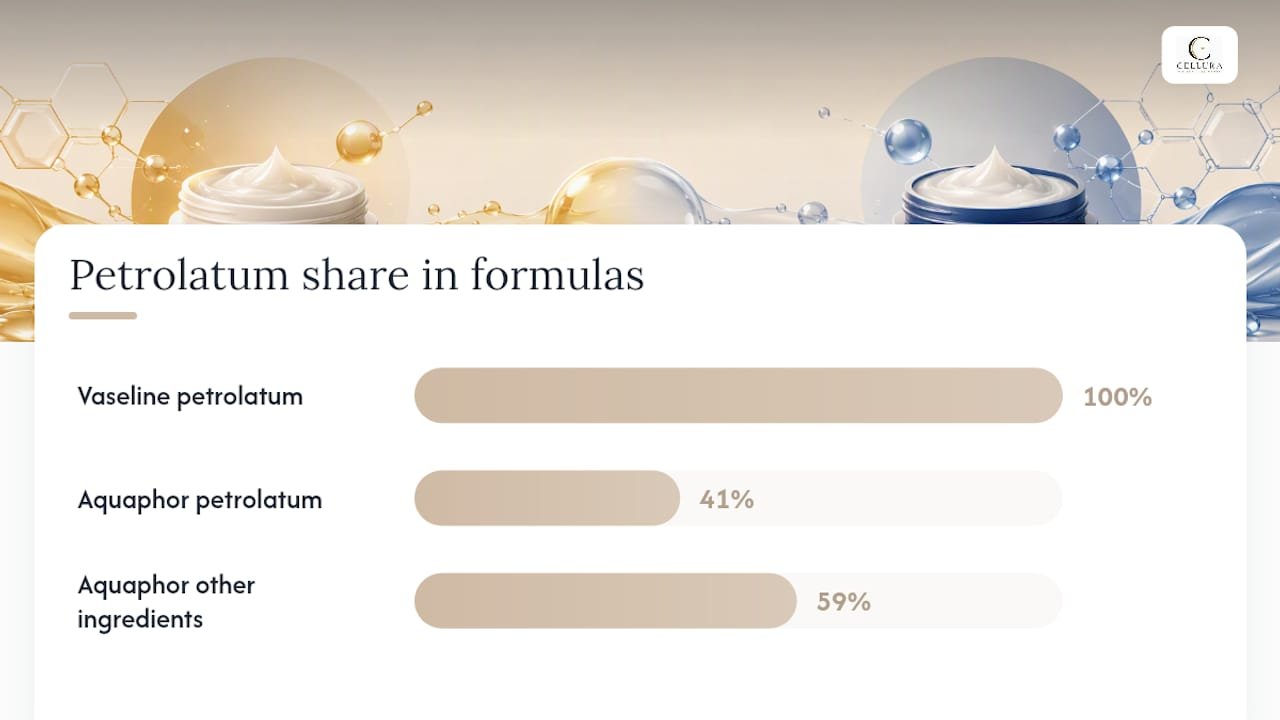
Vaseline Healing Jelly is 100% white petrolatum, full stop. It works as a pure occlusive: a physical film that sits on top of skin and blocks water from escaping. That’s the entire mechanism. No added fragrance, no active hydrators, nothing for your skin to react to beyond the petrolatum itself.
Aquaphor Healing Ointment is roughly 41% petrolatum, with the rest made up of mineral oil, ceresin, glycerin, lanolin alcohol, panthenol, and bisabolol. The DailyMed product label confirms petrolatum as the active ingredient, with the supporting cast doing distinct jobs:
- Glycerin is a humectant. It draws water into the skin’s surface rather than just trapping what’s already there.
- Panthenol (provitamin B5) soothes and supports the skin barrier.
- Lanolin alcohol adds emollient softness, but it’s also the ingredient behind most allergy concerns.
- Bisabolol has calming, anti-irritant properties.
- Ceresin and mineral oil thicken the texture and reinforce the occlusive seal.
That combination is why Aquaphor tends to outperform Vaseline as a moisturizer for genuinely dry skin: it’s occlusive plus humectant, not just occlusive. The tradeoff is texture. Aquaphor feels tackier and slightly grittier going on, while Vaseline glides on smoother and feels less “medical.” Neither breathes particularly well, since both work by blocking airflow and moisture loss at the skin’s surface. That’s the entire point of an occlusive.
Which One Should You Use for Lips, Cuticles, Heels, or Slugging?
Match the product to the job, not to habit.
- Chapped lips or cracked cuticles. Aquaphor’s glycerin and panthenol give these thin-skinned, fast-turnover areas extra hydration on top of the seal. Apply a pea-sized amount before bed and let it absorb overnight.
- Cracked heels or rough elbows. Either works, but Aquaphor’s emollient blend softens thickened skin faster. Apply after a shower while skin is still slightly damp.
- Eczema or chronic dry patches. Aquaphor is the better fit. The humectant load helps compensate for a compromised skin barrier that can’t hold moisture on its own.
- Minor cuts, scrapes, or post-procedure care. Vaseline is often preferred here specifically because it has fewer ingredients, which lowers irritation risk on healing tissue.
- Slugging (the overnight moisture-lock trend). Both work as the final “slug” layer over a full routine, but Vaseline is the more forgiving option for sensitive or acne-prone skin since it carries no added fragrances or lanolin derivatives.
For large areas like arms or legs, Vaseline’s smoother glide spreads faster with less product. For small, targeted spots, Aquaphor’s thicker texture stays put better.
Pro Tip: Layer occlusives over a hydrating serum or humectant, not instead of one. Slapping straight petrolatum onto bare, dry skin traps whatever moisture is already there. It won’t add any. One caution: if you’re acne-prone, heavy occlusives on the chest, back, or forehead can occasionally contribute to clogged pores in people already prone to breakouts.
When Should You Avoid Aquaphor or Vaseline?
Both ointments are safe for most people, but there are real exceptions worth knowing before you reach for either.
- Unclean open wounds. Sealing dirt or bacteria under an occlusive layer raises infection risk. Clean the wound first, and see a clinician for anything deep, gaping, or not healing normally, per American Academy of Dermatology guidance.
- Lanolin allergy. Lanolin is a documented contact allergen, and it’s present in Aquaphor’s lanolin alcohol. If you develop redness, itching, or a rash where you applied it, switch to Vaseline, which contains none.
- Inside the nose, especially in young children. Petrolatum-based products aren’t meant for internal application. There’s a small but real aspiration risk if used inside a child’s nostrils.
- Active acne breakouts. Heavy occlusion over inflamed acne can trap oil and bacteria against the skin. Use sparingly, and only on non-active areas.
Before trying either product on a new or sensitive area, patch-test it. Apply a small amount to your inner forearm, wait 24 to 48 hours, and watch for redness or itching. Beauvex LLC’s patch-test method walks through the full process if you want a more thorough approach, and pairing it with a fragrance-free cleanser beforehand reduces the odds of a false-positive reaction.
What Do Dermatologists Actually Recommend?
Clinicians generally treat both products as staples, and the choice usually comes down to the wound, not personal preference.
Dermatology guidance consistently points to petrolatum-based ointments as a way to keep wounds moist and support barrier repair, which speeds healing compared to letting a wound dry out and scab. Some clinical observations note that Vaseline may cause less redness on certain post-surgical sites than Aquaphor, likely because fewer added ingredients means fewer chances for irritation on tissue that’s actively healing.
Clinicians tend to reach for Vaseline right after a procedure for its minimal-ingredient safety profile, then switch to Aquaphor later if the skin stays dry or flaky once the initial healing has settled.
A short aftercare checklist that covers most situations:
- Clean the area gently before applying anything.
- Apply a thin layer, not a thick coat. More product doesn’t speed healing.
- Reapply once or twice daily, or as your clinician directs post-procedure.
- Stop and consult a professional if you see increasing redness, swelling, warmth, or discharge.
How Barrier Ointments Fit Into a Complete Skincare Routine
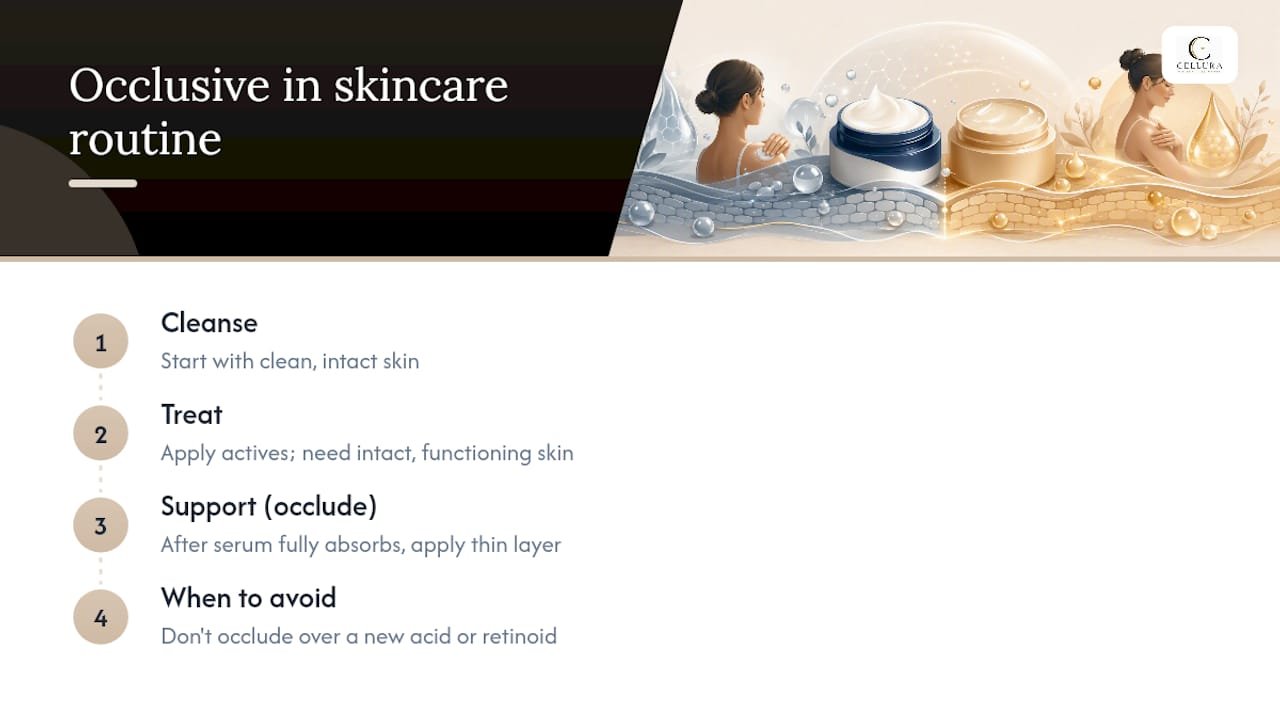
An occlusive is a finishing step, not a treatment on its own, and that’s exactly where it earns its place in a three-step approach: cleanse, treat, then support the barrier.
Actives like niacinamide, tranexamic acid, and alpha-arbutin need intact, functioning skin to work well. A barrier that’s compromised from over-exfoliation or dryness absorbs actives unevenly and reacts faster to irritation. A thin occlusive layer applied after a treatment serum has fully absorbed can lock in that treatment overnight and calm any transient dryness the actives cause.
The practical rule: never occlude immediately over a strong exfoliating acid or retinoid on the same night you’re first testing it, since trapping an active against skin intensifies its effect and its irritation potential. Once your skin has adjusted, a light barrier layer over treated areas, not the whole face, works best.
Our Take: Stop Asking Which One Is “Better”
The “Aquaphor vs. Vaseline” framing sets up a competition that doesn’t reflect how either product actually works. They’re not rivals fighting for the same job. They’re tools with different specs, and the mistake most people make is picking one and using it everywhere.
The more useful question is what job you’re hiring the product for. A cracked heel and a fresh post-procedure incision have nothing in common, and the ingredient lists reflect that. Aquaphor’s humectants are an asset on chronically dry skin and a liability on healing tissue that doesn’t need extra ingredients to react to. Vaseline’s simplicity is a strength for wound care and a limitation if your skin is dehydrated rather than just unprotected.
Where this article’s research actually pushes back on conventional advice is here: an occlusive is not a treatment, and it shouldn’t be judged like one. Its job is to seal in whatever you put underneath it. Get the layer underneath right first, whether that’s a humectant, a brightening active, or nothing at all if the goal is simple wound protection.
— Beauvex LLC
What to Use When Dark Spots, Not Dryness, Are the Problem
Neither Aquaphor nor Vaseline fades hyperpigmentation. That’s not their job, and no amount of occlusion will touch a dark spot left over from old acne.
If post-acne discoloration is what you’re actually trying to solve, that calls for a different category of product entirely: targeted actives that interrupt pigment production. The Cellura Luminé Brightening Serum combines niacinamide, tranexamic acid, and alpha-arbutin to work on discoloration at multiple stages of the pigmentation process, with concentrations listed transparently on the product page rather than buried in vague marketing language.

The two categories actually pair well. Apply the serum to clean, dry skin and give it a few minutes to absorb fully, then follow with a thin barrier layer on any spots that feel tight or flaky, especially in colder months. That sequencing protects the treatment underneath without diluting it. If you’re not sure where to start with layering actives and barrier support together, Beauvex LLC’s guide on fading dark spots after acne walks through a realistic timeline for what to expect and when.
Sources
For readers who want to verify any of the ingredient or safety claims above, these are the strongest primary sources used throughout this comparison:
- Aquaphor vs. Vaseline: Ingredients, Benefits, and Risks
- Aquaphor Healing ointment — DailyMed
- Vaseline® Healing Jelly Original | Vaseline®
- American Academy of Dermatology — petroleum jelly guidance