
Topical tranexamic acid at 2% to 5% concentrations fades post-acne hyperpigmentation and melasma-type spots for most people who use it consistently, with measurable change typically showing up between 8 and 12 weeks. It tends to be gentler on skin than some stronger depigmenting agents during that early adjustment period. This article covers over-the-counter topical formulations only, not oral or prescription tranexamic acid, so if a dermatologist has already put you on a pill, the safety section further down still applies to you, but the routine advice does not.
TL;DR:
- Topical tranexamic acid works by blocking inflammatory pathways, mainly affecting new pigment production rather than removing existing spots.
- Clinical trials show comparable efficacy to hydroquinone with fewer side effects, with noticeable results usually emerging after 8 to 12 weeks of consistent use.
- Applying a serum twice daily with sun protection is crucial, and layering supportive ingredients like niacinamide can enhance tolerability and penetration.
- Its safety profile remains favorable at 2% to 5% concentrations, but caution is advised during pregnancy, breastfeeding, or for those with clotting disorder risks.
- Oral tranexamic acid offers stronger effects but requires medical supervision due to systemic risks, making topical use ideal for localized, post-acne hyperpigmentation.
Table of Contents
- How Topical Tranexamic Acid Fades Dark Spots
- What the Clinical Research Actually Shows
- What Results Actually Look Like Over Time
- Building a Daily Routine Around Tranexamic Acid
- Is Topical Tranexamic Acid Safe to Use Long Term?
- How Beauvex’s Ritual Puts This Research into Practice
- Oral Tranexamic Acid: Dosage, Efficacy, and What It Involves
- Oral vs. Topical Tranexamic Acid: Which Fits Your Situation
- Who Should Avoid Oral Tranexamic Acid
- Monitoring Side Effects During Oral Treatment
- When Topical TXA Makes Sense, and When It Doesn’t
- Ready to Start Your Tranexamic Acid Routine?
- Primary Research Behind This Guide
- Sources
- FAQ
How Topical Tranexamic Acid Fades Dark Spots
Tranexamic acid doesn’t bleach skin the way some lightening agents claim to. It works by blocking a specific chain reaction inside the skin before pigment ever forms.
Melanocytes, the cells that produce pigment, get switched into overdrive by inflammatory signals released after acne breakouts, sun exposure, or hormonal shifts. Tranexamic acid interrupts that process by inhibiting the conversion of plasminogen to plasmin in keratinocytes, which cuts off downstream inflammatory and vascular messengers, including prostaglandins and VEGF, that would otherwise activate melanocytes and trigger new melanin production, according to a mechanistic review of tranexamic acid’s role in hyperpigmentation.
A few things follow from that mechanism:
- It works upstream, meaning it slows new pigment production rather than stripping away pigment already sitting in the skin.
- Because it targets vascular and inflammatory triggers, it tends to help most when lingering redness accompanies the dark spots, a common combination after inflamed acne lesions.
- Results build gradually as older pigment clears through normal skin turnover while new pigment formation slows down.
That’s also why patience matters more with tranexamic acid than with an exfoliating acid that gives you visible peeling in days.
What the Clinical Research Actually Shows
The evidence for topical tranexamic acid is stronger than most over-the-counter actives get, and it comes from head-to-head comparisons against established treatments, not just brand claims.
A 2023 randomized trial comparing 5% tranexamic acid with 20% azelaic acid found comparable improvement in post-acne hyperpigmentation between the two, with tranexamic acid showing an edge in early tolerability. A separate randomized comparison against 3% hydroquinone reported similar efficacy at 12 weeks, but with significantly fewer adverse effects and higher patient satisfaction in the tranexamic acid group. That combination, matching a gold-standard lightening agent while irritating fewer people, is why tranexamic acid has earned its place in serious formulations.
By the numbers: trials pairing tranexamic acid with niacinamide have shown statistically significant reductions in spot intensity and size within an 8-week window, using a 3% TXA plus 5% niacinamide formulation with high user tolerability.
Zoom out to the broader research, though, and the picture gets more complicated. A meta-analysis comparing delivery routes found oral tranexamic acid often produces stronger, more consistent effect sizes than topical application, while topical studies remain promising but inconsistent across trials. Part of that comes down to:
- Wide variation in vehicle formulation, from simple aqueous serums to liposomal delivery systems.
- Small sample sizes across most published trials.
- Inconsistent scoring systems for measuring pigment change, which makes cross-study comparison messy.
None of that undermines topical TXA as a strategy. It does mean the “best” concentration and vehicle combination is still being refined, and formulations that address delivery tend to outperform ones that don’t.
What Results Actually Look Like Over Time
Set your expectations around weeks, not days. Here’s roughly how the timeline unfolds based on trial data:
- Weeks 1 to 4: Skin often looks calmer, with reduced redness around older acne marks, but visible color change in the spots themselves is usually minimal.
- Weeks 4 to 8: Early fading typically becomes noticeable, especially in lighter, more recent post-inflammatory marks.
- Weeks 8 to 12: Most trials report their clearest, statistically measurable improvement in spot intensity and size in this window, matching the 8 to 12 week endpoints used across the majority of published studies.
- Beyond 12 weeks: Continued use maintains gains and helps prevent new spots from darkening, though complete disappearance without any combination therapy is uncommon.
Tranexamic acid mostly stops new pigment from forming while your skin’s natural turnover clears out what’s already there. That means consistent daily sunscreen isn’t optional. Skip it and UV exposure will keep reactivating the same pigment pathway you’re trying to shut down. For a deeper look at pairing sun protection with active treatment, see this guide on fading melasma with the right routine.
Building a Daily Routine Around Tranexamic Acid
Getting results from topical tranexamic acid has as much to do with the routine around it as the ingredient itself.
Apply your tranexamic acid serum twice daily to clean, dry skin. In the morning, always follow with a broad-spectrum SPF 30 or higher; skipping this step is the single most common reason people don’t see results. Stick with it daily for at least 8 to 12 weeks before judging whether it’s working, since that matches the timeline used in the clinical trials showing measurable change.
A few things make the routine work better:
- Pairing ingredients matters. Niacinamide shows up alongside tranexamic acid in several trial formulations and appears to support tolerability and delivery, and vitamin C is another common pairing for readers wanting an added antioxidant boost. For a closer look at how these actives interact, this comparison of tranexamic acid and niacinamide breaks down what each ingredient actually contributes.
- Barrier support isn’t optional. Ingredients like squalane and copper peptides help prevent the secondary inflammation that can blunt an active ingredient’s benefit, particularly if your skin is already reactive from acne treatment.
- Formulation determines how well the active penetrates. Vehicles built with liposomal carriers or low-molecular-weight hyaluronic acid tend to improve delivery into the skin compared to a basic water-based serum.
- Layering order affects absorption. If you’re not sure where an active like this fits into a multi-step routine, this breakdown of skincare application order removes the guesswork.
Pro Tip: Run a 7-day patch test on your inner forearm before applying any new tranexamic acid serum to your face. Stop immediately if you notice persistent stinging, blistering, or swelling rather than the mild, brief tingling that’s common with first use.
Is Topical Tranexamic Acid Safe to Use Long Term?
Topical tranexamic acid in the 2% to 5% range shows low systemic absorption in trials, and when problems do occur, they’re almost always mild and localized rather than body-wide.
The tolerability data is genuinely reassuring: the randomized comparison against hydroquinone found significantly fewer adverse effects in the tranexamic acid group, and a systematic review of delivery methods found topical and intradermal routes favorable for safety compared to other delivery methods.
That safety profile changes considerably with oral tranexamic acid, which carries documented systemic risks including gastrointestinal upset, menstrual cycle changes, and thrombotic concerns serious enough that it requires medical supervision. Those risks belong to a pill taken systemically, not a serum applied to skin, and they sit outside what this article covers.
Still, a few precautions apply to topical use:
- Talk to a healthcare provider before starting if you’re pregnant, breastfeeding, or have a personal or family history of blood clotting disorders, since caution is warranted even with minimal systemic absorption.
- Discontinue use and seek medical attention if you experience a severe reaction like swelling, blistering, or difficulty breathing.
- Mild, temporary tingling on application is common and not usually a reason to stop.
How Beauvex’s Ritual Puts This Research into Practice
A three-step ritual—cleanse, treat, protect—follows the same sequence clinical protocols recommend: prep the skin, apply an evidence-backed active consistently, then reinforce the barrier so irritation doesn’t undercut results.
A serum combining tranexamic acid with niacinamide and alpha-arbutin takes a multi-target approach that mirrors the ingredient pairings favored in several of the trials cited above for improving both delivery and tolerability. Exact ingredient concentrations and related research published with formulas help avoid guessing whether a product is dosed meaningfully or just listed for marketing.
A practical starting routine looks like this: cleanse with the Cellura ClearMark Bar to prep skin without stripping it, apply Luminé Serum twice daily, and finish with a barrier balm at night and sunscreen every morning. Patch-test first, as with any new active. For more on how tranexamic acid stacks up against other brightening ingredients in this kind of layered routine, see this comparison of tranexamic acid and niacinamide.
Oral Tranexamic Acid: Dosage, Efficacy, and What It Involves
Oral tranexamic acid is a separate treatment path from anything covered above, one that involves taking the medication systemically rather than applying it to skin, and it typically requires a prescription and direct physician oversight.
Dosing protocols used in clinical settings generally involve low, divided daily doses taken over several months, with physicians monitoring response and adjusting duration based on how pigmentation responds. Efficacy data for oral tranexamic acid tends to show stronger, more consistent effect sizes than topical application in comparative research, which is part of why it remains a tool dermatologists reach for when topical options alone haven’t delivered enough change.
That stronger effect comes with a different risk profile. Because the medication works systemically rather than staying localized to skin, it carries considerations around clotting risk that don’t apply to a topical serum. This is exactly why oral tranexamic acid sits under medical supervision rather than on an open shelf, and why this article focuses on the topical route: it’s the option available without a prescription and appropriate for at-home use on post-acne marks. If your pigmentation is severe, widespread, or unresponsive to topical treatment, that’s a conversation to have with a dermatologist rather than something to self-manage.
Oral vs. Topical Tranexamic Acid: Which Fits Your Situation
The two routes aren’t interchangeable, and the right choice depends heavily on how severe and widespread the pigmentation is.
Topical tranexamic acid fits people managing focal, post-acne dark spots without a prescription, using a well-tolerated OTC product they control directly. It requires patience, real consistency over 8 to 12 weeks, and diligent sun protection, but it comes with a favorable safety profile at 2% to 5% concentrations. It won’t match the effect size of the oral route in head-to-head comparisons, but it also doesn’t carry systemic risk.
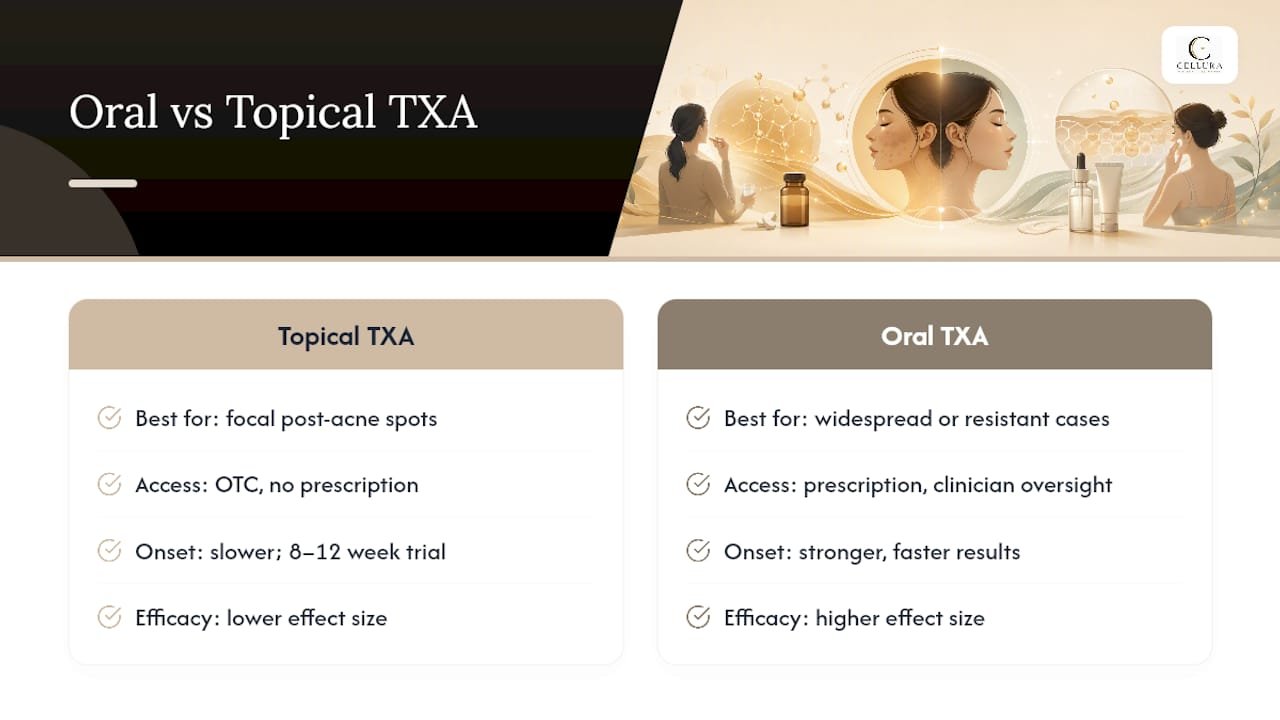
Oral tranexamic acid tends to produce stronger, faster results according to comparative research, which is why dermatologists often reserve it for widespread or treatment-resistant pigmentation. That strength comes bundled with systemic risk, required medical monitoring, and a prescription requirement that topical treatment simply doesn’t involve.
For most readers dealing with a handful of stubborn post-acne marks rather than diffuse, hormonally-driven melasma covering large areas of the face, the topical route offers a reasonable place to start. It’s lower risk, requires no prescription, and the 8-week to 12-week trial data shows it can deliver real, measurable change on its own.
Who Should Avoid Oral Tranexamic Acid
Oral tranexamic acid isn’t appropriate for everyone, and the contraindications here are more serious than anything associated with the topical route.
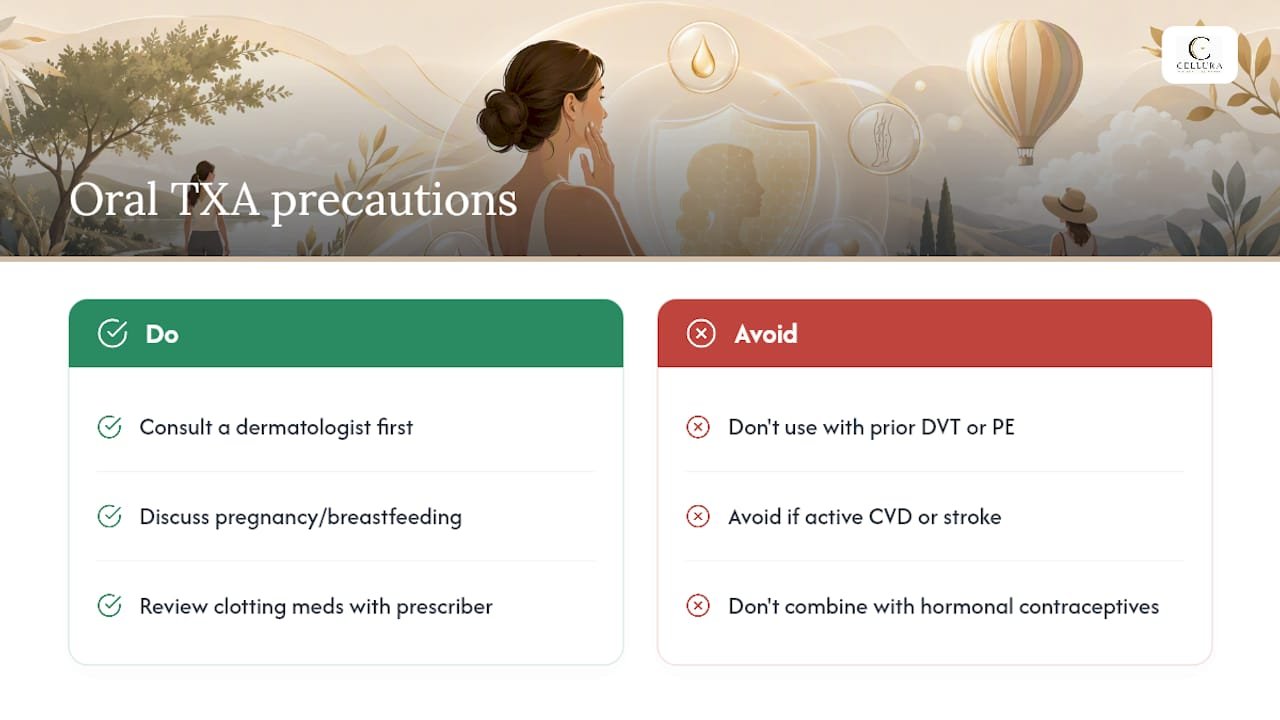
Because the drug affects clotting mechanisms throughout the body, it’s generally avoided in people with a personal or family history of thromboembolic events, including deep vein thrombosis or pulmonary embolism. It also requires caution in anyone with active cardiovascular disease, a history of stroke, or conditions that already elevate clotting risk.
Pregnancy and breastfeeding require a direct conversation with a physician before considering oral treatment, given the systemic nature of the medication. People taking hormonal birth control or other medications that influence clotting factors need their prescriber to weigh that interaction carefully, since combining clot-risk factors compounds the concern rather than simply adding to it.
None of these contraindications apply in the same way to topical tranexamic acid used on skin, precisely because systemic absorption at 2% to 5% concentrations remains low. That’s the core distinction worth remembering: the ingredient is the same, but the risk calculus changes entirely once it’s swallowed rather than applied. Anyone with these risk factors who is considering the oral route should be doing so under a dermatologist’s direct supervision, not through self-directed use of any kind.
Monitoring Side Effects During Oral Treatment
Patients on oral tranexamic acid for melasma are typically monitored by their prescribing physician throughout the course of treatment, precisely because the side effect profile extends beyond the skin.
Commonly reported side effects include gastrointestinal upset, such as nausea or stomach discomfort, along with menstrual cycle changes in women taking the medication. These tend to be the more frequent, lower-severity effects that physicians watch for during routine follow-up.
The more serious concern is thrombotic risk, given tranexamic acid’s mechanism of reducing clot breakdown throughout the body. Physicians typically screen for personal and family clotting history before starting treatment and remain alert to symptoms like leg swelling, chest pain, or sudden shortness of breath during the treatment course, any of which would warrant immediate medical attention.
This level of monitoring is a core part of why oral tranexamic acid remains a prescription-only, physician-supervised treatment rather than something available for self-directed use. It’s also the clearest line separating it from the topical formulations this article focuses on, where the safety profile allows for consistent at-home use without that same monitoring burden.
When Topical TXA Makes Sense, and When It Doesn’t
Topical tranexamic acid is a sensible first move for focal post-acne marks, sensitive skin, or if a stronger depigmenting agent has already irritated you without giving you the payoff.
It’s not the right tool for everything, though. If pigmentation is widespread, appears deep within the skin rather than surface level, seems tied to hormonal shifts, or simply hasn’t budged after three months of consistent, correct use, that’s the point to bring in a dermatologist rather than keep troubleshooting alone.
— Beauvex LLC
Ready to Start Your Tranexamic Acid Routine?
Prescription routes and in-office treatments exist for melasma, but they come with appointments, cost, and, in the case of oral tranexamic acid, real medical oversight. If you’re dealing with post-acne marks rather than severe, treatment-resistant pigmentation, an OTC topical routine gives you a lower-risk starting point you control entirely yourself.

The Cellura Luminé Brightening Serum pairs tranexamic acid with niacinamide and alpha-arbutin to work on pigmentation from multiple angles at once, and Beauvex LLC lists the exact concentrations used rather than hiding behind vague ingredient panels. Prep skin with the Cellura ClearMark Bar before applying serum, and review the research references on each product page so you know what you’re putting on your skin and why. Before adding either to your routine, run a patch test, and commit to daily sunscreen since it’s what protects the progress you’re working toward. If you’re ready to build the full three-step ritual, you can browse the complete Luminé Serum listing and start with the cleanser and serum pairing today.
Primary Research Behind This Guide
- Sobhan et al., 2023: randomized trial comparing 5% tranexamic acid to 20% azelaic acid for post-acne marks.
- Mechanistic review, 2024: explains the anti-plasmin, anti-inflammatory pathway behind tranexamic acid.
- Systematic review, 2022: compares delivery routes for tranexamic acid in hyperpigmentation.
- Randomized trial, 2019: head-to-head comparison of tranexamic acid and hydroquinone.
- Cosmetics study, 2024: 8-week in-use test of a tranexamic acid and niacinamide formulation.
This article is general information, not a substitute for advice from a qualified doctor. Consult a qualified healthcare professional about your own circumstances before acting on anything here.
Sources
- Sobhan et al., randomized trial comparing 5% tranexamic acid and 20% azelaic acid (2023)
- Tranexamic acid for hyperpigmentation and telangiectatic disorders: mechanism and evidence (2024)
- Systematic review: efficacy and best mode of delivery for tranexamic acid in PIH (2022)
- Randomized trial comparing topical 5% TA and 3% hydroquinone showing similar efficacy with better tolerability in TA (2019)
- In-use dermatological test of cream and serum containing 3% TXA + 5% niacinamide (2024)
FAQ
Is Tranexamic Acid Good for Melasma-Type Dark Spots?
Yes, topical tranexamic acid at 2% to 5% has shown measurable improvement in post-acne pigmentation in randomized trials, typically within 8 to 12 weeks of consistent use.
How Does Topical Tranexamic Acid Compare to Hydroquinone?
A randomized trial found topical 5% tranexamic acid matched 3% hydroquinone in efficacy at 12 weeks while causing significantly fewer adverse effects.
How Long Does It Take to See Results From Tranexamic Acid?
Most trials report measurable pigment reduction between 8 and 12 weeks, with some earlier changes possible around week four to six for lighter, more recent marks.
Can I Use Tranexamic Acid With Niacinamide?
Yes, trial formulations frequently combine tranexamic acid with niacinamide, and an 8-week in-use test of a 3% TXA plus 5% niacinamide formula reported significant improvement with high tolerability.