Yes, the sun makes hyperpigmentation worse. Light tells your pigment cells to make more melanin, and cells that are already overactive, such as those in a post-acne mark or a patch of melasma, respond more strongly than the skin around them. Spots that would fade on their own stay dark, and faded spots can come back. The part most people miss is that ultraviolet (UV) rays are not the only trigger. Visible light also darkens skin, and ordinary clear sunscreen does not block it.
This guide explains what is happening in the skin, who is most affected, what protection works, and how to fit fading treatments around the sun so you do not undo your own progress.
TL;DR
- UV rays and visible light both push pigment cells to make more melanin, which deepens existing dark spots and slows their fading.
- Standard non-tinted sunscreens filter UV only. Tinted sunscreen with iron oxide is what dermatologists point to for visible light.
- Daily, year-round protection is the foundation. Brightening actives such as niacinamide and tranexamic acid work best on skin that is not being re-triggered every day.
- Pigmentation is chronic and reactive, so plan for long-term management rather than a one-time cure.
Table of Contents
- What sun does to a dark spot
- UV is not the whole story: visible light
- Who is most affected
- What good sun protection looks like for pigmented skin
- How sun interacts with brightening ingredients
- Perspective: how we think about sun and dark spots
- A realistic plan for the next 12 weeks
- Common mistakes that keep spots dark
- Where our Cellura line fits
- FAQ
- Sources
What sun does to a dark spot
Melanocytes are the cells that make melanin, the pigment that gives skin its color. Melanin is partly a defense system. When light hits the skin, melanocytes make more of it. Normally that spreads out evenly. In skin that has been inflamed by acne, a scratch, a procedure or hormonal shifts, some melanocytes stay overactive and keep depositing pigment in one place. That is a dark spot.
The American Academy of Dermatology describes melasma, for example, as a condition in which melanocytes become more active, and lists sun exposure among the causes, alongside pregnancy, stress, medical conditions and some medications.
Post-inflammatory hyperpigmentation (PIH), the flat brown or dark marks left after a pimple heals, follows the same logic. The pimple causes inflammation, inflammation stimulates melanocytes, and then every sunny day adds a fresh push. A review of the evidence on sunscreen in melasma and PIH states that these conditions are exacerbated by UV rays and visible light, which is why sunscreen is considered an essential part of treatment rather than an optional extra.
Why it feels like spots “come back”
A spot that was fading can darken again after a beach weekend, a long drive or a few days of outdoor workouts. Clinical guidance on treating stubborn dark spots notes that later sun exposure can re-trigger the melanin-producing cells and undo weeks of treatment progress. Nothing is wrong with your product. The stimulus simply returned.
UV is not the whole story: visible light
Most people think of sun protection as a UV problem. UV covers wavelengths of 290 to 400 nm. Visible light runs from 400 to 700 nm, and it is the light you can see.
A dermatology guide to tinted sunscreens for skin of color, published in the Journal of the American Academy of Dermatology, reports that visible light can independently induce persistent darkening, especially in Fitzpatrick skin types IV to VI. The same source reports that visible light produced darker and more sustained pigmentation than UVA1 exposure. Standard non-tinted sunscreens are not designed to protect against it.
The practical answer is iron oxide. It is an ingredient that sits in the inactive list on the label and gives tinted sunscreen its color. It acts as a physical barrier to visible light wavelengths. The AAD’s guidance on fading dark spots in darker skin tones says effective treatment begins with sunscreen and recommends a tinted formula with iron oxides.
Many readers assume that a higher SPF number covers everything. SPF mostly describes UVB protection. It tells you nothing about how much visible light gets through. For dark spots, “tinted, with iron oxide” is the line to look for. For a deeper look at this, see our guide on why tinted SPF comes first for hyperpigmentation on dark skin.
Indoors, windows and screens
The JAAD guide’s background points out that high-energy visible light can pass through windows and screens, which is why dermatology guidance for people with pigmentation concerns treats sunscreen as a daily product, including on days you are mostly inside. If your desk sits next to a window, or you commute by car, the exposure adds up.
Who is most affected
Hyperpigmentation can happen on any skin tone, but it is particularly common and distressing in skin of color. A common misconception is that deeper skin tones are fully protected by their natural melanin. Dr. Henry W. Lim, a dermatologist quoted by Cleveland Clinic, has pointed to that belief as a major barrier to treatment. His point is that skin’s reaction to light, both UV and visible, is ongoing and calls for daily sun protection all year, in any weather.
Some other groups deserve a mention:
- People with melasma. Sun is one of its main triggers, and the condition tends to recur. Our comparison of melasma versus hyperpigmentation explains why one tends to take months and the other years of care.
- People with fresh acne marks. New marks are the most reactive. The first weeks after a pimple heals are when sun protection matters most.
- People using exfoliating acids, retinoids or other active treatments. These can make skin more sensitive, and the background research notes that aggressive treatments can trigger new PIH if used carelessly, especially in skin of color.
What good sun protection looks like for pigmented skin
Start with a tinted, broad-spectrum sunscreen
Choose a sunscreen you will actually wear every day. For dark spots, that means a broad-spectrum formula with iron oxide. Tinted products now come in a wider range of shades than they once did, which matters because a cast that looks chalky or gray is a product people stop using.
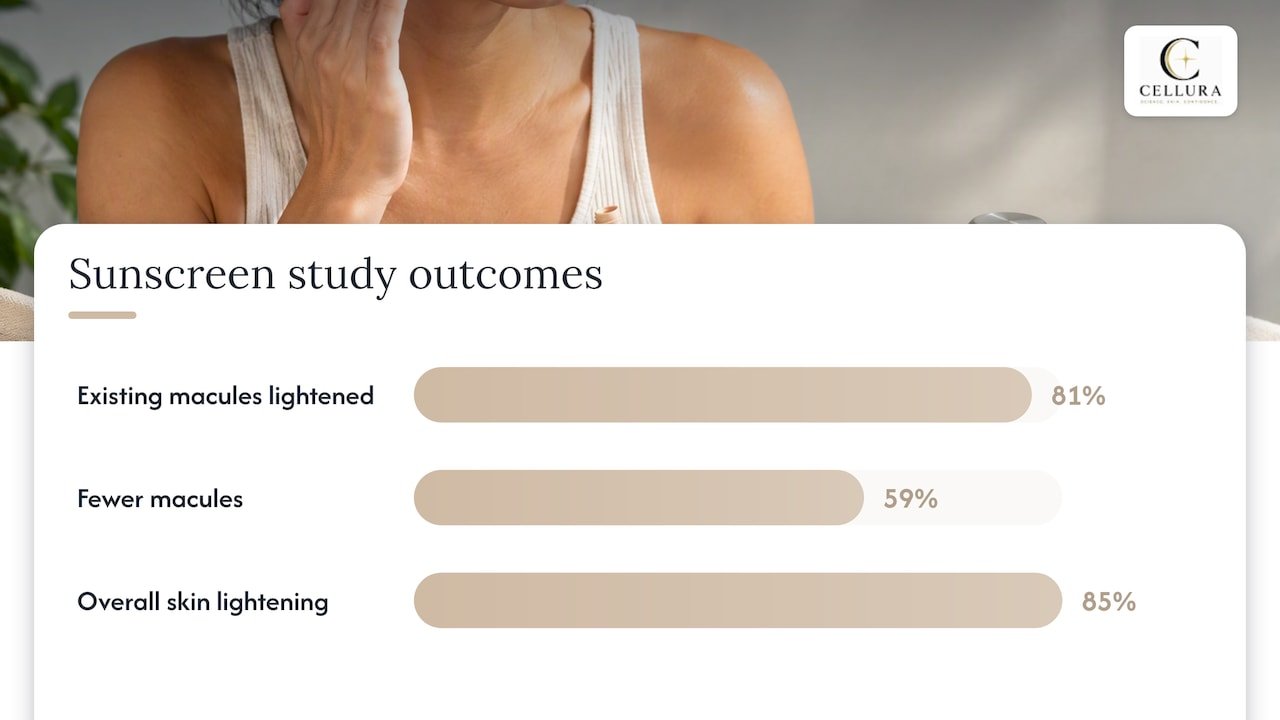
Sunscreen does more than prevent. In a study of 89 African-American and Hispanic participants, daily use of SPF 30 or 60 sunscreen for 8 weeks was linked to lightening of existing hyperpigmented macules in 81% of patients, fewer macules in 59%, and overall skin lightening in 85%. Sunscreen alone is not a treatment plan, but these numbers show how much of the problem is simply ongoing light exposure. We unpack what SPF can and cannot do in does sunscreen fade dark spots.
Apply enough
People usually apply too little to reach the labeled SPF. The JAAD guide’s practical tip is to put on enough that skin looks glistening before you rub it in, with even coverage so there are no gaps where new spots can form. Pay attention to the hairline, the jaw, the sides of the nose and the upper lip. Those are the places that get skipped.
Reapply when you are outside
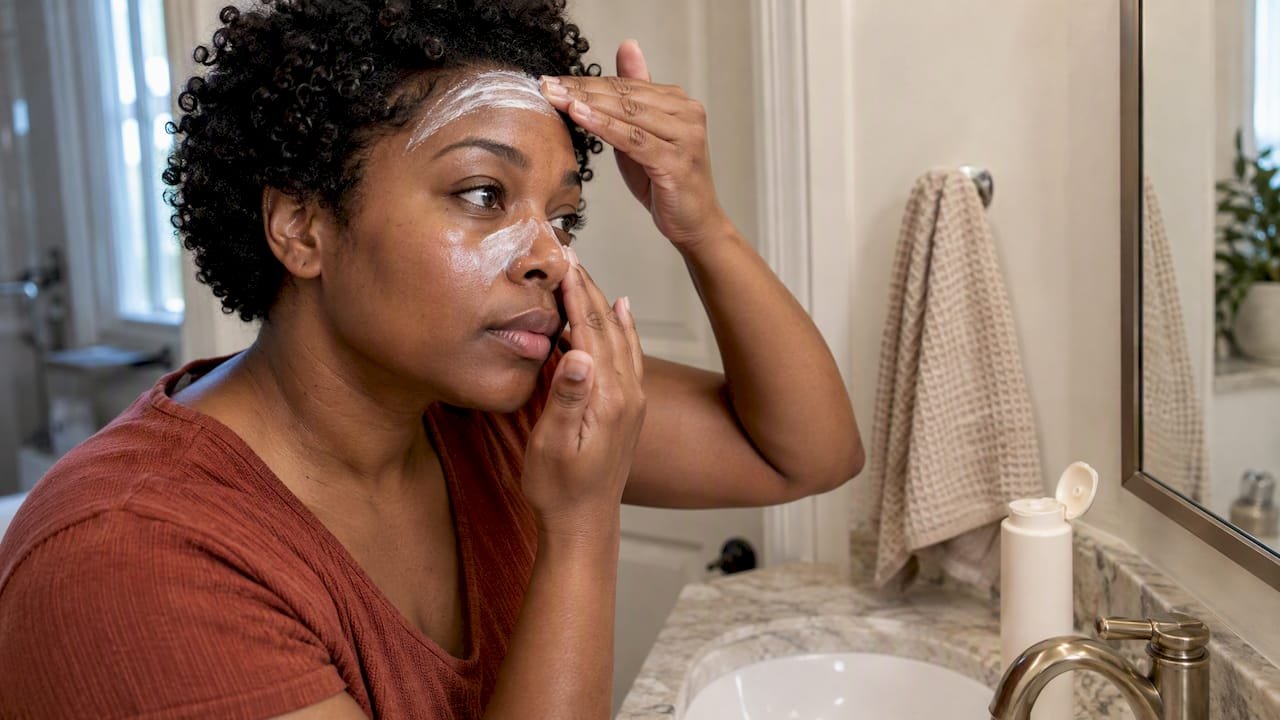
A morning layer will not last through a day of hiking, a lunch on a patio or an afternoon at the park. Reapply when you are outdoors for extended periods, after sweating or swimming, and keep a tinted stick or compact in your bag if reapplying over skin care is awkward.
Add physical shade and eyewear
A wide-brimmed hat takes some of the load off sunscreen, and sunglasses protect the delicate skin around the eyes. If you are shopping for them, a short checklist helps you confirm UV400 protection on sunglasses rather than trusting a tint to do the work. Dark lenses do not guarantee UV filtering.
A simple daily table
| Moment | What to do | Why it matters for spots |
|---|---|---|
| Morning | Cleanse, apply your treatment, moisturize, then tinted SPF with iron oxide | Blocks UV and visible light before they hit active melanocytes |
| Midday outdoors | Reapply sunscreen, wear a hat | Keeps coverage from thinning through the day |
| Near windows or in the car | Keep sunscreen on, even on cloudy days | Visible light passes through glass |
| Evening | Cleanse, treat, support your barrier | Treatments work while light is not re-stimulating cells |
How sun interacts with brightening ingredients
Brightening actives work by interrupting different steps in the pigment pathway. Niacinamide slows the transfer of pigment to surrounding skin cells. Tranexamic acid and alpha-arbutin act earlier in pigment production, and kojic acid also targets that process. A review of targeted ingredients reports that niacinamide (often used at 4%), azelaic acid and tranexamic acid have shown clinical benefit in melasma and post-acne pigmentation after 8 to 12 weeks of consistent use. In one study, participants using a sunscreen combined with niacinamide and other actives had a 44% reduction in MASI scores after 12 weeks.
Notice what that study combined: the actives and sunscreen together. The research background we reviewed makes the same point from the other side. Without sun protection, an active such as niacinamide or tranexamic acid may be undercut, because skin that is constantly stimulated by light keeps making pigment. Think of it as bailing a boat while the hole is still open.
If you want to compare actives, we have written about tranexamic acid versus niacinamide and about choosing tinted SPF plus one active for post-acne marks.
Be careful with strong treatments in sunny months
Lasers, aggressive peels and high-strength acids can themselves trigger PIH if used without care, particularly in skin of color. If you are considering a professional treatment, talk with a board-certified dermatologist or an experienced clinician first, ideally one who treats your skin tone regularly, and ask how they plan to protect your skin from the sun afterward. For a sense of how clinics weigh options such as laser resurfacing against microneedling for different skin tones and downtime, this NP-written comparison of CoolPeel and microneedling is a good place to start. If a prescription option such as hydroquinone is on the table, the physician-reviewed DermNet page on hydroquinone explains how it is used for hyperpigmentation, and a dermatologist can tell you if it fits your skin.
Perspective: how we think about sun and dark spots
We formulate for post-acne discoloration, so we see the same pattern again and again. Someone finds a serum, uses it for three weeks, spends a sunny weekend outdoors, and decides the product failed. Usually the product was not the problem. The routine had no consistent answer to light.
That is why we build around a three-step ritual of cleansing, treatment and barrier support, and why we say plainly that none of it replaces daily sun protection. Our serum, Luminé, combines niacinamide, tranexamic acid, kojic acid and alpha-arbutin to work on pigment at several stages. That can reduce how visible spots look over time. It cannot stop light from reigniting them.
We also publish ingredient concentrations and the research behind each active, and we say where our formulas differ from the studies. We do that because you should be able to judge the evidence yourself. The honest summary of the science is that pigmentation is chronic and reactive. Expect management, not a permanent cure, and expect your results to depend on how steadily you protect your skin.
— Beauvex LLC
A realistic plan for the next 12 weeks
- Weeks 1 to 2: build the habit. Pick a tinted SPF with iron oxide and wear it every morning. Do not add more than one new active at a time, so you can tell what irritates you.
- Weeks 2 to 4: add your treatment. Introduce a brightening serum gradually. Skip scrubs and harsh exfoliation. Irritation can create new marks.
- Weeks 4 to 8: stay consistent. Studies of niacinamide, azelaic acid and tranexamic acid report changes at 8 to 12 weeks, so early weeks can look underwhelming. Take a photo in the same light every two weeks.
- Weeks 8 to 12: assess. Compare photos. If marks are lighter, keep going. If there is no change at all, or if spots are changing shape, bleeding or growing, see a dermatologist. A dark spot that looks different from your other marks should be examined by a professional, not treated at home.
If you want the longer view, our guide to how long dark spots take to fade covers timelines in more detail, and our three-step hyperpigmentation skincare routine shows how the steps fit together.
Common mistakes that keep spots dark
- Trusting SPF number alone. A high SPF without iron oxide leaves visible light largely unaddressed for people prone to pigmentation.
- Skipping sunscreen on cloudy days or indoors. Light still reaches you through clouds and windows.
- Applying a thin layer. Under-applying means you get far less than the labeled protection.
- Picking at spots. Picking creates fresh inflammation and, with it, fresh pigment.
- Switching products every two weeks. Pigment treatments need 8 to 12 weeks to judge fairly.
- Layering too many strong actives. Irritated skin can darken. Introduce changes one at a time.
Where our Cellura line fits
If you are building a routine around post-acne dark spots, the Cellura line covers the three steps: a cleansing bar with salicylic, azelaic and kojic acid, the Luminé Brightening Serum with niacinamide, tranexamic acid, kojic acid and alpha-arbutin, and a barrier balm with GHK-Cu copper peptide, tallow and squalane. Concentrations and research references are published for each product, so you can check what you are putting on your skin. Use them in the evening and morning alongside a tinted sunscreen of your choice, because sun protection stays the first step in any routine for dark spots.
FAQ
Does sun make hyperpigmentation worse?
Yes. UV rays and visible light both stimulate melanocytes to produce more melanin, which deepens existing spots and can create new ones. Skin that is already prone to pigmentation, such as post-acne marks or melasma, reacts more strongly. Daily protection with a tinted, broad-spectrum sunscreen is the best-supported way to limit that effect.
Can sunscreen alone fade dark spots?
It can help. In one study of 89 African-American and Hispanic participants, 8 weeks of daily SPF 30 or 60 sunscreen was associated with lightening of existing macules in 81% of patients. For stubborn spots, dermatologists usually combine sunscreen with a targeted treatment. Your results will depend on your skin and the cause of your spots.
Do I need sunscreen if I stay indoors?
For pigmentation-prone skin, dermatology guidance says yes. Visible light can pass through windows and screens, and standard non-tinted sunscreens do not block it. A tinted sunscreen with iron oxide worn daily covers that gap.
Why did my dark spots get darker after the beach?
Sun exposure re-triggers melanin-producing cells, and clinical guidance notes that it can undo weeks of treatment progress. Spots often look darker within days of intense exposure. Go back to daily tinted SPF, avoid picking at the area, and if a spot keeps changing or does not fade over several months, ask a dermatologist to look at it.
Sources
- Guide to Tinted Sunscreens for Skin of Color, Journal of the American Academy of Dermatology
- How to fade dark spots in darker skin tones, American Academy of Dermatology
- Melasma: Self-care, American Academy of Dermatology
- The Role of Sunscreen in Melasma and Postinflammatory Hyperpigmentation, PMC
- Sunscreen with niacinamide and other actives in facial melasma, PMC
- Sunscreen for Black people, Cleveland Clinic
- Topical retinoids, DermNet
- Hydroquinone (bleaching cream), DermNet