
Evidence-based skincare means choosing ingredients and routines because well-designed human studies show they work at a specific concentration, not because a label, an influencer or a clever name says so. In practice, that gives you three questions for any product. Was the active tested on people? Is the amount in the bottle close to the amount that was tested? And does the brand tell you where its formula departs from the research?
This guide shows how to ask those questions, which parts of skincare have the strongest support, and how the logic plays out for one common problem: dark marks left behind after acne.
TL;DR
- Evidence-based skincare rests on human trials with a defined concentration, objective measurements and a known mechanism. A lab result or a pretty ingredient list is not enough.
- The basics have the best support: gentle cleansing, moisturizer and daily broad-spectrum sunscreen. Add one or two targeted actives on top.
- For post-acne dark spots, treat the acne first, protect from sun every day, and introduce actives slowly, because irritation can darken marks.
- Evidence for some popular actives, including topical tranexamic acid, is promising but mixed. A trustworthy brand says so.
- Dark spots that change in texture or color, itch, burn or hurt need a dermatologist, not another product.
Table of Contents
- What “evidence-based” does and does not mean
- How to evaluate a skincare claim in five checks
- The parts of skincare with the strongest support
- What the research says about post-acne dark spots
- Which ingredients have evidence for dark spots
- A routine built on the evidence
- Our perspective
- Where our Cellura ritual fits
- When to see a dermatologist
- FAQ
- Sources
What “evidence-based” does and does not mean
The phrase gets used loosely. Searches for “science-backed skincare” return everything from dermatology reviews to marketing pages that mention a study once. A useful definition is stricter: the claim traces to published research in people, and you can see how closely the product matches that research.
There is a hierarchy, and it helps to keep it in mind:
- Randomized, controlled trials in people. Strongest for a skincare claim, especially when blinded and compared against a placebo or a standard treatment.
- Smaller or open-label human studies. Useful, but more open to bias.
- Mechanism and lab data. An ingredient blocks an enzyme in a dish. That is a reason to run a trial, not proof that a cream works on your face.
- Brand-run “consumer perception” surveys. Fine as color commentary. Weak as proof.
Most marketing sits at levels 3 and 4 and talks as if it sat at level 1. That gap is what you are learning to spot.
How to evaluate a skincare claim in five checks
A review of cosmeceutical evidence published in a dermatology journal lays out what good proof looks like: peer-reviewed, double-blind, placebo-controlled trials, objective instrumental measurements, adequate skin penetration, a sufficient threshold concentration and a known mechanism. Turn that into a checklist you can run in a few minutes.
1. Who was studied, and for how long?
A 12-week trial in people with acne-related dark marks tells you more about acne marks than a two-day test on healthy forearm skin. Check that the study population resembles you: skin type, age and the condition itself.
2. How was the result measured?
The same review notes that trials should use noninvasive instruments, such as colorimetry for color and tools that measure elasticity, and that photography alone is not adequate. Lighting, angle and editing can change a photo. A colorimeter does not care about flattery.
3. Was there a control group?
Skin often improves on its own, especially after a breakout settles. Without a comparison group, you cannot separate the product from time. Blinded, controlled trials leave less room for bias than open-label or uncontrolled ones.
4. Does the concentration match?
This is the check most brands hope you skip. A study may use an ingredient at one strength, in one vehicle, at one pH. A product that lists the same ingredient far down the label, with no percentage, may deliver a fraction of it. Reaching a threshold concentration and getting the ingredient into the skin both matter. A brand that publishes percentages lets you check. A brand that hides them asks for trust.
5. Does the brand disclose differences?
Even good formulas rarely copy a trial exactly. Maybe the trial used a prescription-strength cream, or a different combination of actives. The honest move is to say so. A line such as “the study tested X alone, and our formula combines X with Y” is a sign of a brand you can reason with.
If you want to evaluate a treatment that sits at the prescription end of the evidence ladder, such as tretinoin for hyperpigmentation, the same checklist applies. Ask what was studied, at what strength, and what a clinician would monitor.
The parts of skincare with the strongest support
Before any serum, the routine itself needs a foundation. A systematic literature review of basic skin care procedures, published in 2015, set out to summarize the empirical evidence for basic skin care and build a clinical algorithm from it, and the same stack keeps appearing in dermatology guidance: cleanse gently, moisturize, protect from the sun.
- Cleanser. The goal is removing oil, sunscreen and grime without leaving skin tight or stripped. Tightness is a sign of barrier stress, which matters more once you add actives.
- Moisturizer. It supports the barrier, which is the layer that keeps water in and irritants out.
- Sunscreen. The most consistently supported step for preventing discoloration from getting worse. More on that below.
- One targeted active. Retinoids, azelaic acid, vitamin C and niacinamide each have human data in different situations. Adding several at once makes it impossible to know what helped or what irritated.
That last point is a practical one. If you change five things on Monday and break out on Friday, you have learned nothing.
What the research says about post-acne dark spots
Post-inflammatory hyperpigmentation (PIH) is the flat brown, tan or dark mark that remains after a pimple heals. It is a good test case for evidence-based thinking, because many products promise to fade it and the quality of support varies a lot.
Treat the cause first
A review of PIH in a US dermatology journal states that management should begin by addressing the underlying inflammatory dermatosis, and that early treatment may hasten resolution and prevent further darkening. For acne, that means a serum cannot do the whole job if new breakouts keep adding new marks. A 2026 clinical perspective on acne-induced pigmentation makes a similar point: manage pigmentation as part of routine acne care, prioritizing treatments that address both the acne and the marks.
If your acne is moderate to severe, or isn’t improving with over-the-counter care, a clinician can prescribe treatment that does more than a drugstore product. Telehealth care for acne is one way to reach a provider without waiting for an in-person slot.
Sunscreen is part of the treatment
UV and visible light can keep pigmented marks dark. The same PIH review says daily broad-spectrum sunscreen with SPF 30 and sun-protective measures help prevent PIH from worsening. If your dark spots are stubborn, skipping sunscreen can cancel the work of every active you apply.
Irritation can make marks worse
The review also notes that irritation from treatment can exacerbate PIH, particularly in higher skin phototypes. This is why “stronger” is not automatically better. It also explains the advice to start retinoids at lower concentrations and titrate up to reduce irritation. For a tolerability-first approach to retinoids, see our guide to retinol for hyperpigmentation.
Skin of color needs specific attention
In deeper skin tones, inflammation is more likely to leave lasting brown marks. The PIH review also points out that conditions that look red or pink on lighter skin may appear brown on skin of color, and that patients should advocate for themselves with medical providers. Our page on dark spots after acne in skin of color covers tinted SPF and keeping the routine to one active.
Which ingredients have evidence for dark spots
Here is where the evidence stands for the actives people ask about most. No ingredient is a guarantee, and results depend on the person, the formula and the time given.
| Ingredient | What the evidence supports | Caveat |
|---|---|---|
| Azelaic acid | In a 12-week trial, 20% azelaic acid cream and 5% tranexamic acid solution were comparably effective for acne-related PIH | One trial, one population, specific concentrations |
| Tranexamic acid (topical) | Promising for pigmentation, but a 2023 review says the evidence is mixed and more is needed before broad recommendation | Oral use requires medical screening, including history of thromboembolic disease |
| Retinoids | Long-standing use in acne and pigmentation; start low and titrate | Irritation can worsen marks |
| Niacinamide, alpha-arbutin, vitamin C | Common in pigment-focused formulas, often combined | Strength varies by study and product |
Two points deserve attention. First, the azelaic acid and tranexamic acid trial compared two treatments with each other, which is useful, but it is not a placebo-controlled test of every product containing those words. Second, the review’s caution about topical tranexamic acid is exactly the kind of limitation that marketing tends to leave out. If you want to go deeper on how these actives compare, we break down tranexamic acid versus azelaic acid by spot color, and tranexamic acid versus niacinamide for fading marks.
A routine built on the evidence
This is a simple structure for post-acne dark spots. It follows the order the research supports: calm the skin, treat the marks, protect the barrier and the skin from the sun.
Morning
- Rinse or cleanse gently.
- Apply a targeted treatment if your skin tolerates it.
- Moisturize.
- Finish with broad-spectrum SPF 30 or higher. A tinted formula is a sensible choice for visible-light-sensitive marks.
Evening
- Cleanse to remove sunscreen and oil.
- Apply your treatment step.
- Seal with a barrier-supporting moisturizer or balm.
Rules that keep the routine safe
- Add one product at a time, about two weeks apart, so you can tell what is helping and what is irritating.
- Give it time. Trials of pigment treatments run on the scale of 8 to 12 weeks, not days.
- Stop and reassess if skin stings, peels or looks redder. Irritation feeds more pigment.
- Don’t pick. Every picked pimple is a fresh inflammation and a fresh mark.
For a full walk-through, our hyperpigmentation skincare routine lays out the three steps for post-acne marks, and the post-inflammatory hyperpigmentation plan goes deeper on sequencing.
Our perspective
We built Beauvex around a frustration we think you share: it is hard to evaluate a dark spot product when the label hides the one number that matters. So we publish the concentration of each active and the research behind it. We also disclose where our formulas differ from the published clinical studies, because a study of one ingredient at one strength is not a study of a finished product, and you deserve to know the difference.
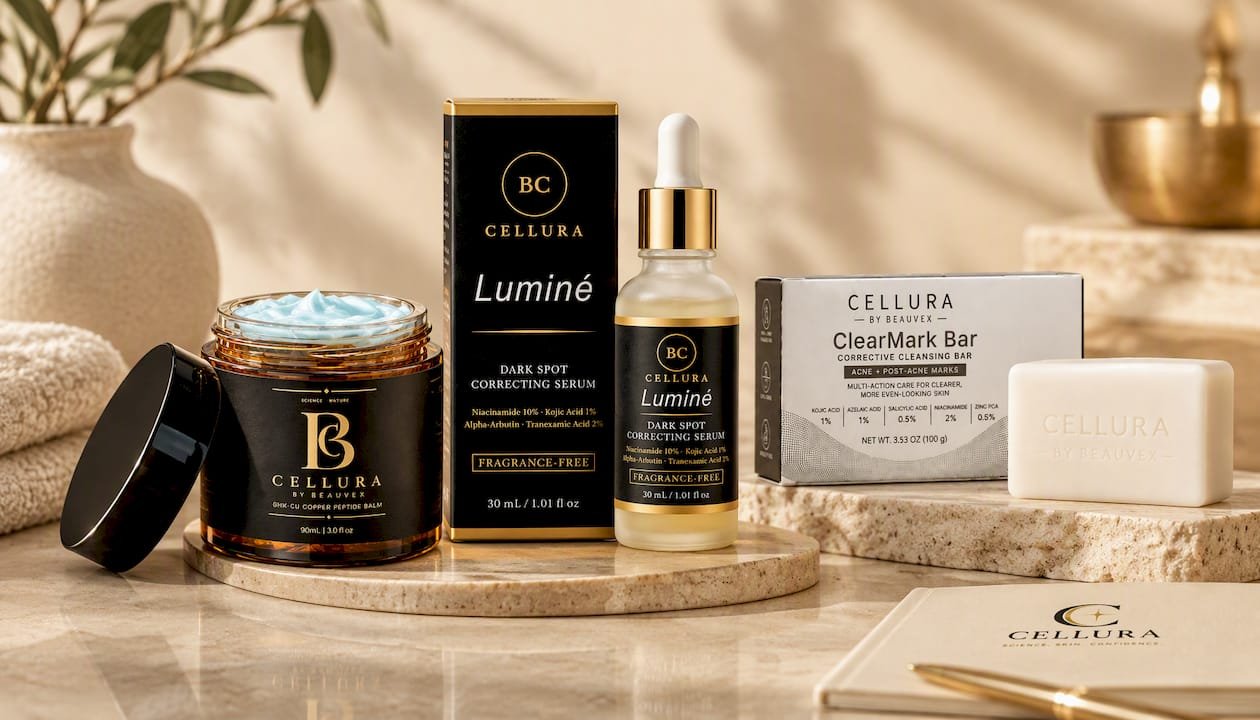
Our ritual follows the structure above. A cleansing bar uses salicylic, azelaic and kojic acid. A serum combines niacinamide, tranexamic acid, kojic acid and alpha-arbutin, so that more than one stage of the pigment process is addressed. A balm built on GHK-Cu copper peptide, tallow and squalane supports the barrier. We think that is a reasonable design, and we think you should be able to check it against the evidence yourself, including the places where the evidence is still developing, as it is for topical tranexamic acid.
— Beauvex LLC
Where our Cellura ritual fits
If your goal is fading stubborn marks left by acne, the Cellura line is a three-step system designed for that single job: cleanse, treat, support the barrier. The Cellura Luminé Brightening Serum is the treatment step, and the full line is on the Cellura page, where the ingredient concentrations and research references for each product are published.
Whichever products you choose, keep sunscreen in the routine. No serum replaces it.
When to see a dermatologist
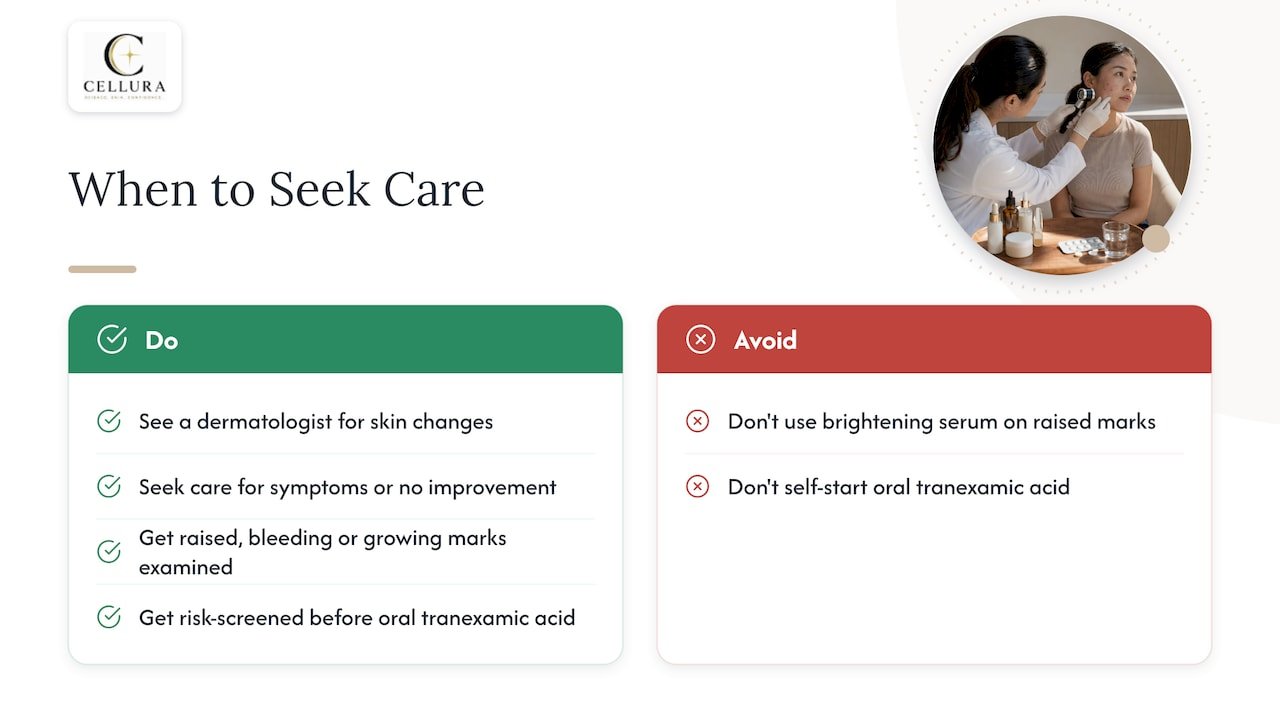
Self-care has limits. See a dermatologist for changes in skin texture or color, or for itching, burning, tenderness or pain, and seek care if an over-the-counter-treated condition has not improved after more than a week. A mark that is raised, bleeding, changing shape or growing needs examination, not a brightening serum.
Also see a professional before using oral tranexamic acid. A 2023 review advises that patients be screened for risk factors, including a history of thromboembolic disease, before starting it. That is a prescription decision, not a shopping decision.
FAQ
What skincare is evidence-based?
Skincare is evidence-based when its claims trace to human studies that measured results objectively, at a concentration close to what is in the product. The routine basics qualify: gentle cleansing, moisturizer and daily broad-spectrum sunscreen. Specific actives such as retinoids and azelaic acid have clinical data, though how strong it is depends on the condition.
How can I tell whether a skincare claim is backed by science?
Look for peer-reviewed trials in people, a control group, instrumental measurements rather than photos alone, and a stated concentration. If a brand cites a study, check that the ingredient and strength match the product. Vague phrases such as “clinically inspired” usually mean the checks were not met.
Is a science-backed routine different from a basic routine?
Not much. The most supported routine is simple: cleanser, moisturizer, sunscreen, and one targeted active chosen for your concern. Adding actives gradually matters more than adding many.
How long does it take to fade post-acne dark spots?
Clinical comparisons of treatments for acne-related PIH ran for 12 weeks, so expect to judge a routine over two to three months rather than days. Daily sunscreen and avoiding new breakouts and irritation all affect how fast marks fade.
Sources
- A comparative study of 20% azelaic acid cream versus 5% tranexamic acid solution for acne-related PIH
- Disorders of hyperpigmentation. Part II. Review of management
- How Much Do We Really Know About Our Favorite Cosmeceutical Ingredients?
- Postinflammatory Hyperpigmentation: A Review of the Epidemiology, Clinical Features, and Treatment Options
- Practical management of acne-induced pigmentation
- How Skin Conditions Look Different on Skin of Color
- Evidence-Based Skin Care: A Systematic Literature Review