
Glycolic acid is an effective exfoliant that helps fade many surface dark spots when used consistently with daily sun protection and, when needed, pigment-inhibiting actives. It works best on epidermal pigmentation like postacne marks and sunspots, and it is less reliable alone for deeper dermal pigment or stubborn melasma. Pair it with broad-spectrum SPF 30+, and if irritation or new darkening shows up, stop and talk to a dermatologist.
TL;DR:
- Glycolic acid effectively accelerates surface cell shedding, improving epidermal pigmentation like postacne marks and sunspots, but is less reliable for deeper melasma.
- Its small molecular size increases penetration and speed but also raises irritation risk, especially with higher concentrations or frequent use.
- Consistent use over 8 to 12 weeks shows noticeable fading, with professional peels providing faster and more significant results in resistant cases.
- Beginners should start with low-strength cleansers or serums two to three times weekly, gradually increasing frequency and combining with depigmenting actives.
- Overly aggressive use can cause irritation and rebound pigmentation, especially in darker skin, making barrier protection and dermatologist guidance essential.
Table of Contents
- Glycolic acid explained: how this exfoliant actually changes pigment
- Which dark spots actually respond to glycolic acid
- Choosing a glycolic acid product: cleanser, leave-on, or professional peel
- How to work glycolic acid into your routine without overdoing it
- When you’ll likely see results and how to measure progress
- Side effects, irritation, and extra care for darker skin tones
- When professional peels or in-office treatments make sense
- How our three-step ritual lines up with this approach
- A realistic mindset for treating dark spots
- Build your routine with Cellura
- FAQ
- Sources
Glycolic acid explained: how this exfoliant actually changes pigment
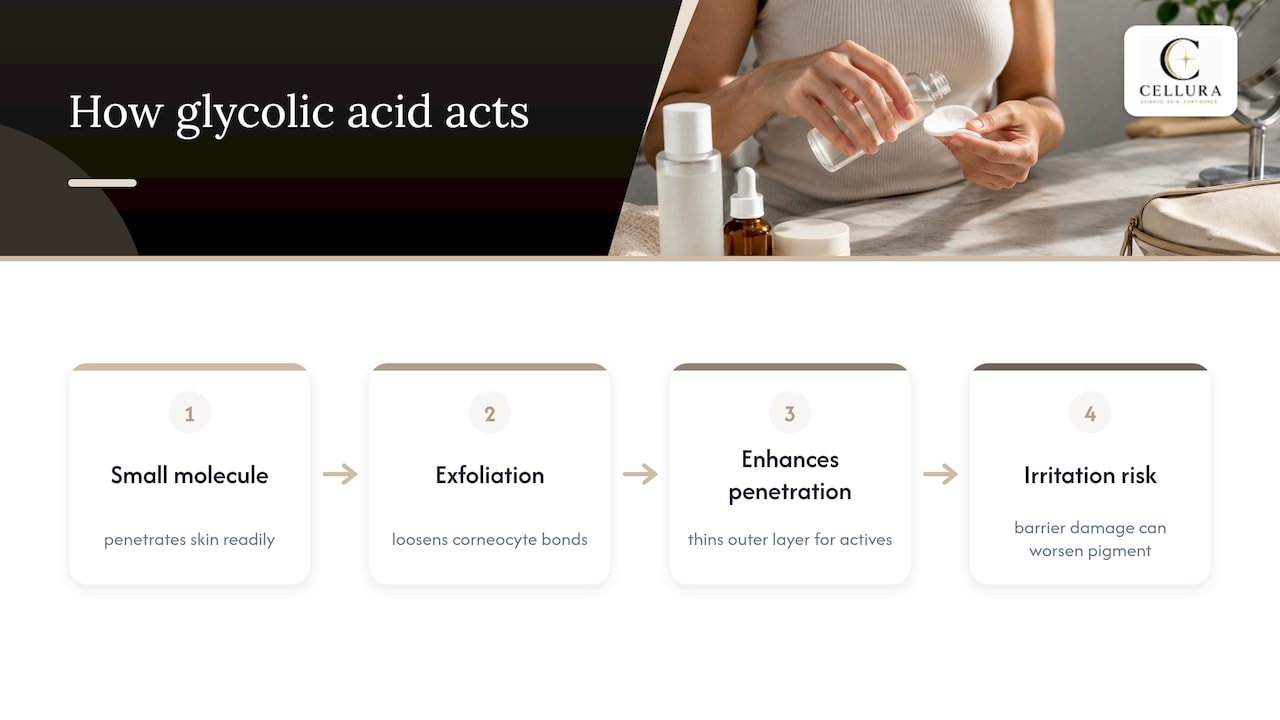
Glycolic acid belongs to the alpha hydroxy acid family, and it has the smallest molecule of the bunch. That size matters: smaller molecules penetrate the skin’s surface more readily than larger AHAs like lactic or mandelic acid, which is part of why glycolic acid tends to work faster but also irritates more easily.
At the mechanical level, glycolic acid loosens the bonds between corneocytes, the dead skin cells sitting on the surface. Looser bonds mean faster shedding, and faster shedding speeds up keratinocyte turnover. Since excess melanin often gets trapped in those surface cells after inflammation or sun exposure, clearing them out faster helps pigmented cells slough off sooner than they would on their own.
That is a different mechanism from how ingredients like hydroquinone, kojic acid, or alpha-arbutin work. Those actives interfere with tyrosinase, the enzyme that drives melanin production, so they slow new pigment from forming in the first place. Glycolic acid does not meaningfully inhibit tyrosinase on its own. Its real value for dark spots is twofold: it clears pigmented surface cells faster, and it thins the outer skin layer enough that depigmenting agents applied afterward can penetrate more effectively.
This explains why glycolic acid rarely works as a standalone fix for stubborn pigmentation. AAD patient guidance lists several over-the-counter options for fading dark spots, including glycolic acid, azelaic acid, retinoids, kojic acid, and vitamin C, and notes that combining exfoliation with pigment inhibitors tends to work better than either approach alone.
Molecule size also explains the irritation trade-off. Because glycolic acid penetrates so readily, it can disrupt the skin barrier if used too often or at too high a concentration, and a disrupted barrier is itself a trigger for more pigmentation, particularly in melanin-rich skin. Understanding that two-sided mechanism, faster cell turnover paired with real irritation risk, is the foundation for using it safely rather than guessing at a routine.
Which dark spots actually respond to glycolic acid
Not every dark mark responds the same way, and the difference comes down to where the pigment sits. Dermatologists generally separate pigmentation into epidermal (close to the surface) and dermal (deeper, in the skin’s middle layer), sometimes checking depth with a Wood’s lamp or dermoscopy before recommending treatment.
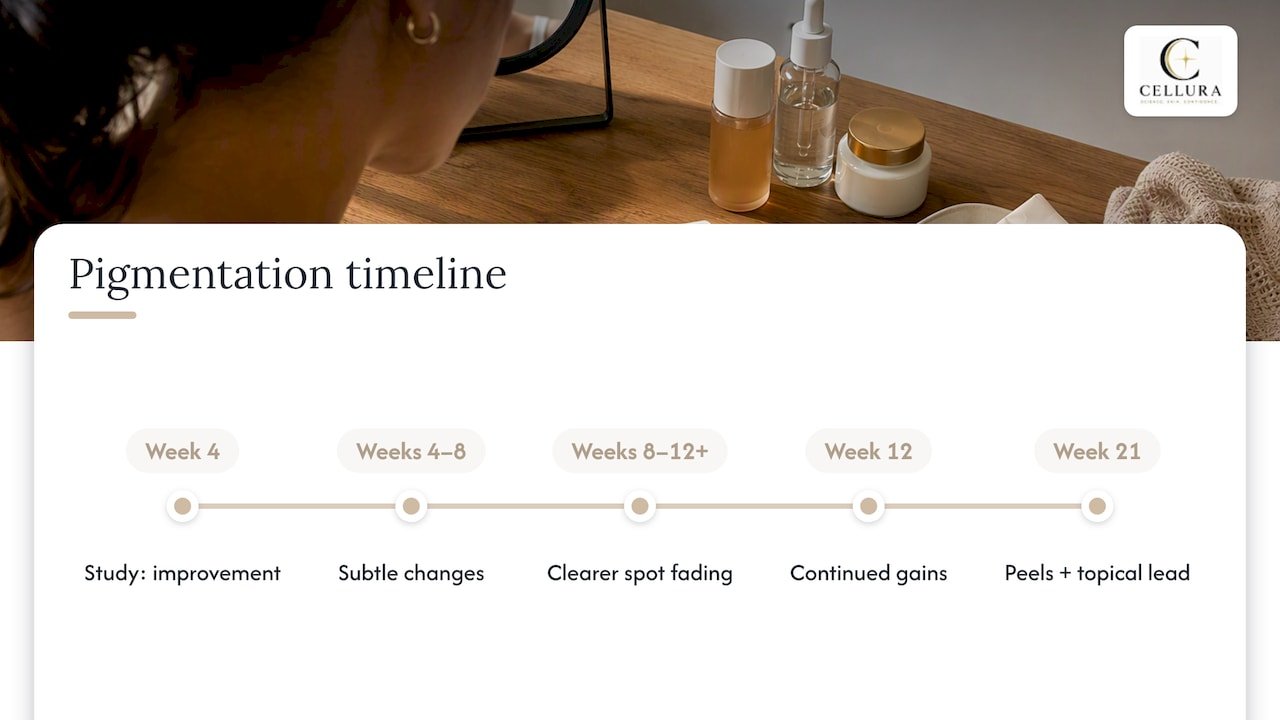
Postinflammatory hyperpigmentation from acne and solar lentigines (classic sunspots) are usually epidermal or close to it, which is why they tend to respond best to exfoliating acids and topical pigment inhibitors. A randomized comparative study in patients with Fitzpatrick skin types III through V found that adding serial glycolic acid peels to a topical regimen produced significantly greater improvement in postinflammatory hyperpigmentation than the topical regimen alone, with meaningful score improvements by week 12 and continuing through week 21.
Melasma is a different story. It often involves pigment at both epidermal and dermal levels, driven by hormonal and vascular factors as well as UV and visible light exposure. AAD guidance on melasma notes that diagnosis typically involves tools like a Wood’s lamp or dermatoscope, and treatment plans are individualized, often combining sun protection with topical medications such as hydroquinone, tretinoin, or azelaic acid, and in refractory cases, oral tranexamic acid. Glycolic acid can support a melasma regimen by improving penetration of those other actives, but it is rarely the main driver of improvement on its own.
Common real-world causes worth distinguishing include acne-related PIH (the most common complaint among people searching for dark spot solutions), UV-induced sunspots that accumulate over years, and hormonal melasma, which tends to be more resistant and more prone to rebound without strict photoprotection.
Choosing a glycolic acid product: cleanser, leave-on, or professional peel
Format and contact time matter as much as concentration.
At-home options generally fall into a few tiers:
- Low-strength cleansers and washes (often under 10%, short contact time) offer gentle, low-risk exfoliation suitable for daily use in most skin types.
- Leave-on serums and lotions commonly range from 4% to 10% glycolic acid, and these are where most people see visible exfoliation and gradual fading.
- Stronger at-home leave-ons, sometimes above 10%, exist but carry higher irritation risk and are best introduced slowly, not used nightly from the start.
- Professional in-office peels use much higher concentrations, often 20% to 70%, applied under supervision for a controlled period and neutralized before leaving.
A trial comparing glycolic and salicylic acid peels in postacne pigmentation found that high-concentration (50%) glycolic acid peels produced strong pigmentation reduction in nearly half of treated patients, with some cases showing very high improvement by six weeks, a result tied specifically to the professional-strength concentration and serial scheduling, not to at-home use.
Clinicians typically run peels in series, spaced weeks apart, precisely because higher concentrations need recovery time and supervised monitoring for excessive peeling or unexpected darkening. That same logic applies, scaled down, to at-home use: start with lower concentrations and shorter contact time, patch test on the inner forearm for 24 to 48 hours before applying anywhere on the face, and avoid daily use of high-strength leave-ons until your skin has built tolerance over several weeks. If you are new to acids generally, a cleanser or a low-percentage leave-on used two to three nights a week is a more realistic starting point than jumping straight to a strong serum.
How to work glycolic acid into your routine without overdoing it
Building a routine around glycolic acid comes down to sequencing and restraint. The acid itself does the exfoliating work; everything else in your routine either protects the barrier or targets pigment through a different pathway.
A practical way to build up tolerance over time:
- Weeks 1 to 2: use a glycolic acid cleanser or a low-percentage leave-on two to three nights a week, followed by a plain moisturizer.
- Weeks 3 to 6: if skin tolerates it well, increase to every other night and consider layering a pigment-targeting serum (niacinamide, azelaic acid, or tranexamic acid) on alternate nights or underneath the acid once tolerance is established.
- Week 6 onward: maintain a sustainable frequency, often three to four nights a week for most people, and reassess strength only if progress stalls after 8 to 12 weeks.
Pro Tip: Apply glycolic acid to fully dry skin and wait a few minutes before layering anything else, since damp skin absorbs acids faster and raises irritation risk.
Layering rules matter more than most routines acknowledge. Retinoids and glycolic acid both increase cell turnover, and using them on the same night often overwhelms the barrier, so alternating nights (acid one night, retinoid the next) is generally safer than combining them. Vitamin C, by contrast, works at a different pH and is often better suited to mornings, leaving glycolic acid and other pigment actives for the evening routine.
The combination evidence is strongest when glycolic acid is used to prime skin for a depigmenting agent rather than relied on alone. The same comparative study in dark-skinned patients found that serial glycolic acid peels paired with a topical modified Kligman formula outperformed the topical formula by itself, with statistically significant differences at both 12 and 21 weeks. A separate 12-week clinical evaluation of a 10% glycolic acid emulsion combined with phytic acid and a soothing complex found measurable improvement in pigmentation and skin luminosity starting as early as week 4 and continuing through week 12, suggesting that pairing the acid with calming, antioxidant-rich formulations can reduce the irritation trade-off while still improving outcomes. For a deeper look at how niacinamide and tranexamic acid specifically complement this kind of exfoliation, see our comparison of tranexamic acid and niacinamide for dark spots. Azelaic acid is another option worth layering in the mornings or on alternate nights, since it inhibits tyrosinase through a mechanism distinct from glycolic acid’s exfoliation.
When you’ll likely see results and how to measure progress
Patience matters more with pigmentation than with almost any other skin concern, because melanocytes and the skin’s natural turnover cycle work on a timeline measured in weeks, not days.
Most people using a glycolic acid leave-on consistently start noticing subtle changes, smoother texture, slightly brighter overall tone, by 4 to 8 weeks. Clearer fading of individual dark spots tends to show up later, often somewhere between 8 and 12-plus weeks of consistent use. The 12-week emulsion study reported significant improvement in pigmentation and luminosity by week 4, with continued gains through week 12, a timeline consistent with typical skin turnover.
Combination approaches tend to move faster. The PIH comparative study found statistically significant improvement in the peels-plus-topical group by week 12, with even greater separation from the topical-only group by week 21, suggesting that serial professional peels paired with a maintained topical routine can outpace topical treatment alone, both in speed and in total improvement.
To judge your own progress fairly, take photos in the same lighting and the same time of day every one to two weeks rather than relying on memory, which tends to either overestimate frustration early on or miss gradual gains. If you see no change at all by 12 weeks of consistent, correctly applied use, that is a reasonable point to either adjust the regimen or bring in a dermatologist rather than keep pushing the same routine indefinitely.
Side effects, irritation, and extra care for darker skin tones
Mild stinging, tightness, light flaking, and pink tone right after application are common and usually expected, especially in the first two to three weeks of use. Real warning signs look different: persistent redness that does not fade within a day, raw or broken skin, swelling, or new dark patches appearing where you applied the product.
That last one deserves attention because it is the opposite of what you are trying to achieve. Irritation itself can trigger postinflammatory hyperpigmentation, which means using glycolic acid too aggressively can create new dark spots while trying to fade existing ones. This risk is higher in melanin-rich skin, where melanocytes respond more readily to inflammation of any kind.
For skin of color specifically, a more conservative approach pays off:
- Start with lower concentrations (think cleansers or sub-10% leave-ons) and build frequency slowly over several weeks instead of jumping to daily use.
- Pair glycolic acid with a tyrosinase-inhibiting active, like niacinamide, azelaic acid, or alpha-arbutin, so pigment production is addressed alongside exfoliation rather than left unchecked. Our guide to arbutin, kojic acid, and tranexamic acid covers how these actives compare.
- Use a tinted sunscreen with iron oxide rather than a plain mineral or chemical SPF, since untinted sunscreens do not block visible light as effectively.
If irritation develops, pause the acid entirely for several days, stick to a bland moisturizer and sunscreen, and reintroduce it at a lower frequency once skin calms down. Persistent irritation, spreading darkness, or no improvement after a reasonable trial period is the point to see a board-certified dermatologist rather than continuing to self-treat. Expert commentary on managing hyperpigmentation frames dark spots as a chronic condition that is managed over time rather than cured outright, which is a useful mindset shift for anyone expecting a single product to finish the job.
When professional peels or in-office treatments make sense
At-home routines handle a lot of surface pigmentation, but some cases call for a dermatologist’s office. Professional glycolic acid peels use concentrations far higher than anything sold for home use, typically in the 20% to 70% range, and they are applied for a timed, controlled period before being neutralized, which lets a provider achieve deeper exfoliation than a leave-on product safely could.
Beyond peels, providers may combine treatments depending on the case: microneedling to improve penetration of topical agents, or targeted laser treatments for resistant pigment, though laser choice depends heavily on skin tone and the type of pigment involved. The comparative peel study found 50% glycolic acid peels produced greater than 75% reduction in postacne pigmentation in nearly half of treated patients, a result that reflects supervised, serial, high-concentration treatment rather than anything achievable with over-the-counter products.
A few situations are reasonable cues to seek professional input rather than continuing to self-treat: pigmentation that has not budged after 12 or more weeks of a correctly applied topical routine, spots that seem to be getting darker or spreading despite diligent sun protection, or any uncertainty about whether a mark is actually pigmentation rather than something that needs a different diagnosis entirely. A dermatologist can also assess pigment depth directly, which at-home guesswork cannot replace.
How our three-step ritual lines up with this approach
We built our routine around a sequence supported by research: clear the surface, target pigment production, then support the barrier that helps manage irritation and rebound darkening. Our ClearMark Bar combines salicylic, azelaic, and kojic acids in a facial cleansing bar, handling gentle surface exfoliation and oil control without the longer contact time of a leave-on acid.
From there, our Luminé Brightening Serum layers niacinamide, tranexamic acid, kojic acid, and alpha-arbutin, actives chosen to interrupt pigment production at several points along the same pathway rather than relying on exfoliation alone. Niacinamide helps calm inflammation while also limiting pigment transfer between skin cells; tranexamic acid and alpha-arbutin work on melanin production through separate mechanisms, which is the same multi-pathway logic that research on combination regimens supports. A barrier-focused balm follows to help offset the dryness and sensitivity that exfoliating acids and depigmenting actives can leave behind.
The exact concentration of every active ingredient in the formulas is published along with the supporting research, allowing consumers to evaluate the evidence themselves rather than rely solely on marketing claims. This transparency underpins the approach taken: showing the reasoning rather than asking for trust in the label.
A realistic mindset for treating dark spots
Dark spots fade on a biological timeline, not a marketing one. The regimens with the best evidence behind them combine exfoliation, targeted pigment inhibitors, and strict daily photoprotection, not a single miracle ingredient used in isolation.
What tends to separate frustration from real progress is consistency over months rather than switching products every few weeks looking for faster results. Sunscreen, including protection against visible light in darker skin tones, is the one step that is nonnegotiable regardless of what else is in your routine. For anything that looks resistant or unusual, a dermatologist’s assessment is worth more than another product.
— Beauvex LLC
Build your routine with Cellura
We designed Cellura around the same science this article walks through: exfoliate, treat pigment at multiple points, then protect the barrier that holds it all together.
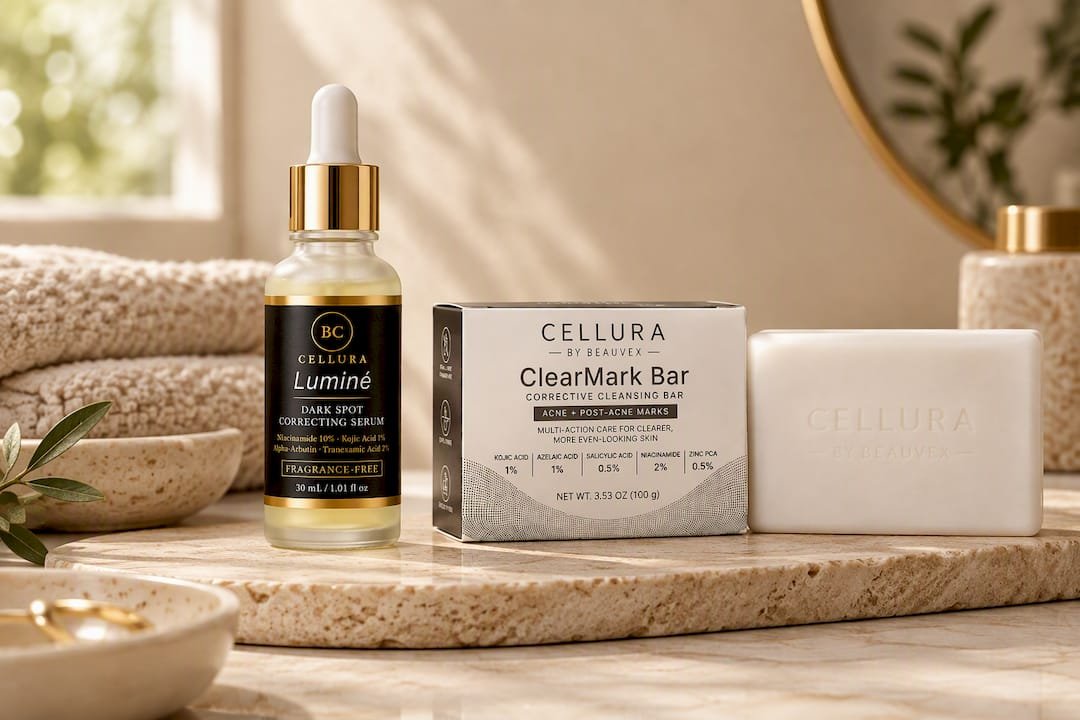
- ClearMark Bar: a multi-active cleansing bar with salicylic, azelaic, and kojic acids that handles daily surface exfoliation without the contact-time risk of a leave-on acid.
- Luminé Brightening Serum: niacinamide, tranexamic acid, kojic acid, and alpha-arbutin working on pigment production from several angles at once.
Every concentration we use is listed on the product page alongside the research behind it, so you can see exactly what you’re applying and why. If you’re ready to put this routine into practice, start with the Cellura line and build from there.
FAQ
How long does it take for glycolic acid to fade dark spots?
Most people see early texture and tone improvements by 4 to 8 weeks, with clearer fading of individual spots often by 8 to 12 or more weeks of consistent use. A 12-week clinical evaluation of a 10% glycolic acid emulsion found significant improvement in pigmentation starting at week 4 and continuing through week 12.
What fades dark spots the fastest?
Combining exfoliation with pigment-targeting actives under professional supervision tends to outpace single-ingredient, at-home routines. A study in dark-skinned patients found that serial glycolic acid peels added to a topical regimen produced significantly greater improvement than the topical regimen alone by week 12, with the gap widening further by week 21.
Can I use 7% glycolic acid every day on my face?
If redness, flaking, or new dark patches appear, reduce frequency or pause and consult a dermatologist.
How do Koreans get rid of dark spots?
There is no single national routine, but many Korean skincare approaches favor gentle, layered exfoliation paired with brightening actives like niacinamide alongside consistent daily sunscreen. Products such as the Beauty of Joseon Glow Serum, which pairs niacinamide with propolis, reflect this layered, barrier-conscious philosophy rather than relying on a single aggressive treatment.
Sources
- Treatment of Postinflammatory Hyperpigmentation With a Combination of Glycolic Acid Peels and a Topical Regimen in Dark-Skinned Patients: A Comparative Study
- Comparative study of glycolic and salicylic acid peels in postacne pigmentation
- Effect of glycolic acid, phytic acid, soothing complex containing emulsion on hyperpigmentation and skin luminosity