
Topical vitamin C can fade certain types of hyperpigmentation, particularly post-inflammatory marks and sun-triggered discoloration, when you use a stable, appropriately concentrated form and pair it with daily sun protection. A systematic review of topical vitamin C trials found measurable lightening on objective skin measures, though visible change usually takes weeks and depends heavily on formulation quality. We built our approach around that nuance: the active matters less than how well it is formulated and protected from the sun.
TL;DR:
- Using stable, appropriately concentrated vitamin C with daily sun protection can improve superficial hyperpigmentation, but visible results take several weeks to appear.
- Formulations with added antioxidants like vitamin E and ferulic acid, opaque packaging, and fresh, non-oxidized serum are crucial for maximum effectiveness.
- Concentrations around 10% and a pH of about 3.5 optimize absorption and minimize irritation; derivatives like THD ascorbate are gentler options for sensitive skin.
- Layering vitamin C in the morning with SPF 30 or higher, especially tinted sunscreens with iron oxides, enhances protection against visible light-triggered pigmentation.
- Sensitive, melanin-rich skin should start with lower concentrations, support the skin barrier, and avoid aggressive actives to reduce the risk of inflammation and post-inflammatory hyperpigmentation.
Table of Contents
- How vitamin C reduces pigmentation: the science
- Which vitamin C form works best, and why stability matters
- Choosing the right concentration and pH for your skin
- Building a routine: layering, combinations, and sunscreen
- Skin-type considerations and avoiding post-inflammatory hyperpigmentation
- What to expect: timelines and when to see a dermatologist
- Evidence summary: what the research actually shows
- Side effects and when vitamin C is not the right choice
- Storing vitamin C products so they stay effective
- Beauvex perspective: a practical starter ritual for post-acne dark spots
- Cellura Luminé serum: built around disclosed, evidence-aligned actives
- FAQ
- Sources
How vitamin C reduces pigmentation: the science
Vitamin C interrupts the pigment-making process at more than one point, which is why dermatologists keep recommending it despite mixed clinical results. The main mechanism is tyrosinase inhibition: ascorbic acid binds copper at the enzyme’s active site, slowing the reaction that converts tyrosine into melanin. A meta-analysis of randomized trials found this effect strong enough to help prevent UV-induced pigmentation at concentrations around 10%.
Beyond enzyme inhibition, vitamin C acts as an antioxidant that neutralizes free radicals generated by UV and visible light, radicals that otherwise push melanocytes into overdrive. Some research also points to effects on melanosome transfer, the process by which pigment granules move into surrounding skin cells, and on collagen synthesis, which can make dark spots look shallower over time.
Vitamin C does not work the same way as every other brightening ingredient:
- Hydroquinone blocks tyrosinase more aggressively but carries higher irritation and regulatory restrictions in some markets.
- Tranexamic acid works upstream, calming the inflammatory signals that trigger pigment production in the first place.
- Retinoids speed cell turnover, helping pigmented cells shed faster rather than altering melanin synthesis directly.
Each mechanism targets a different stage of pigmentation, which is part of why combination routines often outperform single ingredients.
Which vitamin C form works best, and why stability matters
Not all vitamin C is created equal, and the form you choose affects both results and tolerability. L-ascorbic acid (AA) is the most studied and most potent form, but it is unstable in water, oxidizes quickly, and can irritate sensitive or melanin-rich skin at higher strengths. Derivatives were developed to solve that problem:
- THD ascorbate (tetrahexyldecyl ascorbate) is oil-soluble, penetrates well, and tends to cause less irritation than AA.
- Magnesium ascorbyl phosphate is gentler and water-stable but generally weaker in head-to-head potency.
- VC-IP (tetrahexyldecyl ascorbate variant) offers similar lipid-soluble benefits for drier or more reactive skin types.
Formulation is where most vitamin C products succeed or fail. Ascorbic acid oxidizes on contact with air, light, and water, which is why a serum that turns yellow or brown has likely lost potency. Brands address this through antioxidant pairing (vitamin C with vitamin E and ferulic acid, a combination shown to improve photoprotection over vitamin C alone according to the same meta-analysis on UV-induced pigmentation), anhydrous (water-free) vehicles, or encapsulation technology that slows oxidation.
A few signs point to a well-made formula: opaque or airless packaging that blocks light and air, a visible antioxidant pairing like vitamin E and ferulic acid, and a brand willing to publish the actual percentage of active ingredient rather than hiding behind “vitamin C complex.”
Pro Tip: If a vitamin C serum has darkened in color or smells faintly metallic, it has likely oxidized and will not perform as well, regardless of the concentration on the label.
Choosing the right concentration and pH for your skin
Concentration and pH decide how much benefit you get and how much irritation comes with it. Most effective ascorbic acid formulas sit between 10% and 20%, with a meta-analysis of UV-pigmentation trials finding strong preventive effects at roughly 10%, a reasonable starting point for most skin types.
pH plays a direct role in how well ascorbic acid penetrates skin: a lower pH (around 3.5) increases absorption but also increases irritation potential, which is why sensitive skin often does better with a derivative formulated at a more neutral pH.
A short checklist before buying:
- Check the concentration. Look for a specific percentage, not a vague ingredient list position.
- Identify the form. Ascorbic acid, THD ascorbate, and magnesium ascorbyl phosphate behave differently on skin.
- Look for antioxidant partners. Vitamin E and ferulic acid support stability and photoprotection.
- Check the packaging. Opaque, airless, or dark glass bottles protect potency.
- Look for disclosed references. Brands that cite research let you judge claims instead of trusting marketing copy alone.
Building a routine: layering, combinations, and sunscreen
Vitamin C works best as a morning habit, applied after cleansing and before moisturizer and sunscreen. Because it offers some antioxidant protection against daytime UV and visible-light exposure, pairing it with a broad-spectrum SPF 30 or higher locks in the benefit rather than letting it undo itself. Tinted sunscreens containing iron oxides add a layer most plain mineral or chemical sunscreens miss: protection against visible light, which product analyses and dermatology reviews identify as a meaningful trigger for pigment activation, particularly in darker skin tones. Our guide on whether sunscreen fades dark spots covers this in more depth.
Layering with other actives follows a few general rules:
- Niacinamide pairs well with vitamin C in most formulations and can support barrier function rather than fighting it, as covered in our vitamin C and niacinamide routine guide.
- Retinoids are better introduced on alternating nights or started at a low frequency, since combining two active ingredients too quickly raises irritation risk.
- Tranexamic acid can be layered with vitamin C, but a patch test first helps rule out unexpected sensitivity, a point explored further in our piece on tranexamic acid for hyperpigmentation.
For sensitive or melanin-rich skin, starting three to four times per week before building to daily use lowers the chance of irritation turning into new, inflammation-triggered dark marks.
Pro Tip: Apply vitamin C to fully dry skin. Moisture on the skin’s surface can interfere with ascorbic acid’s absorption and slightly raise sting potential.
Skin-type considerations and avoiding post-inflammatory hyperpigmentation
Melanin-rich skin faces a specific risk with any active ingredient: irritation itself can trigger new post-inflammatory hyperpigmentation (PIH), sometimes worse than the original spot. A 2024 systematic review of PIH found that darker skin tones experience more persistent pigmentation and that outcomes across treatments vary, underscoring the need for gentler, better-tolerated options rather than the strongest available ingredient.
Practical adjustments that reduce this risk include:
- Choosing a gentler derivative like THD ascorbate or magnesium ascorbyl phosphate instead of high-strength ascorbic acid.
- Starting at lower concentrations (around 10%) and increasing only if skin tolerates it well.
- Supporting the skin barrier with ceramides or niacinamide alongside any active ingredient routine.
- Prioritizing iron-oxide sunscreen daily, since visible-light protection matters more for melanin-rich skin prone to PIH.
Professional treatments, including prescription combination creams or in-office procedures, become worth considering when over-the-counter routines plateau after several months or when pigmentation appears alongside signs of a deeper issue, such as melasma that worsens with hormonal changes. Our guide to fading melasma covers when combination therapy makes sense.
What to expect: timelines and when to see a dermatologist
Vitamin C acts on pigment biochemistry faster than it shows up visibly. Early biochemical changes can register within 4 to 8 weeks, while most people need 8 to 12 weeks or longer before they notice a visible difference in the mirror, according to the systematic review of topical vitamin C trials.
Superficial, epidermal pigmentation, including most post-acne marks, tends to respond better than deeper dermal pigmentation like melasma, which often needs combination treatment to improve meaningfully.
A few signs call for a dermatologist rather than more waiting: pigmentation that worsens despite consistent use, sudden or spreading dark patches, or signs of contact allergy such as persistent burning, swelling, or blistering where the product was applied.
Evidence summary: what the research actually shows
The clinical picture on vitamin C is encouraging but not definitive. The systematic review of topical vitamin C for melasma and photodamage found real lightening on objective measures, but many trials were small and inconsistent in design, meaning longer-term studies are often needed before visible results are guaranteed.
Other findings worth noting:
- A multi-center case study found that enhanced formulations like THD ascorbate, when combined with retinoid-type products, reduced melanin and improved clinical scores over roughly 12 weeks.
- Combining vitamin C with retinoids appears to boost benefit more consistently than either ingredient alone, though it requires careful tolerability management across seasons and climates.
Enhanced vitamin C formulations combined with retinoid-type serums reduced melanin and improved clinical pigmentation scores over approximately 12 weeks of use.
This is part of why we publish exact concentrations and link our own research references for each active we use: it gives readers a way to judge whether a claim matches the evidence rather than taking marketing language at face value.
Side effects and when vitamin C is not the right choice
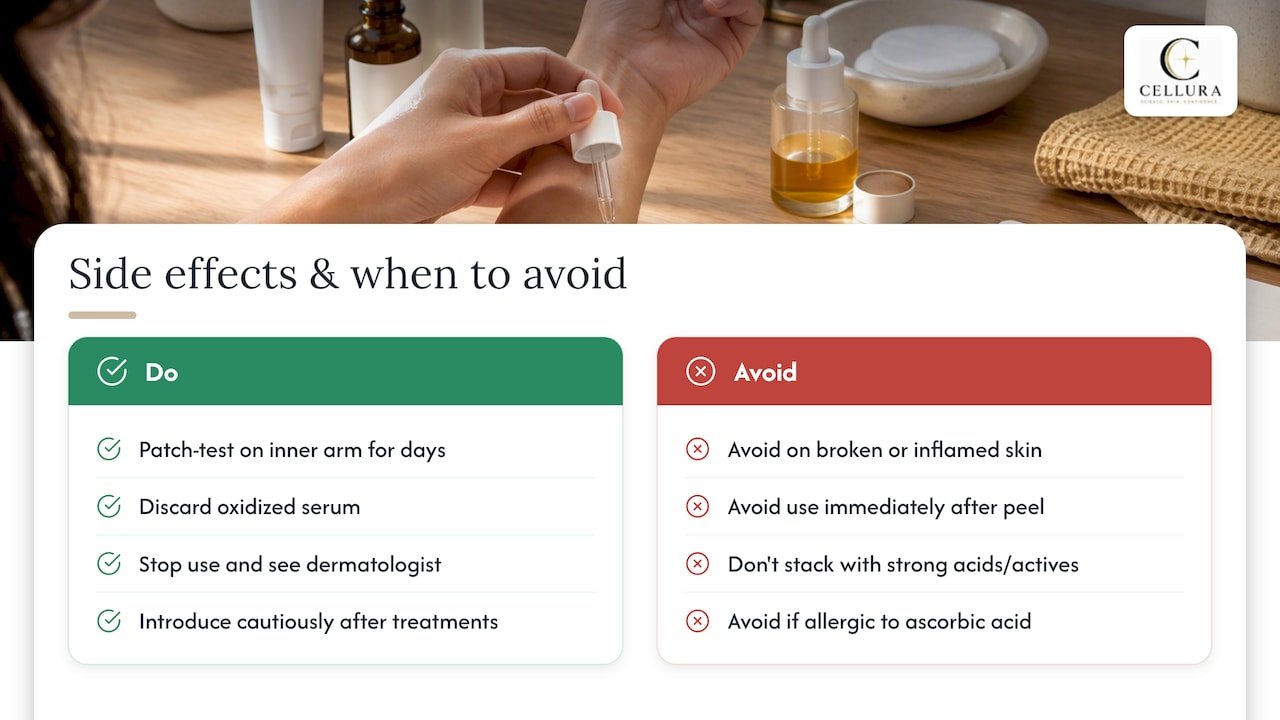
Vitamin C is generally well tolerated, but it is not risk-free, especially on skin already dealing with active hyperpigmentation. The most common side effects are stinging, redness, dryness, and mild flaking, usually tied to high concentrations or low pH formulas used too frequently.
A less obvious risk is yellow or orange staining on fabric and, in rare cases, temporary skin discoloration from degraded product, another reason oxidized serums should be discarded rather than used up.
Vitamin C is best avoided or introduced cautiously in a few situations: on broken or actively inflamed skin, immediately after a chemical peel or other resurfacing procedure, or alongside other strong acids and actives applied at the same time, since stacking actives raises irritation risk without necessarily adding benefit.
People with known sensitivity to ascorbic acid, or a history of contact dermatitis from citrus-derived skincare ingredients, should patch-test any new formula on the inner arm for several days before applying it to the face. Anyone noticing persistent burning, swelling, or a rash that does not resolve within a day or two should stop use and consult a dermatologist, since continuing to use an irritating product on hyperpigmented skin risks creating new post-inflammatory marks rather than fading existing ones.
Storing vitamin C products so they stay effective
Ascorbic acid degrades the moment it meets air, light, or heat, so storage is not a minor detail, it is part of whether the product works at all. A serum left open on a bright bathroom shelf can lose meaningful potency within weeks, even if the formula itself was stable on arrival.
A few habits protect potency:
- Keep vitamin C products in a cool, dark place, a drawer or cabinet rather than a sunlit windowsill.
- Close caps and pumps fully immediately after use to limit air exposure.
- Favor opaque, airless pump packaging over clear jars or droppers, which expose the product to light and air with every use.
- Watch the color: a shift from clear or pale yellow to deep amber or brown signals oxidation, and from that point the product is mostly serving as a reminder to replace it.
Refrigeration is not strictly necessary for most well-packaged derivatives, but it can extend shelf life for pure ascorbic acid formulas, particularly in warm climates. Checking the batch or manufacture date, when available, also helps, since even unopened vitamin C products lose strength gradually over time.
Beauvex perspective: a practical starter ritual for post-acne dark spots
Post-acne dark spots respond best to a layered approach rather than a single serum. Our own thinking centers on a three-step ritual: cleanse with a formula that gently supports cell turnover, follow with a targeted treatment serum that addresses pigmentation at more than one stage, then finish with a barrier-supporting step that keeps irritation, and the PIH it can trigger, in check.
Transparent concentrations and cited references matter here because they let you compare one brightening serum against another on substance rather than claims. A simple starter ritual anyone can try: cleanse, apply a targeted serum, then seal with a barrier-supporting moisturizer and daily sunscreen, adjusting frequency if irritation appears. Persistent or worsening dark spots are worth bringing to a dermatologist.
— Beauvex LLC
Cellura Luminé serum: built around disclosed, evidence-aligned actives
We formulated the Cellura Luminé Brightening Serum, 30 mL / 1 fl oz around actives chosen to interrupt pigmentation at multiple points rather than relying on one mechanism.
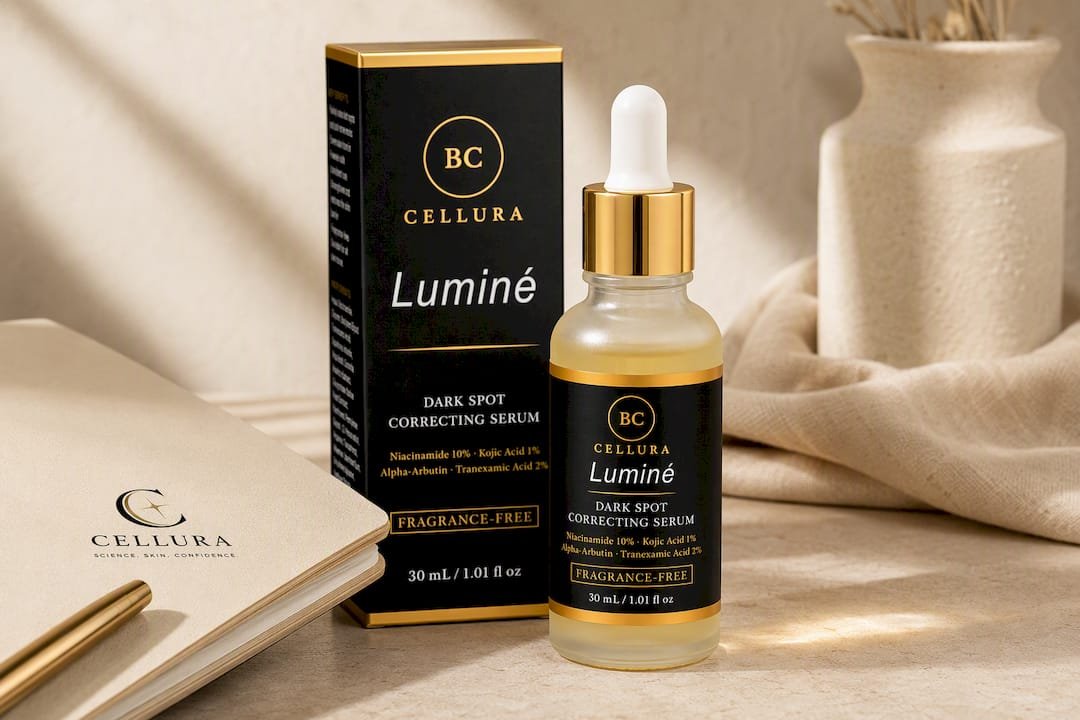
- Niacinamide supports the skin barrier while helping calm inflammation that can trigger new pigmentation.
- Tranexamic acid addresses the inflammatory signaling behind many stubborn dark marks.
- Alpha-arbutin offers a gentler tyrosinase-inhibiting option alongside these other actives.
We publish the exact concentration of each active and the research behind it, so you can weigh tolerability and likely effectiveness before adding it to your routine rather than guessing from an ingredient list. Explore the full Cellura line or start with the three-step ritual built around it.
This article is general information, not a substitute for advice from a qualified doctor. Consult a qualified healthcare professional about your own circumstances before acting on anything here.
FAQ
Does vitamin C clear hyperpigmentation?
Topical vitamin C can reduce certain types of hyperpigmentation, particularly superficial, sun- or inflammation-related marks, when used consistently in a stable, well-formulated product. It rarely clears pigmentation completely on its own and works best alongside daily sun protection and, often, other targeted actives.
Can vitamin C lower cortisol?
Vitamin C’s role in skincare relates to antioxidant and tyrosinase-inhibiting effects on skin pigmentation, not to systemic hormone regulation. Any broader claims about cortisol fall outside what topical skincare research actually measures or supports.
What is hyperpigmentation?
Hyperpigmentation is the darkening of patches of skin caused by excess melanin production, often triggered by sun exposure, inflammation, acne, or hormonal changes. It ranges from superficial marks that fade with consistent care to deeper pigmentation, like melasma, that typically needs a combination approach.
What is the best serum for hyperpigmentation on Black skin?
The best choice for melanin-rich skin tends to be a gentler vitamin C derivative, such as THD ascorbate, or a lower-concentration ascorbic acid formula paired with barrier-supporting ingredients, since irritation itself can trigger post-inflammatory hyperpigmentation. Daily use of a tinted, iron-oxide sunscreen alongside any active ingredient routine is especially important for protecting against visible-light-triggered pigmentation.
Sources
- Systematic review: topical vitamin C for melasma and photodamage
- Antioxidant skincare treatment for hyperpigmented and photodamaged skin: multi-center, cross-seasonal case study
- Meta-analysis: Vitamin C prevents UV-induced pigmentation in healthy volunteers
- Iron oxides in tinted sunscreen — product analysis and review