
Yes, alpha arbutin and tranexamic acid can be combined in a topical skincare routine, and for many people with post-acne dark spots or uneven tone, the pairing works better together than either does alone. Expect gradual fading over several weeks of consistent use, not overnight results, and daily sunscreen is non-negotiable. Patch-test any new product first, and if you’re considering oral tranexamic acid rather than a topical serum, that decision belongs to a clinician.
TL;DR:
- Combining topical tranexamic acid and alpha arbutin targets pigment through different mechanisms, providing a more comprehensive approach to fading dark spots.
- Clinical studies show significant pigmentation reduction within six to eight weeks of consistent use, with visible improvements often starting around week four.
- Use products with disclosed ingredient concentrations and start at the lower end of recommended ranges to minimize irritation risk for sensitive skin.
- Patch-test new products and introduce active ingredients gradually, avoiding mixing multiple potent agents or exfoliants in the same routine initially.
- Long-term pigmentation management relies on continuous use and daily sunscreen, as fading is gradual and new spots can develop without ongoing protection.
Table of Contents
- How each ingredient works and why they’re combined
- What the research and regulators say about safety and dosing
- Safety rules, irritation risk, and important interactions
- How to introduce, layer, and maintain a combined routine
- Beauvex’s evidence-led approach to pigmentation
- Realistic expectations and long-term maintenance
- Try this starter regimen from Beauvex
- Sources
- FAQ
How each ingredient works and why they’re combined
Alpha arbutin and tranexamic acid fade pigment through different routes, which is the whole reason pairing them makes sense.
Alpha arbutin slows the enzyme tyrosinase, which your skin needs to produce melanin. Less tyrosinase activity means less new pigment forms in cells that are already prone to overproducing it, the hallmark of post-acne dark marks. Tranexamic acid works upstream of that. It calms the inflammatory signaling that pushes melanocytes into overdrive after a breakout or UV exposure, and it appears to stabilize how pigment granules transfer into surrounding skin cells.
- Alpha arbutin: inhibits tyrosinase to slow new melanin production at the source.
- Tranexamic acid: reduces inflammation-driven pigment signaling and helps stabilize melanosome transfer.
- Combined effect: addresses both pigment production and the inflammatory triggers that keep renewing it, which single-mechanism products cannot do on their own.
This is why formulas that rely on only one brightening agent often plateau. A breakout fades, a dark mark forms, and a tyrosinase inhibitor alone cannot fully address the inflammatory signal still driving it. Combining the two gives a routine two separate angles of attack on the same discoloration, which is also why multi-active serums have become the standard approach for post-acne marks rather than single-ingredient products.
What the research and regulators say about safety and dosing
The clinical evidence for each ingredient is encouraging, though most trials test them in specific combinations rather than in isolation.
An 8-week double-blind, split-face randomized controlled trial compared 3% topical tranexamic acid cream against 4% hydroquinone cream in 20 people with mixed-type melasma. The tranexamic acid arm showed a significant reduction in pigmentation severity scores at both week 4 and week 8, performing comparably to hydroquinone on patient-reported outcomes.
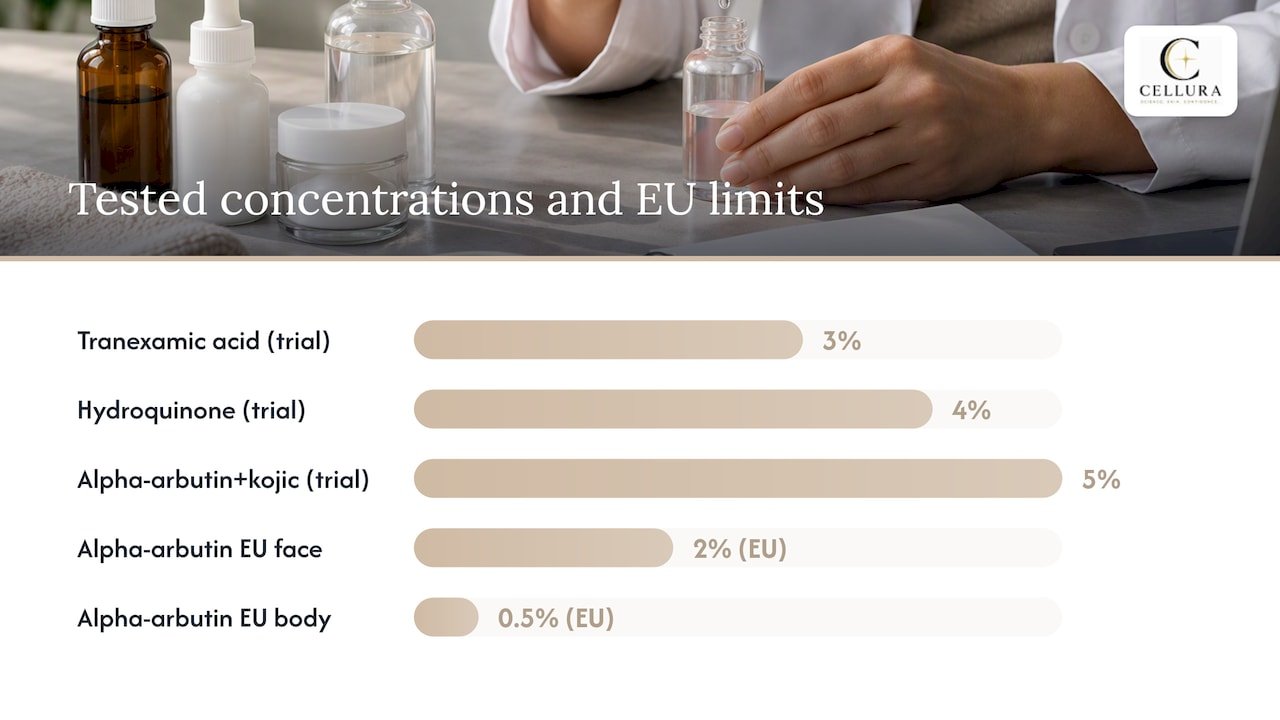
A split-face pilot study found a cream combining alpha-arbutin 5% with kojic acid 2% performed comparably to triple-combination cream for melasma, with fewer adverse events over 12 weeks. Because the formula combined two actives, the result cannot be attributed to alpha arbutin alone, a limitation common across pigmentation research.
On the regulatory side, the EU Scientific Committee on Consumer Safety has concluded alpha-arbutin is safe in face creams up to 2% and body lotions up to 0.5%, a ceiling that applies to cosmetic products sold under EU rules.
- Favor products that disclose exact concentrations rather than vague “brightening complex” labels.
- If you have sensitive or reactive skin, start at the lower end of tested ranges.
- Treat clinical trial percentages as reference points, not guarantees tied to any specific product.
Safety rules, irritation risk, and important interactions
Combining actives raises the odds of irritation if you move too fast, so the sequence matters as much as the ingredients.
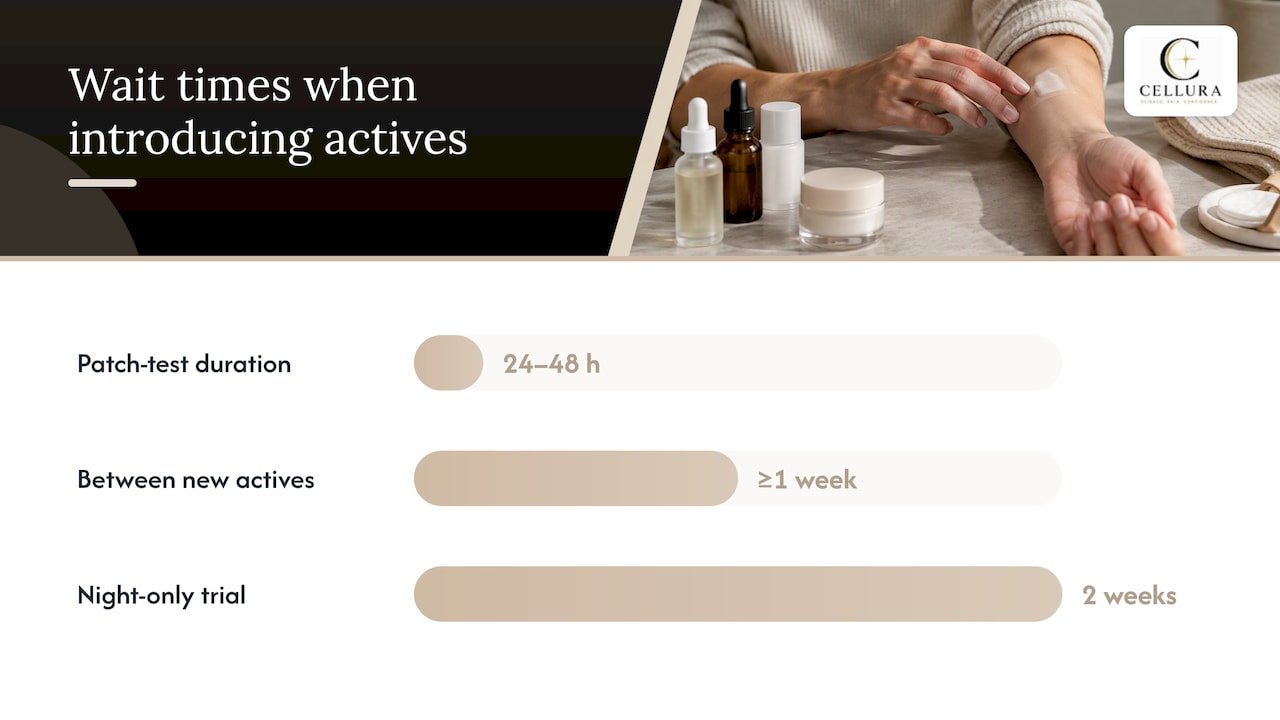
Start with a patch test: apply a small amount behind the ear or on the inner forearm, wait 24 to 48 hours, and only proceed if the skin stays calm. Introduce one new active at a time rather than layering several brighteners, exfoliating acids, and a retinoid in the same week. Chemical exfoliants, retinoids, and multiple brightening agents used together are the most common cause of compounded irritation, not any single ingredient at a safe concentration.
- Patch-test new products for 24 to 48 hours before full-face use.
- Introduce one active at a time, waiting at least a week between additions.
- Avoid stacking exfoliating acids and retinoids with a new brightening serum in the same routine.
- Apply broad-spectrum sunscreen every morning regardless of which actives you use at night.
It’s worth separating topical tranexamic acid from the oral version here. American Academy of Dermatology guidance notes that tranexamic acid can be used topically or orally for melasma, but oral use carries clotting risk and requires a clinician’s assessment. Using a topical serum does not change that calculus if you’re also considering an oral prescription.
Pro Tip: Introduce a new brightening serum at night only for the first two weeks, so you can judge irritation before adding morning use.
How to introduce, layer, and maintain a combined routine
A combined routine works best when you build it in stages rather than starting everything at once.
- Patch-test the new serum for 48 hours, then apply it every other night for one week.
- Move to nightly use if your skin tolerates it, applying the thinnest textures first, cleanser, then serum, then moisturizer.
- Hold off on retinoids or exfoliating acids for the first two to three weeks while your skin adjusts.
- Add sunscreen every morning without exception, since UV exposure undoes pigment progress.
- Reassess at six weeks and again at twelve, since most visible change in arbutin and tranexamic acid routines shows up in that window.
| Stage | Timing | What to watch for |
|---|---|---|
| Patch test | Days 1 to 2 | Redness, itching, or stinging |
| Introduction | Weeks 1 to 2 | Mild tingling is common; peeling is not |
| Full routine | Weeks 3 to — | Early fading, improved tone evenness |
| Maintenance | Weeks — to 12 | Continued fading, stable tolerance |
If irritation shows up, cut back to every other night or drop any exfoliating step until skin calms down. Persistent redness, spreading pigment, or marks that resist a full 12-week routine are reasons to see a dermatologist rather than keep adjusting products at home.
Beauvex’s evidence-led approach to pigmentation
A three-step skincare ritual can address pigment production, calm the inflammation behind it, and protect the skin barrier so actives are tolerated rather than fought.
Certain skincare products include multi-active facial cleansing bars formulated with salicylic, azelaic, and kojic acids to prep skin without stripping it before treatment serums go on. Brightening serums can also combine niacinamide, tranexamic acid, kojic acid, and alpha-arbutin in one formula, designed to work on pigment production and inflammatory signaling simultaneously rather than relying on one mechanism.
- Some skincare brands publish exact ingredient concentrations rather than vague blend names.
- Active ingredients may be paired with research references explaining their inclusion.
- Formulas might disclose differences from published clinical studies rather than imply them away.
Transparency in ingredient disclosure allows consumers to compare alpha arbutin’s known effects against what is printed on product labels, providing more informed evaluation than relying solely on marketing claims.
Realistic expectations and long-term maintenance
Pigment control is maintenance, not a cure. Dark spots fade with consistent use, but new ones can form again if sun exposure or breakouts continue, so sunscreen is the single habit that protects every other step in your routine. If pigmentation spreads, appears symmetrically, or doesn’t budge after a full 12-week routine, that’s a signal to involve a dermatologist rather than keep troubleshooting alone.
— Beauvex LLC
Try this starter regimen from Beauvex

If you’ve read this far, you already know what to look for: clear concentrations, complementary mechanisms, and a routine you’ll actually stick with. Beauvex publishes both, so you’re not guessing what’s in the bottle or why it’s there.
- Start with the Cellura ClearMark Bar to prep skin without over-stripping it.
- Follow with the Cellura Luminé Brightening Serum, formulated with niacinamide, tranexamic acid, and alpha-arbutin at disclosed concentrations.
- Browse the full Cellura line if you want the complete three-step ritual in one order.
FAQ
Can tranexamic acid and alpha arbutin be used together?
Yes, topical tranexamic acid and alpha arbutin are commonly combined in cosmetic serums because they target pigment through different mechanisms. Patch-test first and pair the routine with daily sunscreen, since both ingredients work best as part of a complete photoprotection habit.
What cannot be mixed with tranexamic acid?
There is no official list of ingredients that cannot be combined with topical tranexamic acid, but stacking it with multiple exfoliating acids, retinoids, and other brightening agents at once raises irritation risk. AAD guidance also distinguishes topical use from oral tranexamic acid, which carries clotting risk and requires a clinician’s evaluation.
How long does it take for arbutin and tranexamic acid to work?
Most people notice early changes in tone evenness within six weeks of consistent use, with more visible fading by twelve weeks. The 3% tranexamic acid trial recorded significant improvement at week 4 and continued gains through week 8, which lines up with typical real-world timelines.
Does alpha arbutin remove dark spots permanently?
No, alpha arbutin fades existing pigment but does not prevent new dark spots from forming if breakouts or unprotected sun exposure continue. Lasting results depend on ongoing use and daily broad-spectrum sunscreen rather than a one-time treatment.