
This article covers topical, evidence-backed actives for treating post-acne dark spots, not pregnancy-safety guidance for hormonal melasma. The ingredients with the strongest clinical support are niacinamide, azelaic acid, tranexamic acid, kojic acid, arbutin, and salicylic acid. Used consistently in a three-step routine with daily sunscreen, these actives typically produce visible fading within 8 to 12 weeks.
TL;DR:
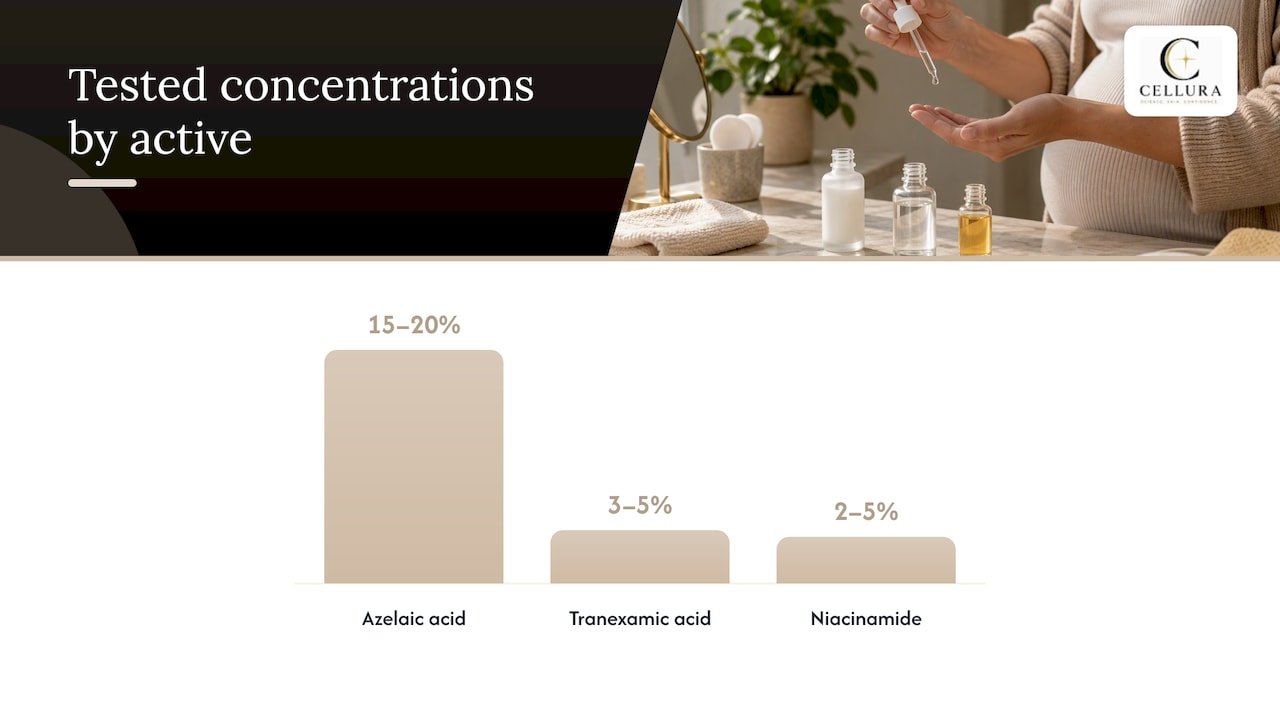
- Azelaic acid at 15 to 20% shows effective results for post-inflammatory hyperpigmentation, especially when used at the higher end of the concentration range.
- Trans-3% to 5% topical tranexamic acid serums demonstrate visible improvements within 12 weeks, starting as early as two weeks with consistent use.
- Niacinamide at 2 to 5% helps reduce melanin transfer and supports skin barrier function, making it a well-tolerated active for ongoing use.
- Proper formulation, including pH, stabilizers, and exact concentration disclosures, significantly influences the effectiveness of tyrosinase-inhibiting ingredients like kojic acid and arbutin.
- Visible improvements typically appear between weeks 8 and 12 when daily sunscreen accompanies active treatment, with early subtle changes possible around week 2.
Table of Contents
- Which ingredients have the best evidence for post-acne dark spots
- How these actives work and what concentrations to look for
- How to build a three-step routine for fading dark spots
- What results to expect and when to see a dermatologist
- Safety profiles and pregnancy risk categories for these ingredients
- Alternatives when a standard active is not the right fit
- Why a healthcare provider should be part of this decision
- What is known about fetal and maternal exposure to these treatments
- Natural and non-chemical options for hyperpigmentation during pregnancy
- Why ingredient transparency changes how you shop for these actives
- How the Cellura Luminé Brightening Serum fits this routine
- Selected studies and guidance behind this article
- Sources
- FAQ
Which ingredients have the best evidence for post-acne dark spots
Post-inflammatory hyperpigmentation from acne responds to a specific set of topical actives that have been tested in clinical trials, though most of that research overlaps with melasma studies rather than isolating acne-related PIH alone.
- Azelaic acid: Randomized trials show it works for PIH and melasma, commonly formulated at 15 to 20% with good tolerability. A comparative trial in acne patients found 20% azelaic acid cream effective against PIH, generally requiring the higher end of that range for visible results.
- Tranexamic acid: Topical formulations have performed well in dyschromia studies. A 12-week clinical evaluation of a serum with 3% tranexamic acid, 1% kojic acid, and 5% niacinamide showed measurable improvement beginning at week 2 and continuing through week 12, with a reduced melanin index and good tolerability.
- Niacinamide: Reduces melanosome transfer to surrounding skin cells, with clinical benefit reported at 2 to 5% concentrations. It also supports barrier function, which matters for skin already irritated by acne.
- Kojic acid and arbutin: Both act as tyrosinase inhibitors with clinical support in a systematic review of depigmenting agents, though formulation stability affects how well they hold up on the shelf, and irritation is possible at higher concentrations.
- Salicylic acid: Useful for exfoliation and PIH management, but regulators have flagged nuances worth knowing. The EMA/PRAC scientific assessment recommended updated product-information language for topical salicylic acid, citing limited data, even though topical exposure levels are generally low.
The main limitation across this research: many trials study melasma or mixed dyschromia rather than isolating acne-related PIH, so the acne-specific evidence base, while supportive, is still smaller than the melasma literature. For a deeper comparison of two of the most-studied actives, see tranexamic acid versus niacinamide.
How these actives work and what concentrations to look for
Each ingredient interrupts pigment production at a different point, which is why combination formulas often outperform single-active products.
- Niacinamide slows the transfer of melanin-containing melanosomes from pigment cells to skin cells.
- Azelaic acid, kojic acid, and arbutin inhibit tyrosinase, the enzyme that drives melanin production.
- Tranexamic acid works through anti-inflammatory and plasmin-inhibiting pathways that calm the pigment response to injury.
- Salicylic acid works differently: it exfoliates and unclogs pores, helping prevent new PIH from forming rather than treating existing spots.
Trial-supported concentration ranges vary noticeably by ingredient. Azelaic acid performs best at 15 to 20%, topical tranexamic acid is frequently tested at 3 to 5% in serum form, and niacinamide shows benefit at 2 to 5%. Kojic acid and arbutin concentrations vary more widely across studies, largely because both actives are prone to oxidation and need proper stabilization to remain effective.
Formulation details beyond the active percentage matter too. The pH of a product, the vehicle it is suspended in, and any stabilizers used all influence how much of an active actually reaches the skin and stays effective over time. This is part of why two products listing the same percentage of an ingredient can behave differently. Since concentration reporting is inconsistent across the market, it helps to favor products that publish their exact percentages and cite the studies behind them, rather than listing an ingredient without context. The Luminé Brightening Serum page is one example of a product that discloses this detail.
How to build a three-step routine for fading dark spots
A cleanse-treat-protect structure keeps the routine simple while making room for the actives with the best evidence.
- Cleanse gently. Use a mild cleanser daily. If active acne is still present, a cleanser containing salicylic or azelaic acid used a few times a week can help without over-drying skin that is already prone to irritation.
- Treat with a targeted serum. Choose one or two actives at evidence-backed concentrations, such as niacinamide paired with tranexamic acid, and patch-test before full-face use. A retinoid can be layered in separately for acne control on nights it is not skipped, since combining too many actives at once raises irritation risk.
- Support the barrier. Follow with a moisturizer containing ceramides, squalane, or peptides. A compromised barrier is itself a driver of new pigmentation, so this step is not optional even when skin looks calm.
- Protect from light daily. Apply broad-spectrum SPF 30 or higher every morning. For deeper phototypes, visible-light protection matters as much as UV filtering, since visible light also triggers pigment production.
Pro Tip: Introduce a new active two to three nights a week for the first two weeks, then increase frequency only if skin tolerates it without persistent redness or flaking.
Mild, short-lived redness after starting an active is common. Persistent stinging, peeling, or worsening dark spots is not, and signals it is time to scale back. For a full walkthrough of routine sequencing, see how to fade dark spots after acne.
What results to expect and when to see a dermatologist
Patience matters more than most people expect with pigment-focused actives.
- Early, subtle change can show up around week 2, but the more measurable improvement documented in trials arrives between weeks 8 and 12, driven largely by consistent use and daily sunscreen.
- Common side effects include mild dryness, transient redness, and occasional stinging, most of which respond to reducing application frequency or adding a richer barrier moisturizer.
- If pigmentation worsens, irritation becomes severe, or there is no visible response after a full 8 to 12 week trial, it is worth consulting a dermatologist about procedural options or prescription-strength therapies rather than continuing to self-treat.
Safety profiles and pregnancy risk categories for these ingredients
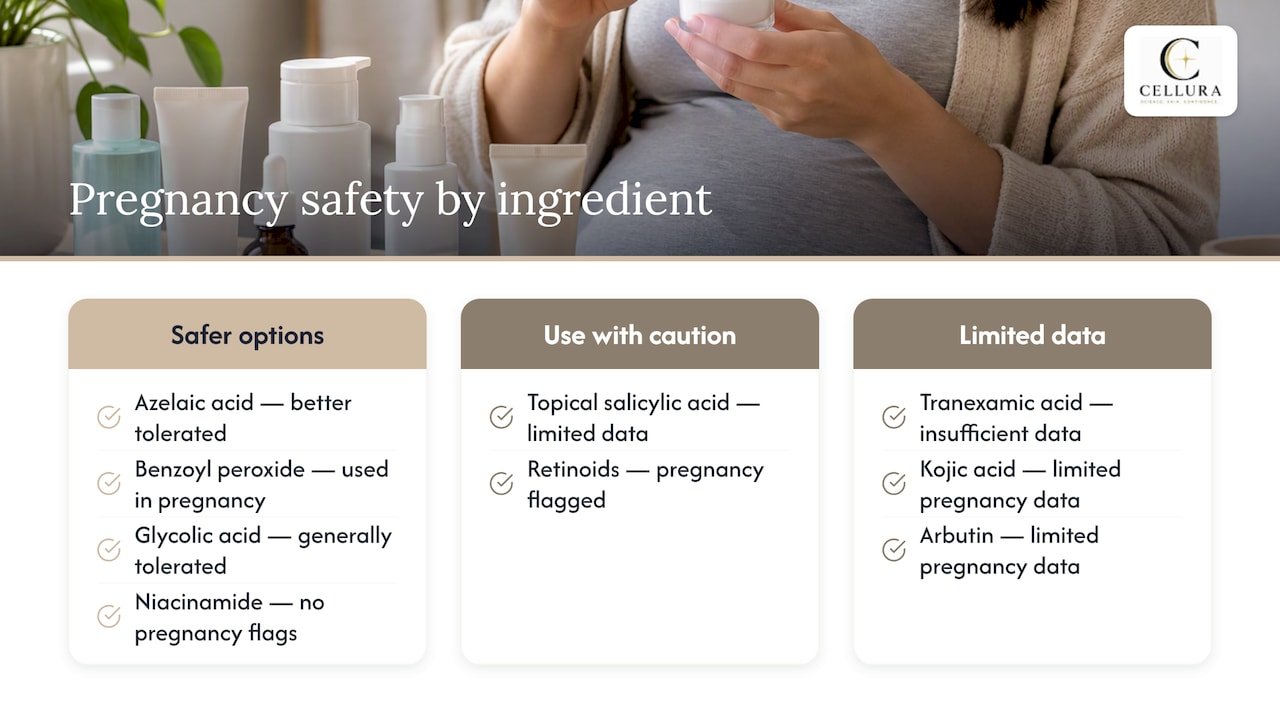
Readers researching hyperpigmentation often want to know how these same actives are viewed during pregnancy, even when their primary interest is post-acne dark spots. Azelaic acid is generally considered one of the better-tolerated topical options in pregnancy contexts, alongside benzoyl peroxide and glycolic acid, according to a dermatologic conditions in pregnancy guidance summary. Niacinamide is widely used and has not raised the same flags as retinoids in pregnancy safety discussions.
Topical salicylic acid warrants more caution. The EMA/PRAC assessment recommended updated product-information language specifically because of limited pregnancy data, even though absorption through topical use is generally low. Tranexamic acid, kojic acid, and arbutin have less pregnancy-specific safety data published, which means caution defaults to a conversation with a healthcare provider rather than assuming safety by extension from their PIH efficacy data.
None of this changes the guidance for readers not pregnant: the ingredients above remain the ones with the clearest evidence for treating acne-related dark spots. But anyone pregnant or breastfeeding should treat this as a separate decision, made with a clinician, rather than one settled by a skincare label.
Alternatives when a standard active is not the right fit
Retinoids are typically avoided in pregnancy guidance contexts, and some people simply do not tolerate higher-strength actives like 20% azelaic acid or layered combination serums. In both cases, there are still options with some clinical support.
Benzoyl peroxide and lower-strength glycolic acid appear in the same pregnancy-safety guidance summary as azelaic acid as commonly recommended, generally well-tolerated choices for active acne management, which indirectly helps prevent new PIH from forming. Niacinamide remains one of the gentler pigment-focused actives across the literature, useful for readers who react poorly to stronger tyrosinase inhibitors or exfoliating acids. For exfoliation without salicylic acid’s regulatory caveats, a lower-concentration lactic or glycolic acid can serve a similar unclogging function, though with less pigment-specific evidence behind it.
The right substitution depends on which ingredient is being avoided and why. Someone avoiding salicylic acid for pregnancy-related caution has a very different profile than someone avoiding azelaic acid because of irritation, so the swap should match the specific concern rather than defaulting to “gentler is always better.”
Why a healthcare provider should be part of this decision
Skincare labels are not designed to account for individual pregnancy risk factors, prior skin history, or interactions with other medications. The pregnancy-safety guidance referenced throughout this piece comes from clinical and regulatory sources, not product marketing, and it is written in general terms rather than as personalized advice.
Anyone pregnant or breastfeeding who wants to treat acne-related dark spots should raise the specific actives they are considering with an obstetrician, midwife, or dermatologist before starting. This matters most for ingredients with thinner safety data, like tranexamic acid and kojic acid, where the absence of red flags is not the same as documented safety. A provider can also weigh in on timing, since some routines are easier to justify pausing or adjusting during pregnancy and resuming afterward. Resources like Honey & Sage’s pregnancy and baby prep guides can help with the broader shared-decision-making context around pregnancy care, though they are not a substitute for direct medical guidance on specific actives.
What is known about fetal and maternal exposure to these treatments
Topical application generally results in far lower systemic absorption than oral medications, which is part of why several of these actives are viewed cautiously rather than being outright prohibited. Still, the available data is limited for most pigment-focused ingredients, which is precisely why the EMA/PRAC assessment on salicylic acid called for updated labeling rather than concluding the ingredient was clearly safe or clearly harmful in pregnancy.
For the mother, the more immediate concern with most of these actives is irritation rather than systemic effects, particularly on skin that may already be more reactive during pregnancy due to hormonal shifts. For the fetus, the concern is theoretical absorption through the skin reaching systemic circulation, which is why ingredients with thin data get a cautious label even without documented harm. This is also why retinoids, which do have documented developmental risk at oral doses, are treated differently in pregnancy guidance than an ingredient like azelaic acid, which has a more reassuring track record. None of this is a substitute for a conversation with a provider who knows the individual’s full health history.
Natural and non-chemical options for hyperpigmentation during pregnancy
For readers who prefer to minimize active ingredients altogether during pregnancy, the options are more limited in clinical support but not nonexistent. Diligent sun protection, including a physical sunscreen and simple sun avoidance during peak hours, does more to prevent new pigmentation and worsening of existing spots than almost any single active ingredient, pregnancy-safe or not.
Beyond sun protection, the honest answer is that non-chemical approaches have much thinner evidence behind them than the topical actives discussed earlier in this piece. Gentle exfoliation through non-acid physical methods, consistent barrier support with simple emollients, and time are the main tools available without introducing an active ingredient of uncertain pregnancy status. Many cases of pregnancy-related pigmentation change also fade on their own after delivery as hormones stabilize, which is a different pattern than acne-related PIH, which typically needs active intervention to fade fully. Anyone hoping to speed up fading during pregnancy should still route that decision through a provider rather than substituting an unproven natural remedy for medical guidance.
Why ingredient transparency changes how you shop for these actives
Reading trial data is only useful if a product actually tells you what is inside it. Most of the confusion in this category comes from labels that name an ingredient without stating its concentration, leaving you to guess whether it matches what the studies tested. Some skincare brands build their three-step ritual—cleanse, treat, and support the barrier—around that gap by publishing exact concentrations and citing research behind each active rather than leaving buyers to take claims on faith.
— Beauvex LLC
How the Cellura Luminé Brightening Serum fits this routine
If you are ready to put the treat step into practice, the Cellura Luminé Brightening Serum combines niacinamide, tranexamic acid, and alpha-arbutin, three of the actives with the clinical support outlined above, in one formula.
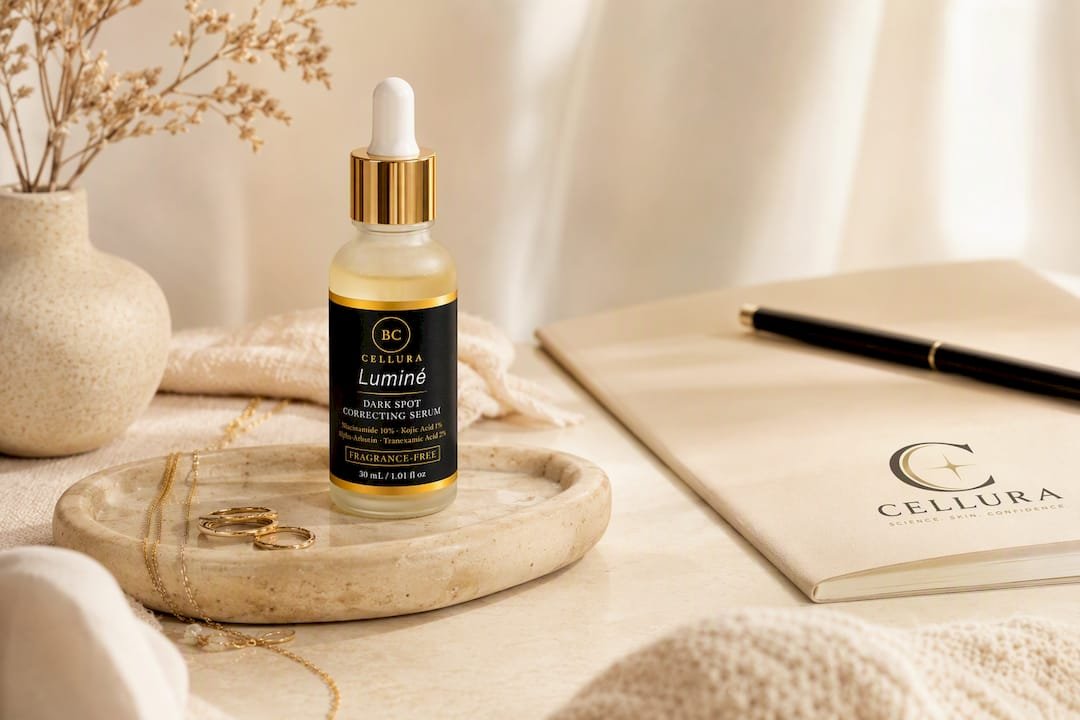
- Concentrations and the studies behind them are published on the product page, so you can check the formula against the trial data yourself.
- It suits readers who want a single serum built to slot into the treat step of a three-step ritual rather than piecing together multiple single-ingredient products.
- The serum is part of the broader Cellura line, which follows the same cleanse, treat, and barrier-support structure.
For readers who tolerate exfoliation well, pairing this serum with a dedicated azelaic acid product on alternate nights can add tyrosinase inhibition to the melanosome-transfer and anti-inflammatory action already built into the serum.
Selected studies and guidance behind this article
This article draws on randomized trials on azelaic acid and tranexamic acid for PIH, a systematic review of depigmenting agents, a 2025 sunscreen and niacinamide PIH-prevention trial, and regulatory guidance from the EMA on topical salicylic acid. Full citations appear linked throughout the sections above.
Sources
- Effect of a Tranexamic Acid, Kojic Acid, and Niacinamide Containing Serum on Facial Dyschromia: A Clinical Evaluation
- A comparative study of 20% azelaic acid cream versus 5% tranexamic acid solution for the treatment of postinflammatory hyperpigmentation in patients with acne vulgaris
- Clinical evidence for natural and non-hydroquinone depigmenting agents in hyperpigmentation
- Salicylic acid (topical) — PRAC / CMDh scientific conclusions (EMA)
FAQ
Is niacinamide effective for post-acne dark spots?
Yes, niacinamide is supported by clinical evidence showing it slows the transfer of pigment to surrounding skin cells, with benefit reported at 2 to 5% concentrations. It is also one of the better-tolerated actives, making it a common base ingredient in combination serums.
Is azelaic acid effective for treating acne-related hyperpigmentation?
Yes, azelaic acid has randomized trial support for post-inflammatory hyperpigmentation, typically formulated at 15 to 20% for visible effect. It is also generally regarded as one of the better-tolerated options among topical acne actives.
How long does it take to see results from these actives?
Some fading can appear as early as week 2, but the more measurable improvement documented in clinical studies shows up between weeks 8 and 12 of consistent use. Daily sunscreen use alongside the active ingredient is a major factor in reaching that result.
What does the Cellura Luminé Brightening Serum contain?
The Cellura Luminé Brightening Serum combines niacinamide, tranexamic acid, and alpha-arbutin, actives with documented support for post-inflammatory hyperpigmentation. Its exact concentrations and supporting research are published on the product page.
Can salicylic acid still be used to treat post-acne dark spots?
Salicylic acid remains useful for exfoliation and preventing new breakouts that lead to dark spots, though a regulatory review from the EMA flagged limited data on topical use in certain contexts. For most people treating acne-related PIH outside of pregnancy, it remains a reasonable part of the cleanse step.