Kojic acid tends to act faster on stubborn dark spots but carries a higher irritation risk, while alpha arbutin works more slowly and gently, making it easier to use daily. If your skin is reactive or you’re treating melasma long term, alpha arbutin is the safer starting point. If you have isolated post-acne marks and tolerate actives well, kojic acid can speed things along, especially when paired with the routine rules covered later.
TL;DR:
- Kojic acid can produce visible dark spot fading within four to six weeks but carries a higher risk of irritation, especially at concentrations above 2%.
- Alpha arbutin works more slowly over eight to twelve weeks and is better tolerated, making it suitable for sensitive or reactive skin.
- Clinical trials indicate that combination formulas with lower concentrations of both ingredients can match the effectiveness of prescription treatments with fewer side effects.
- Regulatory safe limits are up to 1% for kojic acid in leave-on products and 2% for alpha arbutin in face creams, emphasizing the importance of proper formulation and patch testing.
- Alternating use of the ingredients, supported by daily sunscreen, offers an effective approach to target stubborn spots while minimizing irritation risks.
Table of Contents
- Kojic acid vs alpha arbutin at a glance
- Why the two ingredients act so differently on skin
- What clinical trials actually show about results and timelines
- How much of each ingredient is actually safe to use
- Building a routine that uses both ingredients well
- Where Beauvex’s formulas fit this comparison
- A practical framework for choosing between them
- Try Beauvex’s transparent approach to dark spot care
- Sources
- FAQ
Kojic acid vs alpha arbutin at a glance
Both ingredients block the enzyme tyrosinase, which drives melanin production, but they do it differently and at different speeds. That difference shows up in how fast you see results and how much your skin complains along the way.
- Speed of action: kojic acid often shows visible fading within 4 to 6 weeks of consistent use; alpha arbutin tends to work more gradually over 8 to 12 weeks.
- Irritation risk: kojic acid is more likely to cause stinging, redness, or dryness, particularly above 2%; alpha arbutin is generally better tolerated, even on sensitive or darker skin tones.
- Common formats: kojic acid appears in cleansers, soaps, and serums; alpha arbutin is most often found in serums and creams meant for daily leave-on use.
- Typical concentrations: kojic acid products commonly range from 1% to 4%, though regulatory guidance caps leave-on face products lower; alpha arbutin products typically sit between 1% and 5%, with formulation quality affecting how much actually penetrates skin.
Alpha arbutin fits best as a daily maintenance ingredient for melasma-prone or reactive skin, since it delivers steady inhibition without the sting. Kojic acid fits best as a targeted, shorter-term treatment for post-inflammatory hyperpigmentation (PIH) or stubborn spots where a stronger nudge is worth the tradeoff. Neither is a universal answer. The right pick depends on how your skin reacts to actives and how much time you’re willing to give the process.
Why the two ingredients act so differently on skin
Kojic acid works by chelating copper at the active site of tyrosinase, which disrupts the enzyme’s ability to catalyze melanin synthesis. It also has antioxidant properties that help calm some of the oxidative stress linked to hyperpigmentation. That dual action is part of why it can move faster, but copper chelation is also chemically reactive, which is part of why it’s more irritating at higher strengths.
Alpha arbutin is a glycosylated form of hydroquinone. Skin enzymes break the sugar bond slowly, releasing small amounts of the active compound over time. That slow release is exactly why alpha arbutin feels gentler: it never floods the skin with a large dose at once.
Formulation changes both stories. A few things that shift the balance:
- Lower pH formulas can increase kojic acid’s activity but also raise irritation risk.
- Buffered, slightly acidic to neutral pH formulas tend to improve alpha arbutin’s stability without added sting.
- Delivery vehicle matters too: a rinse-off cleanser limits contact time and lowers irritation risk compared with a leave-on serum at the same concentration.
Pro Tip: If you’re new to either ingredient, start with a lower concentration in a rinse-off format like a cleansing bar before moving to a leave-on serum.
What clinical trials actually show about results and timelines
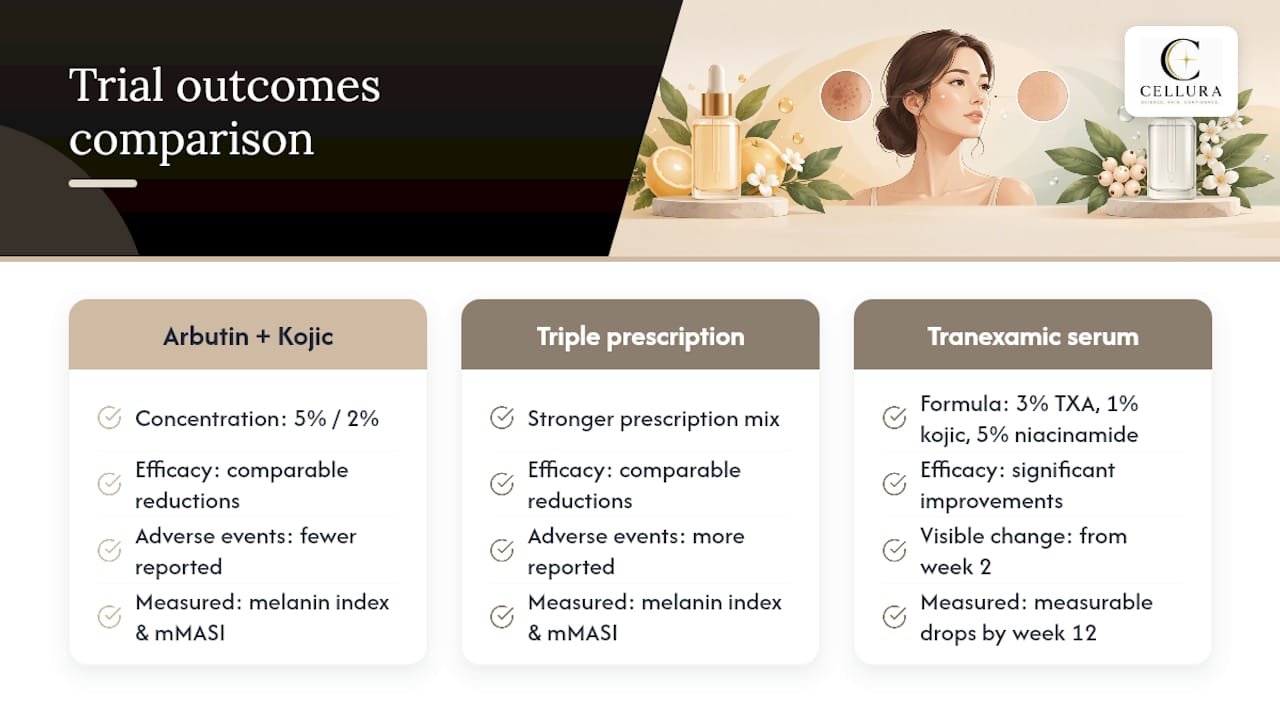
Trial data gives a more grounded picture than marketing claims. A split-face randomized pilot trial comparing a cream with alpha-arbutin 5% and kojic acid 2% against a triple combination cream for melasma found comparable reductions in melanin index and mMASI scores, with fewer adverse events on the arbutin and kojic acid side. That’s a meaningful finding: a gentler combination performed similarly to a stronger prescription-strength option in that study.
Combination serums show similar promise. A 12-week clinical evaluation of a serum containing 3% tranexamic acid, 1% kojic acid, and 5% niacinamide found significant improvements in melanin index and dyschromia by week 12, using Mexameter measurements, with visible change beginning as early as week 2.
By week 12, split-face and controlled trials on combination formulas have documented measurable drops in melanin index, a finding drawn from the tranexamic acid, kojic acid, and niacinamide serum study, meaning realistic expectations should be measured in months, not days.
A few caveats matter here. These trials tend to run on small sample sizes, and results vary by skin type, baseline pigmentation, and sun exposure during the study period. None of the improvements hold without daily sunscreen, and none of them are permanent fixes: melanin production restarts if triggers like UV exposure or inflammation continue. The consistent theme across trials is that combination formulas targeting multiple pathways in melanogenesis tend to outperform single ingredients used alone, often letting formulators use lower, gentler concentrations of the more irritating actives.
How much of each ingredient is actually safe to use
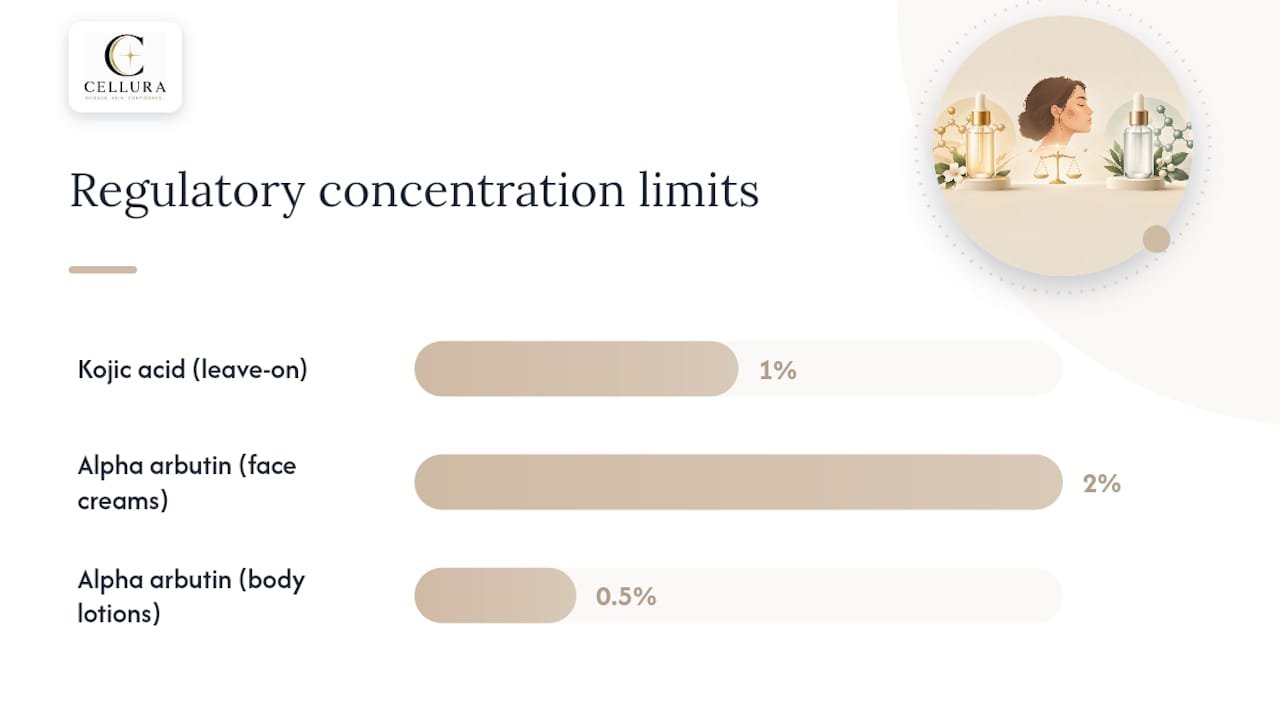
Regulatory bodies have set clear limits based on safety data, and those numbers are worth checking against any product label. The SCCS opinion on kojic acid considers the ingredient safe in leave-on face and hand products at concentrations up to 1%. That’s lower than what many over-the-counter products claim, which is one reason kojic acid soaps and cleansers (rinse-off formats with limited contact time) are more common than leave-on serums at higher strengths.
For alpha arbutin, the SCCS safety opinion sets the limit at up to 2% in face creams and 0.5% in body lotions, reflecting the lower systemic exposure concern with its slow-release mechanism.
- Irritation, stinging, and dryness are the most common adverse reactions to both ingredients, especially at the upper end of concentration ranges.
- Over-irritating skin can trigger a rebound of post-inflammatory hyperpigmentation, undoing the progress you were trying to make.
- Patch-test any new active on your inner arm or behind your ear for 48 hours before applying it to your face.
Formulation quality affects safety too. Maintaining product pH in a moderate range and using high-purity raw materials both reduce the already low risk of arbutin breaking down into free hydroquinone during use, and proper storage away from heat and light helps preserve stability in both ingredient types.
Pro Tip: Introduce a new active two to three nights a week for the first two weeks, then increase frequency slowly if your skin tolerates it without redness or peeling.
Building a routine that uses both ingredients well
Alpha arbutin works well as a daily, year-round maintenance step, particularly for melasma or sensitive skin that can’t handle frequent actives. Kojic acid works better as a targeted, shorter course aimed at specific dark spots, especially when your skin can tolerate a firmer approach.
Combining them is possible and, per the split-face trial data above, can work as well as stronger prescription creams when concentrations are kept moderate. Use a lower kojic acid percentage, alternate nights with alpha arbutin rather than layering both daily, and support the mix with soothing actives like niacinamide, which reduces irritation while also inhibiting melanosome transfer.
A simple introductory approach:
- Weeks 1 and 2: apply alpha arbutin serum four nights a week, patch-testing kojic acid separately.
- Weeks 3 and 4: alternate alpha arbutin and kojic acid nights, three each per week.
- Weeks 5 and 6: increase kojic acid nights if tolerated well, keeping alpha arbutin on the remaining nights.
- Every morning: apply broad-spectrum sunscreen, since both ingredients lose effectiveness without UV protection and unprotected skin will keep making new pigment.
For a full breakdown of layering order with other actives, see this guide to applying skincare products in the right order.
Where Beauvex’s formulas fit this comparison
Beauvex builds its three-step ritual (cleanse, treat, support) around the same evidence discussed above. The Cellura line publishes exact ingredient concentrations and research references for each active, so you can check them against SCCS limits and trial data yourself rather than taking a marketing claim at face value.
The Luminé Brightening Serum combines niacinamide, tranexamic acid, kojic acid, and alpha arbutin, targeting multiple points in the pigmentation pathway at once, similar to the combination formulas that performed well in the trials above. That multi-pathway approach is meant to support both spot-targeting and daily maintenance without relying on one ingredient at a high, irritating dose. Compare the listed concentrations against the regulatory limits and studies discussed here before deciding what fits your skin.
A practical framework for choosing between them
Start gentle if your skin reacts easily: alpha arbutin, used daily, is the lower-risk choice for melasma or sensitive skin. If you’re dealing with stubborn, isolated spots and your skin tolerates actives well, a short course of kojic acid at a modest concentration can move faster. Combine the two under daily sunscreen, watch for irritation, and see a dermatologist if melasma or PIH doesn’t respond after a few months of consistent use.
— Beauvex LLC
Try Beauvex’s transparent approach to dark spot care
Most brightening products don’t tell you what concentration you’re actually applying, which makes it hard to judge whether a product matches the regulatory limits or clinical data covered above. Beauvex publishes exact percentages for every active, so you’re comparing real numbers instead of guessing.
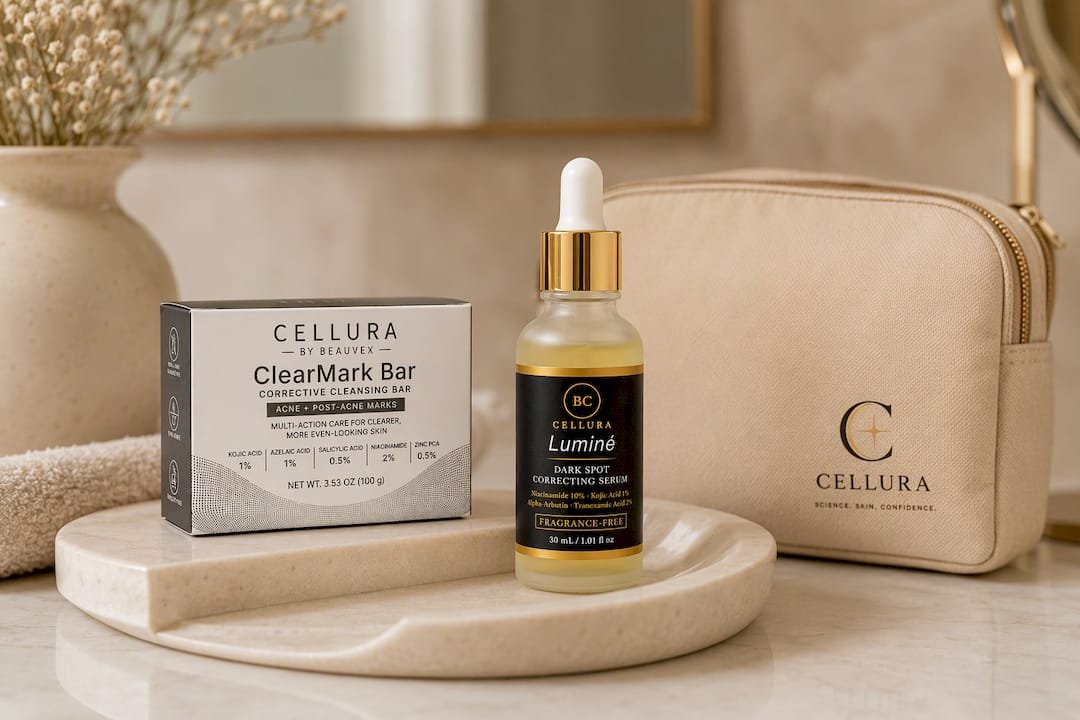
The Cellura ClearMark Bar is a multi-active facial cleansing bar built with salicylic, azelaic, and kojic acid, suited to the rinse-off, lower-irritation-risk kojic acid use discussed earlier in this article. The Cellura Luminé Brightening Serum pairs niacinamide, tranexamic acid, kojic acid, and alpha arbutin in one leave-on step, aligned with the combination approach that performed well in the trials above.
Folding both into the six-week routine outlined earlier is straightforward: use the ClearMark Bar as your cleansing step, then apply the Luminé Serum on treatment nights, always finishing with sunscreen in the morning. Check the Cellura product line for full ingredient concentrations and pricing details before you buy.
Sources
- Opinion on Kojic acid – SCCS corrigendum (2023)
- The Efficacy of Topical Cosmetic Containing AlphaADArbutin 5% and Kojic Acid 2% Compared With Triple Combination Cream for the Treatment of Melasma (PubMed)
- Effect of a Tranexamic Acid, Kojic Acid, and Niacinamide Containing Serum on Facial Dyschromia (J Drugs Dermatol, 2019)
FAQ
Is it okay to use kojic acid and alpha arbutin together?
Yes, and split-face trial data on a combined alpha arbutin and kojic acid cream found it performed comparably to a stronger triple combination cream for melasma, with fewer adverse events. Alternating nights or using lower concentrations of each reduces irritation risk while still targeting multiple pigment pathways.
Why is my skin getting darker after using kojic acid?
Darkening after starting kojic acid usually signals irritation, which can trigger a rebound of post-inflammatory hyperpigmentation rather than fading it. This often happens when the concentration is too high or the active is applied too frequently without giving skin time to adjust; scaling back frequency and adding sunscreen typically helps.
Does alpha arbutin permanently remove hyperpigmentation?
No single ingredient permanently removes hyperpigmentation, since melanin production restarts whenever skin is exposed to triggers like UV light or inflammation. Alpha arbutin can meaningfully fade existing dark spots over weeks to months, based on the timelines seen in clinical trials, but ongoing sun protection and maintenance are needed to keep results.
What works better than kojic acid?
No single ingredient is consistently more effective than kojic acid for every skin type, but combination formulas that pair it with alpha arbutin, niacinamide, or tranexamic acid tend to outperform kojic acid used alone, according to the trial data discussed above. The better question is usually which combination fits your skin’s tolerance and your pigmentation type.