
Apply dark spot serum at night for most formulas, right after cleansing and before moisturizer. Morning use works only for stable, gentle actives like niacinamide, and it comes with a non-negotiable condition: broad-spectrum sunscreen right after. Skip the SPF and you can undo whatever progress the serum made overnight. This guidance is built around that exact tradeoff.
TL;DR:
- Most dark spot serums should be applied at night to avoid sun sensitivity and ensure active ingredients remain stable.
- Applying in the morning is limited to stable vitamins like vitamin C and niacinamide, always with broad-spectrum SPF 30+ afterward.
- Layer products from thin to thick after cleansing, allowing time for actives like retinoids and acids to absorb before applying moisturizer.
- Start with application every other night to build tolerance, increasing to nightly use once irritation subsides, but avoid multiple exfoliants on the same night.
- Clear patch testing and consistent sunscreen use are essential, as clinical improvements become visible after two to four weeks of regular use.
Table of Contents
- Should You Apply Dark Spot Serum in the Morning or at Night?
- Where in Your Routine Does Dark Spot Serum Go?
- How Often Should You Use Dark Spot Serum?
- Which Ingredients Should Never Be Mixed the Same Day?
- How Do You Patch Test a New Dark Spot Serum?
- How Long Until You See Results From a Dark Spot Serum?
- How Beauvex’s 3-Step Ritual Shapes Application Timing
- What Habits Actually Move the Needle
- Try the Cellura Luminé Brightening Serum
- Sources
- FAQ
Should You Apply Dark Spot Serum in the Morning or at Night?
Night is the better default for most dark spot serums, and the reasoning is practical, not superstitious. Skin repairs itself overnight without UV exposure competing for resources, and several brightening actives, especially retinoids and stronger acids, become unstable or skin-sensitizing in sunlight. Applying them at night sidesteps that risk entirely.
Morning application only makes sense for a narrow set of ingredients: stable vitamin C derivatives, niacinamide, and antioxidant blends that hold up under sunlight. Even then, sunscreen isn’t optional. The American Academy of Dermatology is explicit that daily broad-spectrum SPF 30+ with reapplication is central to treating pigmentation, since UV and visible light are what trigger melanin production in the first place.
Here’s how the main ingredient groups usually sort by time of day:
- Retinoids and strong acids: night only, due to sun sensitivity.
- Stable vitamin C: morning, always paired with SPF.
- Niacinamide and tranexamic acid: flexible, works AM or PM.
- Alpha-arbutin: typically PM, though some formulas tolerate AM use.
Where in Your Routine Does Dark Spot Serum Go?
Order matters almost as much as timing. Medical News Today’s guidance on layering confirms the standard rule: apply from thinnest to thickest so each product actually absorbs instead of sitting on top of the last one.
- Cleanse your face and pat it dry.
- Apply a toner if you use one.
- Apply your treatment or dark spot serum, letting it sit for 30 to 60 seconds until it feels tacky.
- Follow with moisturizer to lock in hydration and buffer any active ingredients.
- In the morning, finish with sunscreen. This step is not optional.
If you’re targeting isolated spots rather than overall tone, use the dot method: press small amounts directly onto discoloration instead of spreading a full-face layer. For general brightening, a thin, even layer across the whole face works better. Retinoids and acids are the exception to the waiting-time rule. Give them extra time, sometimes several minutes, before layering anything else on top.
How Often Should You Use Dark Spot Serum?
Once nightly is the standard starting point for most formulas. Some clinically tested serums are designed for twice-daily use, but that only applies when the product label says so.
- Start potent actives every other night for the first two to four weeks.
- Increase to nightly use once your skin shows no redness, flaking, or stinging.
- Reduce frequency immediately if irritation shows up, then rebuild slowly.
- Use a pea-sized amount for full-face application, or a dot for targeted spots. More product doesn’t speed up results.
Pro Tip: Layering a light moisturizer directly over a new active during the first two weeks can blunt irritation without meaningfully reducing effectiveness. It’s a simple way to build tolerance without abandoning the product.
Which Ingredients Should Never Be Mixed the Same Day?
Timing rules exist because certain actives compete or amplify each other’s side effects. Getting this wrong is the fastest way to end up with irritation instead of brighter skin.
- Vitamin C: best in the morning, paired with sunscreen; choose a stable derivative if you’re applying it before sun exposure.
- Retinoids and strong acids (glycolic, salicylic): night only, and never combined with each other on the same evening.
- Niacinamide and tranexamic acid: gentle enough for AM or PM, and they layer well with most other actives.
- Multiple exfoliants: avoid stacking two exfoliating acids in one routine. Alternate nights instead, one on, one off.
If your routine already includes a retinoid, add a new brightening acid on the opposite nights rather than the same one. This is where most over-exfoliation and rebound pigmentation actually starts.
How Do You Patch Test a New Dark Spot Serum?
Apply a small amount to your inner forearm or behind your ear and leave it for 48 to 72 hours before using it on your face. Watch for redness, itching, or bumps. Clear skin after that window is a reasonable green light to move forward.
If irritation shows up once you’re using it on your face, stop immediately, drop back to every other night, and add a moisturizer layer for buffering. Avoid stacking it with other active ingredients until your skin settles.
- Persistent redness lasting more than a few days.
- Increased darkening rather than fading.
- Stinging that doesn’t ease within minutes of application.
Pro Tip: If pigmentation looks worse after a few weeks instead of better, stop the active and consult a dermatologist. Inflammation from over-exfoliation can trigger new post-inflammatory dark spots, undoing the progress you were chasing.
How Long Until You See Results From a Dark Spot Serum?
Clinical testing on a depigmenting serum combining tranexamic acid and niacinamide found measurable reductions in brown spot count within 14 days, with statistically significant clinical improvement by day 28 when paired with consistent sunscreen use, according to a study in the Journal of Cosmetic Dermatology. Deeper, longer-standing spots take longer, often stretching toward the two to three month mark before change is obvious in the mirror.

Consistency and daily SPF are what protect that progress once it shows up. If you’ve used a serum correctly for several months with no change, that’s the point to loop in a dermatologist rather than switching products repeatedly.
How Beauvex’s 3-Step Ritual Shapes Application Timing
Beauvex LLC built its system around three steps: cleanse, treat, and support the barrier. The treatment step is where a serum like Luminé Serum does its work, combining niacinamide, tranexamic acid, and alpha-arbutin to interrupt pigmentation at multiple points in the process rather than relying on one mechanism.
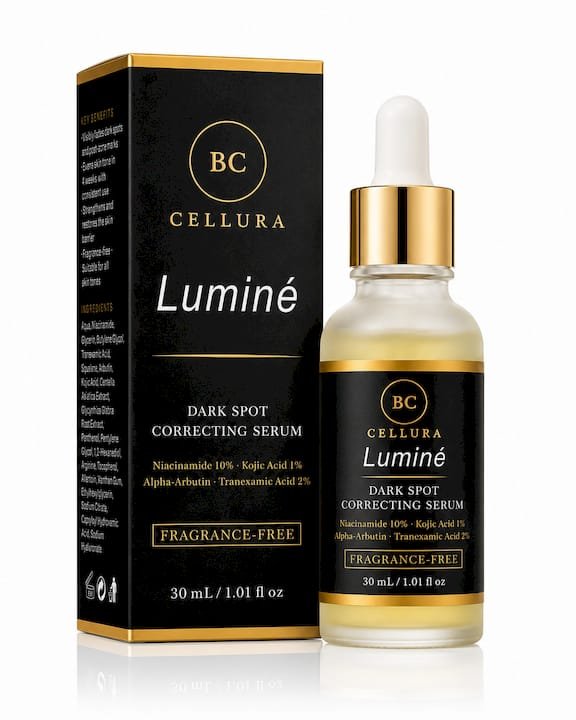
That ingredient mix is intentionally flexible on timing. Niacinamide and tranexamic acid tolerate AM or PM use, while alpha-arbutin performs best at night. Exact concentrations and research references for each active are published, which lets you match the ramp-up pace (every other night, then nightly) to what your skin tolerates instead of guessing.
What Habits Actually Move the Needle
If you can only manage one consistent step, make it nightly application. Morning routines with SPF fail more often than they should, simply from forgetting reapplication.
Take a photo every four to eight weeks under the same lighting. Progress on dark spots is slow enough that memory alone will trick you into thinking nothing’s happening.
Sunscreen isn’t a supporting player here. It’s the one ingredient every brightening routine depends on, morning after morning, with no exceptions.
— Beauvex LLC
Try the Cellura Luminé Brightening Serum
The Cellura line is built around one idea competitors rarely commit to: publishing exact ingredient concentrations and research citations instead of vague marketing claims, so you can evaluate the formula before you buy it.
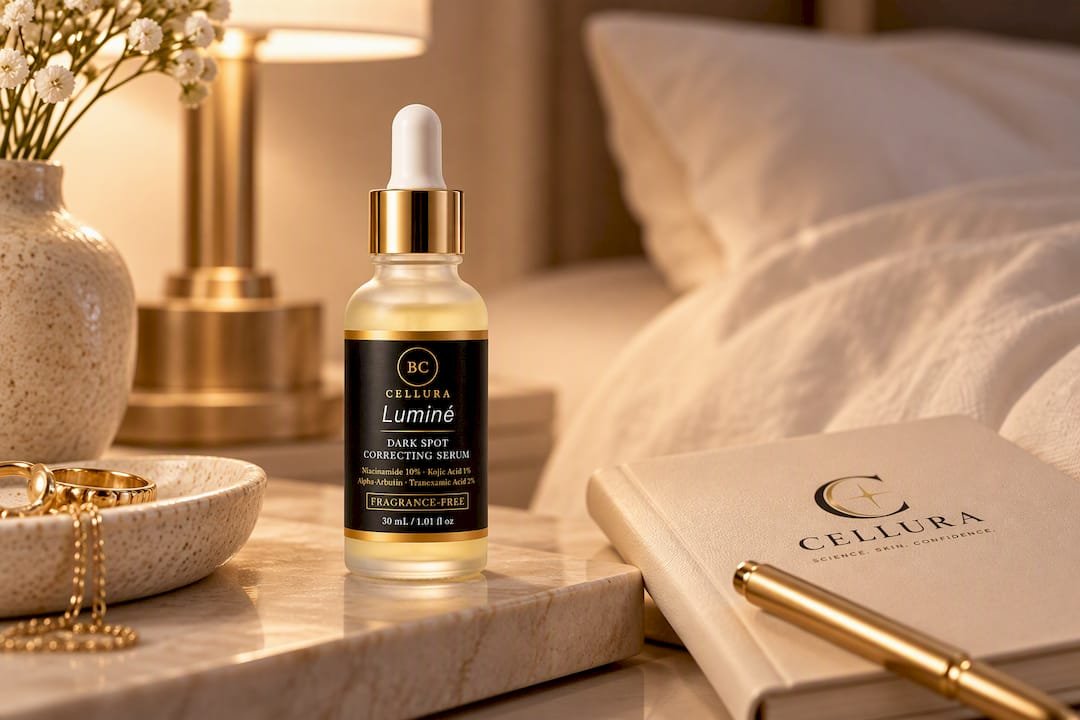
The Cellura Luminé Brightening Serum, 30 mL / 1 fl oz, combines niacinamide, tranexamic acid, and alpha-arbutin for post-acne discoloration. Start every other night for the first two weeks, apply after cleansing and before moisturizer, and increase to nightly once your skin tolerates it without irritation. If you use it in the morning, sunscreen afterward is required, not optional. Patch test first on your inner forearm, especially if your skin reacts easily to actives. Pricing and full ingredient details are listed on the product page.
Sources
- Efficacy and tolerability of a depigmenting gel serum comprising tranexamic acid, niacinamide, 4‐butylresorcinol, phytic acid, and a mixture of hydroxy acids – Journal of Cosmetic Dermatology
- Melasma treatment – American Academy of Dermatology (AAD)
- Should you apply serum or moisturizer first? – Medical News Today
FAQ
Does Dark Spot Serum Actually Work?
Yes, when it contains researched actives and is used consistently with sunscreen. Clinical testing on a niacinamide and tranexamic acid formula showed measurable spot reduction within 14 days and clinical improvement by day 28, though results depend heavily on how deep and old the pigmentation is.
Do You Put Dark Spot Corrector On Before or After Moisturizer?
Before. Serums are thinner and formulated to absorb quickly, while moisturizer is meant to seal everything in, according to layering guidance from Medical News Today. Applying it in the reverse order blocks the active ingredients from reaching skin at all.
Can I Leave Serum on My Face Overnight?
Yes, most dark spot serums are formulated for overnight wear and are designed to be layered under a moisturizer before bed. This is actually when many potent actives, like retinoids and stronger acids, work best, since they’re not competing with sun exposure.
How Long Does It Take for a Dark Spot Corrector to Work?
Instrumental improvements can appear within two weeks, with visible clinical changes typically showing between four and eight weeks with consistent use, based on clinical trial data. Deeper or older spots often take longer, and daily sunscreen is required to protect any progress made.
Should I Use Dark Spot Serum at Night?
Night is the recommended timing for most dark spot serums, particularly those containing retinoids or exfoliating acids that increase sun sensitivity. Flexible ingredients like niacinamide can be used morning or night, but morning application always requires sunscreen afterward.