
Retinol wins on raw evidence: it has decades of randomized trials behind it for wrinkles and pigmentation, though it comes with irritation and sun sensitivity. Copper peptides (GHK-Cu) work more slowly, support collagen repair with far less drama, and suit skin that can’t tolerate an aggressive retinoid. You don’t have to pick a side. The simplest approach is retinol at night, copper peptides in the morning (or alternating nights), always with sunscreen and a patch test first.
TL;DR:
- Retinol provides faster, well-documented improvements in wrinkles and dark spots within approximately 12 weeks, but it often causes initial irritation and increased sun sensitivity.
- Copper peptides work more gradually, supporting collagen and elastin synthesis with less irritation, making them suitable for reactive or barrier-compromised skin.
- Combining retinol and copper peptides requires careful timing, with best results achieved by applying copper peptides in the morning and retinol at night to avoid pH conflicts.
- Individuals with sensitive, thin, or compromised skin should prioritize copper peptides as the primary active to minimize irritation, adding retinol later if tolerated.
- Alternative retinoid-like compounds, such as oleyl adapalenate, may outperform retinol in speed and tolerability, though the larger evidence base still favors retinol.
Table of Contents
- Retinol vs Copper Peptides: A Quick Comparison
- How Do Retinol and Copper Peptides Actually Work?
- What Does the Clinical Evidence Actually Show?
- Is It Safe? Side Effects and Who Should Be Careful
- How to Use Retinol and Copper Peptides Together
- Who Should Choose Retinol vs Copper Peptides?
- The Beauvex Approach to Barrier-Safe Actives
- Why the “Pick One” Framing Gets This Wrong
- A Copper Peptide Option Worth Checking Before You Buy
- Sources
- FAQ
Retinol vs Copper Peptides: A Quick Comparison
Retinol pushes skin cells to turn over faster and ramps up collagen production at the genetic level. It’s the ingredient with the deepest research base for fine lines, texture, and dark spots, and a network meta-analysis of topical photoaging treatments ranks retinol and tretinoin near the top for both wrinkle reduction and hyperpigmentation. Copper peptides work differently. GHK-Cu signals fibroblasts to rebuild collagen, elastin, and the structural matrix underneath skin, without triggering the same turnover-driven irritation.
Here’s how the two stack up at a glance:
- Retinol: fast, well-documented results on wrinkles and dark spots; irritation and dryness are common in the first weeks; best for skin that tolerates actives well.
- Copper peptides: slower, gentler collagen and repair support; minimal irritation risk; best for reactive, thin, or barrier-compromised skin.
- Speed: retinol shows measurable change around 12 weeks in trials; copper peptides tend to work on a similar or longer timeline with a softer side-effect profile.
- Risk management: retinol needs titration and daily SPF; copper peptides need far less ramp-up but still deserve a patch test.
How Do Retinol and Copper Peptides Actually Work?
Retinol itself is inactive. Skin enzymes convert it to retinoic acid, which binds RAR and RXR receptors inside skin cells and switches on genes tied to collagen production and cell turnover. That turnover boost is exactly why retinol clears dead cells and evens pigmentation, but it’s also why the outer barrier gets thinner and more reactive during the first several weeks. Retinoids also block MMP enzymes, the ones that chew through collagen after UV exposure, which is part of why they show up so consistently in photoaging research.
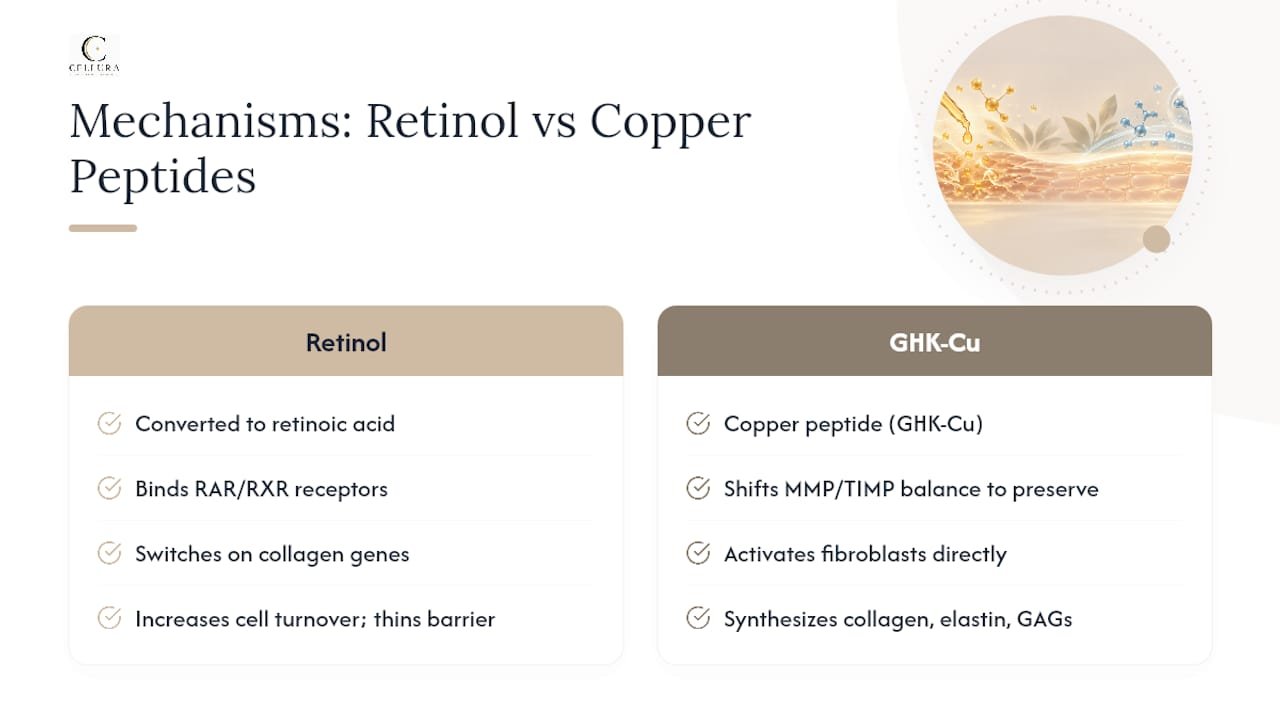
GHK-Cu takes a different route. Copper peptides shift the balance between MMPs and their natural inhibitors (TIMPs) toward preservation rather than breakdown, and they activate fibroblasts directly to synthesize new collagen, elastin, and the glycosaminoglycans that keep skin plump. There’s no forced turnover cascade, no shedding of the outer layer, no receptor cascade demanding an adjustment period. That’s the mechanistic reason copper peptides tend to feel calmer on skin: they’re signaling repair rather than accelerating cell replacement. It also explains why copper peptides don’t carry the same photosensitivity warning retinol does. You’re not thinning the stratum corneum or speeding turnover, so sun reactivity doesn’t spike the way it does with a retinoid.
What Does the Clinical Evidence Actually Show?
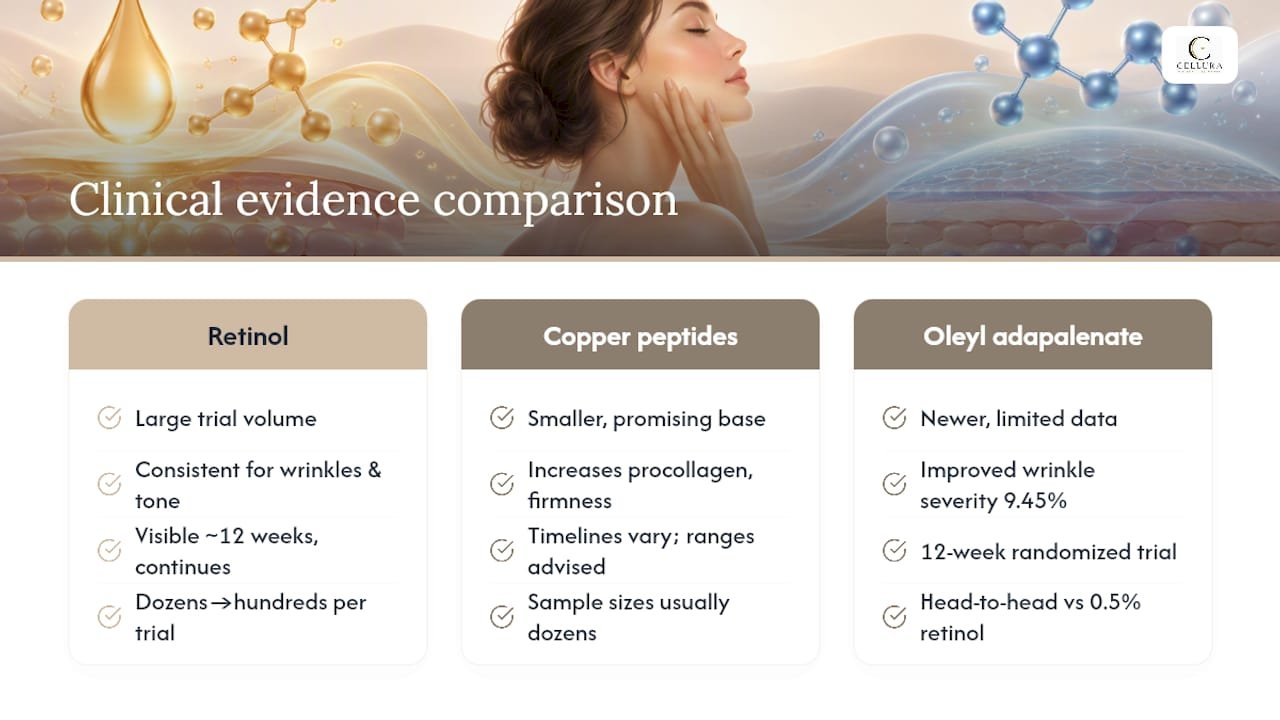
The trial data favors retinol in volume, not necessarily in every single outcome. The network meta-analysis of topical photoaging agents ranks retinol and tretinoin among the most consistently effective compounds for fine wrinkles and uneven tone across dozens of randomized trials, and most protocols show visible change starting around the 12 week mark, with continued improvement over several months of steady use.
Copper peptides have a thinner but genuinely promising evidence base. Smaller cosmetic trials and lab studies show GHK-Cu increasing procollagen and improving skin firmness, though sample sizes tend to run in the dozens rather than the hundreds, and there simply aren’t as many large randomized trials as retinol has accumulated over the years. That’s not a knock on the mechanism. It just means the confidence interval is wider.
One trial worth knowing about directly challenges the idea that retinol is automatically the strongest option available. A 12-week randomized, double-blind head-to-head trial compared 0.5% retinol against 0.5% oleyl adapalenate, a newer retinoid-adjacent compound, and found the adapalenate version improved wrinkle severity by roughly 9.45 percent versus 4.11 percent for retinol, while causing less erythema and less transepidermal water loss. That’s a useful data point if you’re exploring retinol alternatives: newer pro-drug compounds can sometimes outperform retinol on both speed and tolerability in a controlled trial, though retinol still has the larger overall body of long-term evidence behind it.
Comparing retinol and copper-peptide studies directly is messy because they rarely measure the same endpoints. One trial tracks wrinkle depth by imaging, another tracks patient-reported firmness, a third measures procollagen in biopsy samples. Treat timelines as ranges, not guarantees.
Is It Safe? Side Effects and Who Should Be Careful
Retinol’s side effects are well documented and include redness, flaking, dryness, and increased transepidermal water loss, especially during early use, according to research on retinoid mechanisms in photoaged skin. These effects usually settle once skin adjusts, but they’re the reason so many people quit retinol before it has a chance to work.
Copper peptides carry a much shorter list of documented issues. Some people report mild sensitivity or a metallic reaction at high concentrations, but there isn’t a large body of long-term safety trials the way there is for retinoids, so “gentler” doesn’t mean “zero risk for everyone.”
A few practical safety notes:
- Retinoids increase photosensitivity, so AAD guidance recommends nighttime use plus daily sunscreen, without exception.
- Retinol is generally advised against during pregnancy; copper peptide safety data during pregnancy is limited, so consult a healthcare provider about their use.
- If irritation shows up, drop retinol frequency before you drop it entirely, and lean on copper peptides or a barrier balm to give skin recovery time.
- Patch test any new active for a week before applying it to your whole face.
Pro Tip: If retinol leaves your skin raw and flaking within days, that’s not “purging,” that’s overuse. Cut back to twice a week and let a copper peptide product handle repair on the off nights.
How to Use Retinol and Copper Peptides Together
Yes, you can use copper peptides and retinol together, and for most people it’s the better long-term strategy than picking just one. The catch is formulation chemistry: retinoid vehicles usually sit at a low pH, and that acidity can destabilize GHK-Cu complexes, weakening the copper peptide before it does anything useful.
- Default split: apply copper peptides at a different time of day than retinol, typically copper peptides in the morning and retinol at night. This sidesteps the pH conflict entirely and needs no extra thinking.
- If you must layer at the same time, wait 20 to 30 minutes between products so each one’s pH stabilizes on skin before the next goes on.
- Titrate retinol slowly: start with infrequent use and increase frequency gradually as skin tolerates.
- Use copper peptides daily if tolerance allows. There’s no titration curve the way there is with retinol.
Alternating nights (retinol one night, copper peptide the next) works just as well as an AM/PM split if you prefer a one-product-at-a-time routine.
Who Should Choose Retinol vs Copper Peptides?
If your skin tolerates actives reasonably well and your main goals are fine lines, texture, and stubborn pigmentation, retinol has the stronger track record and should probably be your primary active. Robust, resilient skin recovers fast enough from the early irritation phase to make the tradeoff worth it.
If your skin is reactive, thin, compromised by rosacea or eczema, or you’re older with a weaker barrier, copper peptides make more sense as the primary anti-aging active, with retinol introduced slowly later if at all. Copper peptides also work well as a supporting player: someone already on retinol who develops persistent redness often does better switching to alternating nights rather than quitting active care completely. If irritation lingers past a few weeks despite scaling back, that’s the point to loop in a dermatologist instead of guessing further.
The Beauvex Approach to Barrier-Safe Actives
Every skincare ritual follows the same logic: cleanse, treat, then support the barrier. That third step isn’t an afterthought. When a retinoid is thinning and stressing the outer skin layer, skipping barrier support is how people end up quitting a treatment that was actually working.
That’s the role a GHK-Cu balm plays inside the Beauvex routine: it’s not competing with a retinoid for the same job, it’s covering the recovery work retinol doesn’t do on its own. Beauvex LLC publishes exact ingredient concentrations and research references on its product pages, so you can check what you’re actually applying instead of taking a marketing claim on faith.
Why the “Pick One” Framing Gets This Wrong
Most articles on this topic set up a winner-take-all fight, and that framing misses what the evidence actually supports. Retinol has more trials, more data, and a longer track record. Copper peptides have a real, if smaller, evidence base for collagen support with a much lower irritation cost. Treating them as competitors ignores that they solve different problems.
The bigger mistake we see is people abandoning retinol entirely at the first sign of redness, when the real fix is usually slower titration plus a repair step, not a full ingredient switch. Barrier support isn’t a nice add-on to a retinol routine. It’s the difference between someone who sticks with retinol for six months and sees real results, and someone who quits after two weeks of flaking and never goes back.
If you’re deciding where to start, prioritize tolerance first, efficacy second. An active you can’t stay consistent with delivers nothing, no matter how strong its trial data looks on paper.
— Beauvex LLC
A Copper Peptide Option Worth Checking Before You Buy
If you’re building a retinol routine and need something to handle repair on the side, the Cellura Balm is a GHK-Cu copper peptide balm designed for exactly that gap. It fits naturally into either an AM/PM split (balm in the morning, retinol at night) or an alternating-night schedule if you’d rather run one active at a time.
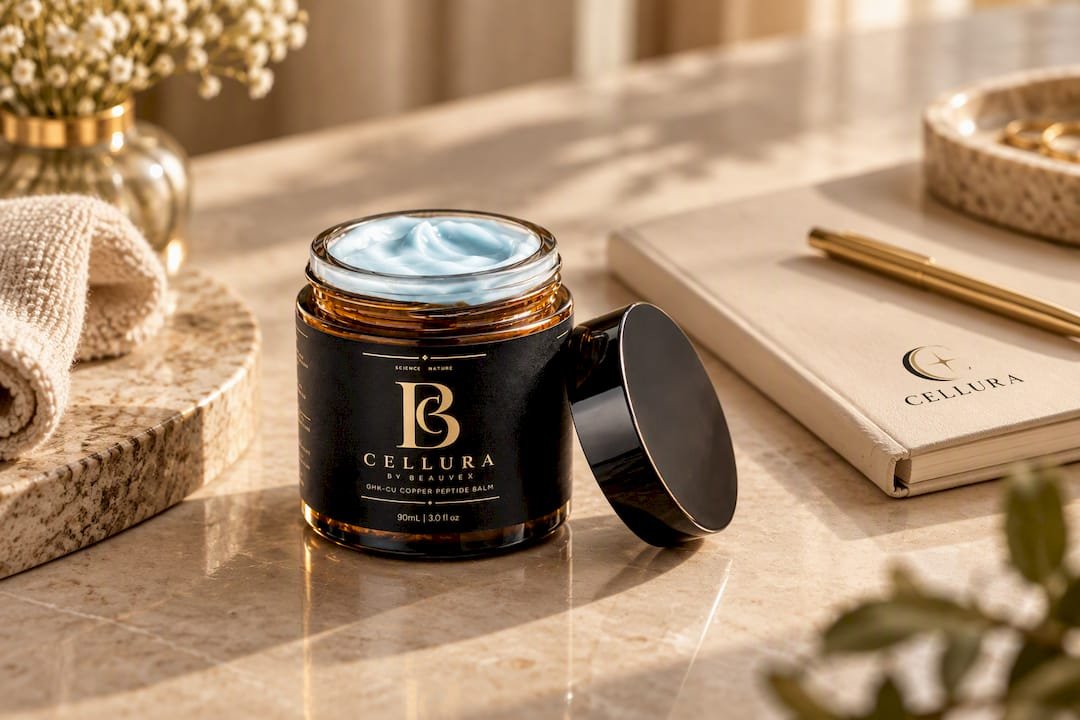
Before buying anything, check the ingredient concentrations and research references listed on the product page itself. That’s the same transparency standard Beauvex LLC applies across its Cellura line, so you’re evaluating the formula on the evidence, not the packaging. If your current routine already includes a retinoid and your skin is asking for backup, that product page is the next stop.
Sources
- Systematic review and network meta-analysis of topical compounds for skin photoaging
- Retinoid or retinol? (AAD patient guidance)
FAQ
What Do Koreans Use Instead of Retinol?
Many Korean skincare routines lean on gentler actives like niacinamide, centella asiatica, and peptide complexes, including copper peptides, to support collagen without the irritation retinol can cause. The goal is the same collagen and repair support, just delivered with a lower tolerance barrier.
What Are the Downsides of Using Copper Peptides?
Copper peptides can cause mild sensitivity or a metallic skin reaction in some people, and the safety data for long-term daily use isn’t as extensive as retinol’s research history. Results also tend to build more gradually than retinol’s, so patience matters more than urgency here.
Can You Do Copper Peptides and Retinol Together?
Yes. The most reliable method is copper peptides in the morning and retinol at night, which avoids the pH conflict between the two formulas entirely. If you apply them at the same time of day, wait 20 to 30 minutes between products.
What Works Faster Than Retinol?
In a 12-week head-to-head trial, oleyl adapalenate improved wrinkle severity more than retinol at the same concentration, with less irritation. That doesn’t make it universally “faster” than retinol for everyone, but it’s a real example of a newer compound outperforming retinol in a controlled comparison.