
Glycolic acid is the stronger, deeper-penetrating resurfacer best suited to oily, photoaged, or resilient skin. Lactic acid is the gentler, humectant-rich exfoliant that works better on dry, sensitive, or dehydrated skin. Both are alpha hydroxy acids, but glycolic trades comfort for speed, while lactic trades intensity for hydration. Whichever you pick, daily sunscreen isn’t optional. AHAs raise sun sensitivity, and that risk doesn’t vanish the day you stop using them.
TL;DR:
- Glycolic acid penetrates deeper and is more effective for stubborn skin issues but carries a higher risk of irritation, especially at higher concentrations.
- Lactic acid is gentler, improves skin hydration, and may rebuild the skin barrier, making it suitable for sensitive, dehydrated, or eczema-prone skin.
- Product strength depends more on pH and formulation quality than on the percentage label, making well-formulated lower-percentage acids potentially more effective than higher-percentage poorly balanced ones.
- Combining full-strength glycolic and lactic acids on the same night can cause barrier damage; alternate or choose a low-dose formula for safer, effective results.
- Consistent sun protection is essential during and after AHA use, regardless of the type or strength, due to increased sun sensitivity.
Table of Contents
- What Lactic Acid Is and Why It Works for Dry or Sensitive Skin
- What Glycolic Acid Is and Why It’s the Stronger Resurfacer
- Molecular Size, pH, and Why the Label Percentage Lies to You
- Which Acid to Choose by Skin Type and Concern
- How to Use These Acids Safely, Step by Step
- Can You Use Glycolic and Lactic Acid Together?
- How an Evidence-Based Routine Supports Safe AHA Use
- What the Research Actually Tells Us About Choosing an Acid
- Building Your Routine Around Cellura
- Sources
- FAQ
What Lactic Acid Is and Why It Works for Dry or Sensitive Skin
Lactic acid is an alpha hydroxy acid derived from fermented milk sugars, though most skincare formulas now use a synthetic version for consistency. Its molecule weighs roughly 90 daltons, noticeably larger than glycolic acid’s, and that size is exactly why it earns its reputation as the gentler AHA. Bigger molecules move through the skin’s outer layer more slowly, which limits how deep they reach and how much irritation they cause along the way.
What sets lactic acid apart isn’t just gentleness. It’s a genuine humectant, meaning it pulls water into the skin while it exfoliates, and the clinical evidence behind that dual action is solid. One study found that topical L-lactic acid increased ceramide levels in the stratum corneum by roughly 48% while measurably improving barrier function. That’s a meaningful finding: most exfoliants weaken the barrier a little as a side effect of doing their job. Lactic acid appears to rebuild part of it while it works.
Typical formulations break down like this:
- Over-the-counter serums and toners: 5% to 12% lactic acid, often buffered with glycerin or other humectants.
- In-office peels: 30% to 50% concentrations, applied under professional supervision for deeper resurfacing.
- Primary uses: gentle exfoliation, hydration support, mild tone brightening, and barrier maintenance for compromised skin.
If your skin flushes red at the mention of “acid,” or if you deal with eczema-prone patches, rosacea, or general dryness, lactic acid is usually the safer entry point into chemical exfoliation.
What Glycolic Acid Is and Why It’s the Stronger Resurfacer
Glycolic acid is the smallest AHA molecule in common use, weighing about 76 daltons. That smaller size lets it slip past the skin’s outer barrier faster and reach deeper into the epidermis than lactic acid does at an equivalent concentration. It’s the reason dermatologists reach for glycolic first when the goal is texture correction, fine lines, or stubborn post-inflammatory pigmentation rather than surface-level polish.
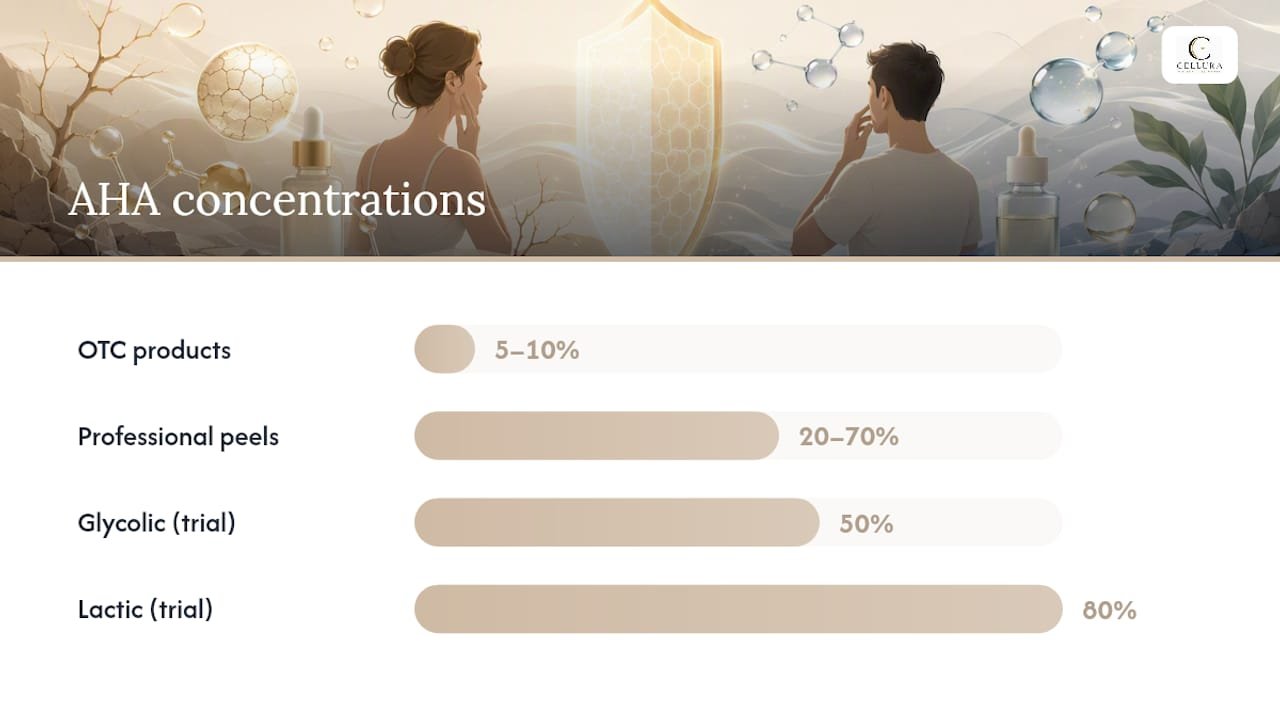
The clinical record backs that reputation. A randomized trial comparing peel strengths found that a 50% glycolic acid peel reduced melasma severity scores more than an 80% lactic acid peel, with a statistically significant difference (P = 0.009) and no meaningful gap in side effects between the two. That’s a striking result: glycolic at a lower percentage outperformed lactic at a much higher one, which tells you concentration alone doesn’t predict outcome. Molecular behavior does.
Common ranges look like this:
- OTC products: 5% to 10%, formulated for daily or every-other-day use.
- Professional peels: 20% to 70%, sometimes layered in successive sessions for melasma or deep texture work.
- Primary uses: photoaging, rough texture, enlarged pores, and pigmentation when paired with a topical brightening regimen.
The tradeoff is irritation. Glycolic’s faster penetration means a higher chance of stinging, redness, or flaking, especially at OTC concentrations above 8% or in peels handled without proper pH control. Oily, thicker, or sun-damaged skin generally tolerates it best; if your skin barrier is already compromised, glycolic can make things worse before it makes them better.
Molecular Size, pH, and Why the Label Percentage Lies to You
The single biggest thing people get wrong about AHAs: the percentage on the bottle is not the whole story. What actually determines how strong an acid behaves on your skin is its free-acid content, which depends on the formula’s pH, not just the labeled concentration.
Here’s the mechanism. Every AHA has a pKa, the pH at which half the acid molecules are in their active, unbound form. Below that pKa, more of the acid exists as “free acid,” ready to interact with skin cells. A 10% glycolic acid serum formulated at pH 3.8 might deliver roughly 50% of its acid in free form, while a poorly formulated 15% version at pH 5 could deliver far less active acid despite the higher number on the label. That’s why two products with different percentages can feel identical, or two products with the same percentage can feel wildly different.
The core comparison points:
- Molecular weight: glycolic (~76 Da) penetrates deeper and faster than lactic (~90 Da), raising both efficacy and irritation potential.
- Free-acid fraction: pH, not the percentage on the label, determines how much acid is actually active.
- Hydration behavior: lactic acid pulls in moisture and supports ceramide production; glycolic doesn’t carry that humectant benefit but reaches deeper for collagen stimulation.
- Concentration reality: a well-buffered 5% glycolic complex has shown better hydration and tolerability than a raw 20% glycolic formula in clinical testing, proof that formulation quality often beats raw strength.
One synopsis comparing AHAs at equal molar concentrations found that L(+)-lactic acid and glycolic acid performed similarly on effectiveness, but lactic caused noticeably less stinging and fewer complaints at higher strengths. That’s the practical takeaway: lactic isn’t a weaker glycolic substitute. It’s a different tool that happens to overlap in what it can treat.
Which Acid to Choose by Skin Type and Concern
Matching the acid to your actual skin, not to whichever one has better marketing, is what determines whether you get results or just irritation. Here’s how to think through it.
- Dry, dehydrated, or sensitive skin: start with lactic acid at 5% to 10%, used two to three times a week. Pair it with humectants like glycerin or hyaluronic acid, and prioritize a barrier-supporting moisturizer on non-acid nights.
- Oily, acne-prone, or texture-focused skin: glycolic acid at 5% to 10% OTC is a reasonable starting point, three times a week, building up gradually. Deeper texture or scarring concerns may call for professional peels, but that decision belongs with a dermatologist, not a bathroom mirror.
- Hyperpigmentation, including melasma, and skin of color: the safest path tends to be serial low-strength glycolic sessions rather than one aggressive high-strength peel, ideally paired with topical pigment inhibitors. Research on postinflammatory hyperpigmentation supports combining glycolic peels with a topical brightening regimen for better control with fewer complications in darker skin tones. Lactic or mandelic acid can serve as a gentler alternative when tolerance is a concern.
- First-time AHA users of any skin type: patch test on your inner forearm for 48 hours before applying anything to your face. Start at the lowest concentration available, and only increase frequency once your skin shows zero redness or flaking for two consecutive weeks.
- Anyone with active eczema, rosacea flares, or a damaged barrier: hold off on both acids until the skin calms down, then reintroduce lactic acid first, since it’s the less provocative of the two.
Pro Tip: If you’re not sure whether your skin can handle daily exfoliation, cut the frequency in half for your first two weeks. Skin that looks fine after a treatment can still be inflamed at a level you can’t see, and stacking sessions on top of that hidden irritation is how people end up with a wrecked barrier by week three.
See a dermatologist if you notice persistent burning, spreading redness, or pigment changes that worsen instead of fade. Chemical exfoliation should improve your skin gradually, not create new problems while it works on old ones.
How to Use These Acids Safely, Step by Step
Order matters as much as concentration. A typical evening routine with an AHA runs like this: cleanse, apply the leave-on acid to dry skin, wait for full absorption, layer any treatment serums, then seal with a moisturizer. Mornings skip the acid entirely and end with broad-spectrum sunscreen, no exceptions.
Frequency depends on strength. A 5% product might be tolerated nightly by resilient skin, while anything above 10% glycolic or 12% lactic is usually safer at two to three nights a week until your skin proves it can handle more. Watch for tightness, visible flaking, or a burning sensation that lingers past a few minutes. Those are signs to pull back, not push through.
What to avoid combining on the same night:
- High-strength AHAs layered with retinoids or retinol, which compounds irritation and offers no added benefit.
- Two different exfoliating acids (glycolic plus a BHA like salicylic, for instance) unless a formula was specifically designed for that pairing.
- Physical scrubs or exfoliating brushes on the same night as a chemical exfoliant.
The FDA’s own guidance is direct on sun exposure: AHA-containing products increase sun sensitivity during use and for seven days after you stop, because skin doesn’t have a built-in way to compensate for the thinning effect immediately. That means sunscreen isn’t just a “use it when you remember” step. It’s a daily requirement for the entire period you’re actively exfoliating, plus a week of buffer afterward.
| Concern | Recommended step | Why it matters |
|---|---|---|
| Barrier support | Ceramide or peptide moisturizer | Rebuilds lipids AHAs can strip |
| Hydration | Glycerin or hyaluronic acid serum | Offsets dryness from exfoliation |
| Sun protection | Broad-spectrum SPF 30+, daily | Required during use and 7 days after stopping |
| Over-exfoliation signs | Pause acid, add barrier repair | Prevents lasting damage |
Can You Use Glycolic and Lactic Acid Together?
You can combine them, but stacking full concentrations of both on the same night is asking for trouble. Two different AHAs applied together compound the exfoliation effect in a way that outpaces your skin’s ability to recover, which raises the odds of barrier damage and, for darker skin tones, a higher risk of post-inflammatory hyperpigmentation from the irritation itself.
The safer patterns:
- Alternate nights: glycolic on Monday and Thursday, lactic on Tuesday and Friday, with a rest night in between.
- Low-dose combination formulas: some products blend small percentages of each specifically to balance resurfacing with hydration, which works better than DIY-stacking two separate high-strength products.
- Professional supervision for peels: combining acid types at peel strength should happen in a clinical setting, not at home.
Combining them is genuinely useful if you want glycolic’s resurfacing reach alongside lactic’s hydration, but it’s unnecessary if your main concern is straightforward dryness or straightforward texture. Pick the acid that matches your primary goal first, and treat combination formulas as a refinement, not a starting point.
How an Evidence-Based Routine Supports Safe AHA Use
Exfoliation only works long term when the skin barrier gets equal attention, which is the logic behind a three-step approach: cleansing, treatment, and barrier support. Skip that third step while using AHAs regularly, and you’re running a resurfacing routine with no shock absorber.
The cleansing stage should never fight the acid step. A cleanser loaded with its own strong actives can leave skin over-sensitized before the exfoliant even goes on, which is why pairing a milder, barrier-conscious cleanse with your AHA nights makes more sense than doubling up on actives.
The treatment stage is where pigmentation gets addressed directly. A serum combining niacinamide, tranexamic acid, and alpha-arbutin uses ingredients that work on melanin production through different pathways rather than relying on exfoliation alone to fade dark marks. Used after an AHA has done its resurfacing work, a serum like this targets the pigment that exfoliation exposes but doesn’t erase on its own. You can review the exact concentrations behind tranexamic acid’s role in fading discoloration if you want to see the research before deciding how it fits your routine.
What matters for readers pairing AHAs with a pigment-focused serum:
- Confirm your exfoliation schedule leaves calm, non-inflamed skin before layering additional actives.
- Check ingredient concentrations directly rather than trusting marketing language alone.
- Introduce brightening actives gradually, watching for compounding irritation with your acid nights.
What the Research Actually Tells Us About Choosing an Acid
Most advice online treats this as a strength contest, glycolic wins because it’s “stronger.” That framing misses the point. The lactic acid research showing a 48% increase in ceramides proves it does something glycolic doesn’t: it repairs while it exfoliates. That’s not a lesser mechanism. It’s a different one, suited to a different problem.
Where conventional advice really falls short is treating concentration as the main variable. The pH and free-acid research makes clear that a well-formulated 5% product can outperform a sloppy 20% one. Readers fixate on the number on the label when they should be asking whether the formula was built with pH and delivery in mind.
If there’s one priority to take from this: match the acid to the actual problem, not to the acid’s reputation. Dry and reactive skin gets more from lactic’s hydration than it will ever get from pushing through glycolic’s intensity. Resilient, oily, or deeply photoaged skin benefits from glycolic’s reach. Pigmentation concerns need the acid paired with a targeted brightening step, since exfoliation alone rarely finishes that job.
— Beauvex LLC
Building Your Routine Around Cellura
If you’re already weighing glycolic against lactic acid, you’ve done the hard part: figuring out what your skin actually needs. The next question is what surrounds that acid step, because exfoliation without barrier support and pigment-targeted follow-up only gets you halfway to clear, even-toned skin.

The Cellura ClearMark Bar is formulated as the cleansing step that comes before and after your acid nights, built to clean without stripping the barrier your AHA is already working to keep intact. Pair that with the Cellura Luminé Brightening Serum, which layers niacinamide, tranexamic acid, and alpha-arbutin to target the dark marks that exfoliation exposes but can’t fully clear on its own. Both products list their exact ingredient concentrations on the Cellura product line page, so you can check what you’re applying before you commit, rather than taking a marketing claim at face value.
Start slow if you’re introducing either product alongside an AHA for the first time, monitor how your skin responds for two weeks, and adjust frequency from there. Browse the full Cellura ritual and see which combination matches the routine you’ve just mapped out for your skin type.
Sources
- Effect of lactic acid on epidermal barrier lipids and function
- Guidance for industry: Labeling cosmetics containing alpha-hydroxy acids
- Comparison of glycolic acid and lactic acid peels in melasma and pigmentary disorders
This article is general information, not a substitute for advice from a qualified doctor. Consult a qualified healthcare professional about your own circumstances before acting on anything here.
FAQ
Which Is Stronger: 10% Lactic Acid or 7% Glycolic Acid?
Glycolic acid at 7% is generally stronger and more penetrating than lactic acid at 10%, because glycolic’s smaller molecular size lets it reach deeper into skin regardless of concentration. That said, the real strength also depends on the product’s pH, since a poorly formulated glycolic serum can underperform a well-buffered lactic one.
Is Lactic Acid Good for Removing Dark Spots?
Lactic acid offers mild brightening through gentle, consistent exfoliation, but it’s not the strongest option for stubborn dark spots on its own. Glycolic acid peels have shown greater reduction in melasma severity scores than lactic peels in clinical testing, and pairing either acid with a targeted brightening serum like Luminé tends to produce better results than exfoliation alone.
What Should You Never Mix With Glycolic Acid?
Avoid layering glycolic acid with retinoids, other strong exfoliating acids, or physical scrubs on the same night, since the combination compounds irritation without added benefit. Give your skin a rest night between actives, and always follow glycolic use with daily sunscreen the next morning.
Can I Use Glycolic and Lactic Acid Together?
Yes, but alternating nights or using a low-dose combination formula is safer than applying both at full strength in the same routine. Stacking two AHAs at high concentration raises the risk of barrier damage and irritation-driven pigmentation, especially on sensitive or darker skin tones.
Does Sunscreen Matter More With Glycolic Than Lactic Acid?
Both acids increase sun sensitivity, and the FDA advises sun protection during use and for seven days after stopping any AHA product, regardless of which one you choose. Glycolic’s deeper penetration may make the sensitivity slightly more pronounced, but skipping sunscreen with lactic acid carries the same underlying risk.