
Niacinamide can irritate your skin, but it’s rarely the ingredient itself. Stop the suspect product now, strip your routine down to a gentle cleanser and a barrier moisturizer, and skip every other active until the redness settles. Most reactions trace back to layering, a poorly buffered formula, or a barrier already worn down by retinoids or acids, not a true allergy. True allergic reactions are uncommon; if you see swelling, blistering, or trouble breathing, get medical care right away.
TL;DR:
- Most niacinamide irritation results from layering, poorly buffered formulas, or compromised skin barriers, not from the ingredient itself.
- Signs of irritation include immediate tingling, persistent redness, dryness, or small bumps, often linked to formulation pH or vehicle issues.
- Quick recovery involves stopping all products containing niacinamide, simplifying to a gentle cleanser and barrier moisturizer, and avoiding actives until skin heals.
- Reintroduction should start with low concentrations around 2% in buffered formulas, patch testing, and gradually increasing frequency once tolerance is confirmed.
- Severe reactions such as swelling or blistering require urgent medical attention, as they indicate allergic responses or significant skin damage.
Table of Contents
- Why Niacinamide Irritation Happens in the First Place
- Recognizing the Symptoms of Niacinamide Irritation
- Irritation, Purging, or Something Else Entirely?
- Your Immediate Triage Routine for Irritated Skin
- Reintroducing Niacinamide Without Repeating the Reaction
- When Irritation Needs a Clinician’s Attention
- Beauvex’s Formulation-First Approach to Safer Niacinamide Use
- Keep the Ingredient, Fix the Formula
- Try a Gentler Path Back to Niacinamide
- Sources
- FAQ
Why Niacinamide Irritation Happens in the First Place
Niacinamide (nicotinamide) is not the same molecule as niacin (nicotinic acid), and that distinction explains most of the confusion around flushing. Niacin at high oral doses is a known vasodilator that causes flushing, while niacinamide typically does not trigger that response at standard doses. A PubMed review from the Cosmetic Ingredient Review panel found niacinamide non-toxic and not a significant sensitizer, with clinical testing at typical cosmetic concentrations showing little irritation in most trials. So where does the burning come from?
Trace nicotinic acid impurities or niacinamide that has degraded from light exposure or a low pH can create the same transient vasodilation niacin causes orally, which is one reason switching brands sometimes stops the flushing even when the labeled percentage stays the same. Formulation matters just as much as the raw ingredient:
- Gel serums built on alcohol or solvent bases tend to sting more than buffered creams or lotions.
- Products without humectants like glycerin or panthenol leave skin more reactive.
- Using three or four products that all contain niacinamide stacks your effective dose without you realizing it.
- A barrier already stressed by retinoids, exfoliating acids, or dry winter air lowers your tolerance threshold for everything, including niacinamide.
Recognizing the Symptoms of Niacinamide Irritation
Some reactions show up fast. A warm flush, tingling, or a stinging sensation within minutes of application usually points to a formulation issue rather than a deeper problem. Other reactions build over hours or days, showing up as sustained redness, itchiness, or dry flaking that lingers well after you’ve rinsed the product off.
How to spot the difference:
- Immediate stinging that fades in 20 to 30 minutes: usually a vehicle or pH issue.
- Redness or dryness that persists for hours or returns with every application: barrier stress or cumulative overload.
- Small bumps that appear within a day or two: often irritation, not a breakout in the acne sense.
- Rosacea-prone skin and very fair or reactive skin types report flushing more often than average, according to dermatologist commentary in Harper’s Bazaar, which points to layering and cumulative exposure as the most common triggers behind reported “niacinamide sensitivity.”
Irritation, Purging, or Something Else Entirely?
Niacinamide rarely causes true purging. Purging is a phenomenon tied to ingredients that speed up cell turnover, like retinoids and salicylic acid, not to niacinamide’s mechanism of action. If new breakouts show up after you add a niacinamide product, look elsewhere in your routine first.
Use this quick sequence to narrow down the cause:
- Check the timeline. Purging from an exfoliant typically peaks around two to six weeks and clears. Irritation from niacinamide usually appears within days and does not resolve on its own until you stop the product.
- Rule out allergic contact dermatitis. Watch for delayed onset (24 to 72 hours), widespread rash beyond the application area, blistering, or swelling. These point to fragrance, preservatives, or another ingredient, not niacinamide.
- Scan the full ingredient list. Fragrance, certain solvents, essential oils, and other actives are far more likely culprits than niacinamide itself.
- Consider fungal acne. Uniform, itchy small bumps that don’t respond to typical acne treatment sometimes point to malassezia folliculitis, unrelated to any active ingredient.
Your Immediate Triage Routine for Irritated Skin
Once you suspect niacinamide is behind the redness, resist the urge to add more products to fix it. Simplicity heals faster than a stacked routine.
- Stop the suspect product immediately. Pull anything new from your routine, including the niacinamide product and anything introduced around the same time.
- Simplify to two steps. A fragrance free cleanser and a barrier-repair moisturizer with ceramides and humectants are enough while your skin recovers. Cool compresses several times a day calm active burning or stinging.
- Avoid actives and physical exfoliation entirely until the skin looks and feels normal for at least a week. Retinoids, acids, and scrubs will only extend the recovery window.
- A short course of an over-the-counter or prescription topical steroid can help with severe inflammation, but only under a clinician’s guidance since misuse can thin skin over time.
Pro Tip: Keep a cheap tube of plain petroleum jelly or a ceramide balm on hand. Slugging irritated patches overnight traps moisture and speeds up barrier recovery faster than most specialty products.
Watch for facial swelling, difficulty breathing, or blistering. Those are red flags for urgent care, not a wait-and-see situation, according to WebMD’s safety listing for niacinamide.
Reintroducing Niacinamide Without Repeating the Reaction
Once your skin has calmed down for at least a week, you can usually bring niacinamide back safely. A medically reviewed protocol from Ubie Health recommends patch testing on the inner arm for 7 to 14 days before applying anything to your face again.
- Start with a low-concentration, buffered cream or lotion, around 2%, rather than jumping back to a stronger gel serum.
- Apply every other night at first, only after moisturizer, and increase frequency slowly once tolerance is confirmed.
- Check every product in your routine, cleansers, toners, moisturizers, for niacinamide so you’re not layering three sources without realizing it.
- Pair it with ceramides, panthenol, or glycerin, since buffered formulas with humectants tend to be better tolerated than solvent-heavy gels.
When Irritation Needs a Clinician’s Attention
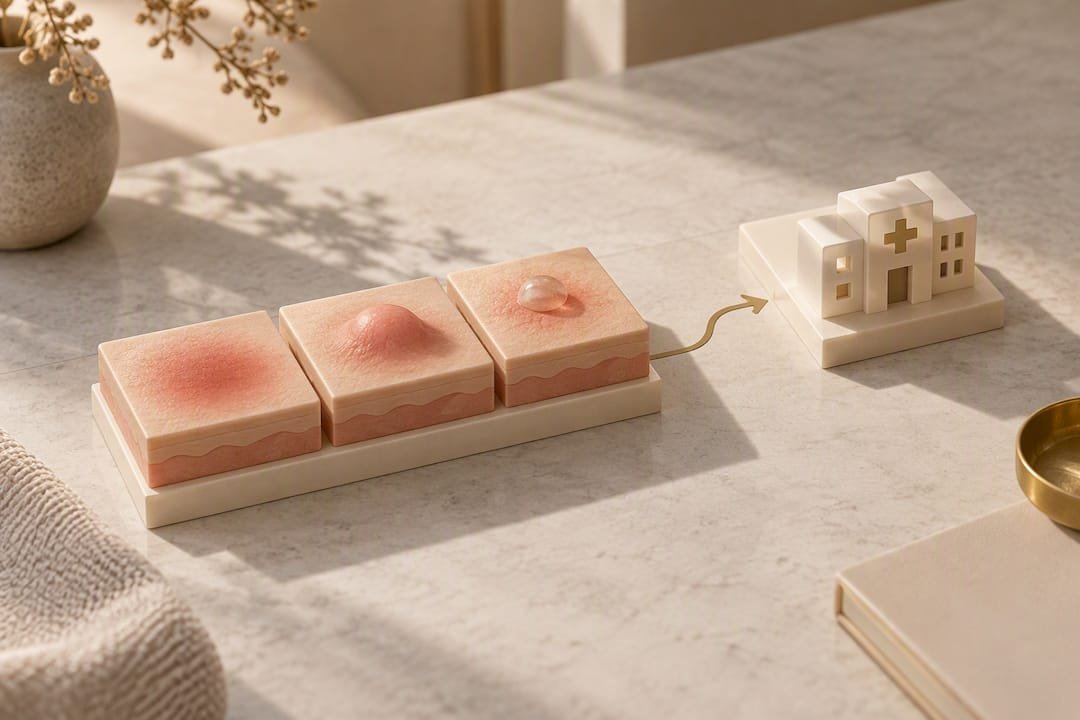
Facial swelling, airway symptoms, blistering, or a severe widespread rash need urgent evaluation, not a wait-it-out approach. Persistent dermatitis that won’t calm down after simplifying your routine, or genuine uncertainty about whether you’re dealing with rosacea, fungal acne, or allergic contact dermatitis, is worth a dermatology visit even when it isn’t an emergency.
- Bring a list of every product you’ve used in the past month, ideally with photos of the reaction at different stages.
- Note the timeline: when symptoms started relative to each new product.
- Mention any patch testing you’ve already done.
- A dermatologist may run formal patch testing or, rarely, a biopsy if the picture stays unclear.
Beauvex’s Formulation-First Approach to Safer Niacinamide Use
The Cellura line is built around a three-step ritual: cleanse, treat, support the barrier, emphasizing how sequencing and formulation determine whether an active helps or irritates. The Luminé Brightening Serum combines niacinamide with tranexamic acid and alpha-arbutin, targeting pigmentation from multiple angles rather than relying on a single high-percentage active.
- Ingredient concentrations are disclosed to inform what is applied instead of leaving it to marketing claims.
- Research references accompany active ingredients, allowing consumers to evaluate the supporting evidence.
- A patch-test guide walks through the same conservative reintroduction protocol dermatology sources recommend.
Keep the Ingredient, Fix the Formula
Most people who react to niacinamide don’t need to give it up. They need a different vehicle, fewer layers, or a lower starting concentration. That’s a formulation problem, not an ingredient problem, and it’s usually solvable in a week or two.
Choosing brands that disclose concentrations and cite their evidence gives you a real shot at troubleshooting instead of guessing. Skin that’s already inflamed doesn’t need more actives thrown at it. It needs a barrier-first routine and patience. If redness or bumps stick around past a couple of weeks of simplification, that’s the point to bring in a dermatologist rather than trying another serum.
— Beauvex LLC
Try a Gentler Path Back to Niacinamide
The Cellura line aims to serve skin that needs an active ingredient with clear knowledge of its contents. Every concentration is published, not hidden behind vague marketing language, so you can match what you’re applying to what your skin can actually tolerate.

The ClearMark Bar uses salicylic, azelaic, and kojic acids in a gentle cleansing format, a reasonable first step when you’re simplifying a reactive routine. Once your skin has settled, the Luminé Brightening Serum offers niacinamide alongside tranexamic acid and alpha-arbutin at disclosed concentrations, so reintroduction doesn’t mean starting from zero information. Patch test on your inner arm first, then bring either product into your routine one step at a time. Check the Cellura line for the full three-step system if you want cleansing, treatment, and barrier support working together from day one.
Sources
- Safety Assessment of Niacinamide and Niacin in Cosmetics — PubMed (CIR/NIH)
- Stop Niacinamide Breakouts Now! Medically Approved Steps — Ubie Health
- Niacinamide skin irritation from product layering, explained — Harper’s Bazaar
This article is general information, not a substitute for advice from a qualified doctor. Consult a qualified healthcare professional about your own circumstances before acting on anything here.
FAQ
How Can You Tell If Your Skin Doesn’t Like Niacinamide?
Look for stinging, warm flushing, or redness within minutes of application, or sustained redness and small bumps that build over a day or two. If the same reaction happens every time you use a product containing niacinamide and clears up once you stop, that’s a strong signal your current formulation doesn’t agree with you.
What Does Niacinamide Irritation Actually Look Like?
It typically shows up as redness, a warm or burning sensation, tingling, or small irritation bumps rather than deep, painful cystic breakouts. Dryness and flaking can follow if the reaction continues for several days without intervention.
How Do You Get Rid of a Niacinamide Rash?
Stop the product immediately and simplify your routine to a fragrance-free cleanser and a ceramide-based barrier moisturizer, following the clinically reviewed triage steps of stopping, simplifying, and repairing before reintroducing anything. Cool compresses help with active burning, and a short course of topical steroid may help under a clinician’s supervision if inflammation is severe.
Why Is Your Skin Burning After Using Niacinamide?
Burning usually points to the vehicle, a trace nicotinic acid impurity, or cumulative exposure from layering several niacinamide products at once, rather than the ingredient itself being unsafe. Switching to a buffered, humectant-rich formula at a lower concentration around 2% often resolves the burning without giving up the ingredient entirely.
Is Niacinamide Irritation the Same as an Allergic Reaction?
No. True allergic reactions to niacinamide are uncommon, and most reported sensitivities trace back to fragrance, solvents, or formulation issues rather than a genuine allergy. Delayed onset, widespread rash, blistering, or swelling point to an allergic or contact dermatitis reaction and warrant medical evaluation.