Yes, alpha arbutin and kojic acid can be combined safely in a well-formulated product. Most effective pairings use typical cosmetic concentrations of alpha arbutin and kojic acid within recommended use ranges, backed by daily broad-spectrum sunscreen and a patch test before your first full application. Start every other night and work up to nightly use as your skin adjusts. Expect the first visible change around 4 to 8 weeks, with clearer, more consistent fading by 8 to 12 weeks.
TL;DR:
- Combining alpha arbutin and kojic acid is safe when used at recommended concentrations and with daily sun protection; start gradually and expect visible improvements within 4 to 12 weeks.
- Kojic acid is unstable and prone to oxidation unless formulated with stabilizers, while alpha arbutin’s stability depends on maintaining a pH between 3.5 and 6.5.
- Clinical studies indicate that a well-formulated combination can rival prescription therapies for melasma, with less irritation and rebound pigmentation, but larger trials are needed for definitive proof.
- Kojic acid carries higher irritation and sensitivity risks, especially for darker skin tones, so patch testing and gradual introduction are essential for safe long-term use.
- Layering active ingredients like vitamin C or retinoids alongside alpha arbutin and kojic acid can increase irritation, so timing and spacing are critical for effective, irritation-free routines.
Table of Contents
- How Alpha Arbutin and Kojic Acid Work Together
- What Do Clinical Trials Actually Show?
- Why Formulation and pH Determine Whether It Actually Works
- How to Avoid Irritation and Paradoxical Darkening
- Building an AM/PM Routine Around These Two Ingredients
- What to Look for on the Label
- Watch Out for These Ingredient Interactions
- Who Should Avoid This Combination
- Adjusting Your Routine for Sensitive Skin
- Sourcing Products You Can Actually Trust
- Where Combination Products Fit Into a Real Maintenance Plan
- Try a Transparent, Evidence-Backed Routine
- Sources
- FAQ
How Alpha Arbutin and Kojic Acid Work Together
Pigment doesn’t form from one switch flipping. It comes from an enzyme called tyrosinase doing its job a little too well, converting tyrosine into melanin in overactive spots left behind by acne, sun exposure, or hormonal shifts. Alpha arbutin and kojic acid interrupt that process from two different angles, which is the entire reason pairing them makes practical sense instead of being redundant.
Alpha arbutin works as a competitive tyrosinase inhibitor. It’s a derivative of hydroquinone bound to glucose, and it essentially occupies the enzyme’s active site without triggering the harsher reactivity associated with hydroquinone itself. It also appears to influence how melanosomes, the tiny pigment-carrying structures inside skin cells, mature and distribute melanin. The tradeoff is speed: alpha arbutin tends to work gradually, which is also why it’s gentle enough for long-term daily use.
Kojic acid takes a more aggressive route. It chelates copper at the tyrosinase enzyme’s core, effectively starving the enzyme of a mineral it needs to function. It’s also an antioxidant in its own right, which gives it a secondary benefit against the oxidative stress that can worsen post-inflammatory dark marks. Kojic acid often shows early improvement in overall skin tone faster than alpha arbutin, but that speed comes with a real cost: it’s more likely to irritate, especially at higher concentrations or in unstable formulas.
Put those two mechanisms side by side and you get:
- Alpha arbutin: slow, steady, low irritation, works from inside the enzyme’s binding pocket.
- Kojic acid: faster acting, higher irritation risk, works by removing the enzyme’s copper cofactor.
- Combined effect: two separate points of interference in the same pathway, which tends to outperform doubling down on one ingredient alone.
That non-overlapping mechanism is exactly why dermatology formulators keep returning to this pairing instead of stacking two copper-chelators or two competitive inhibitors that fight for the same biochemical real estate.
What Do Clinical Trials Actually Show?
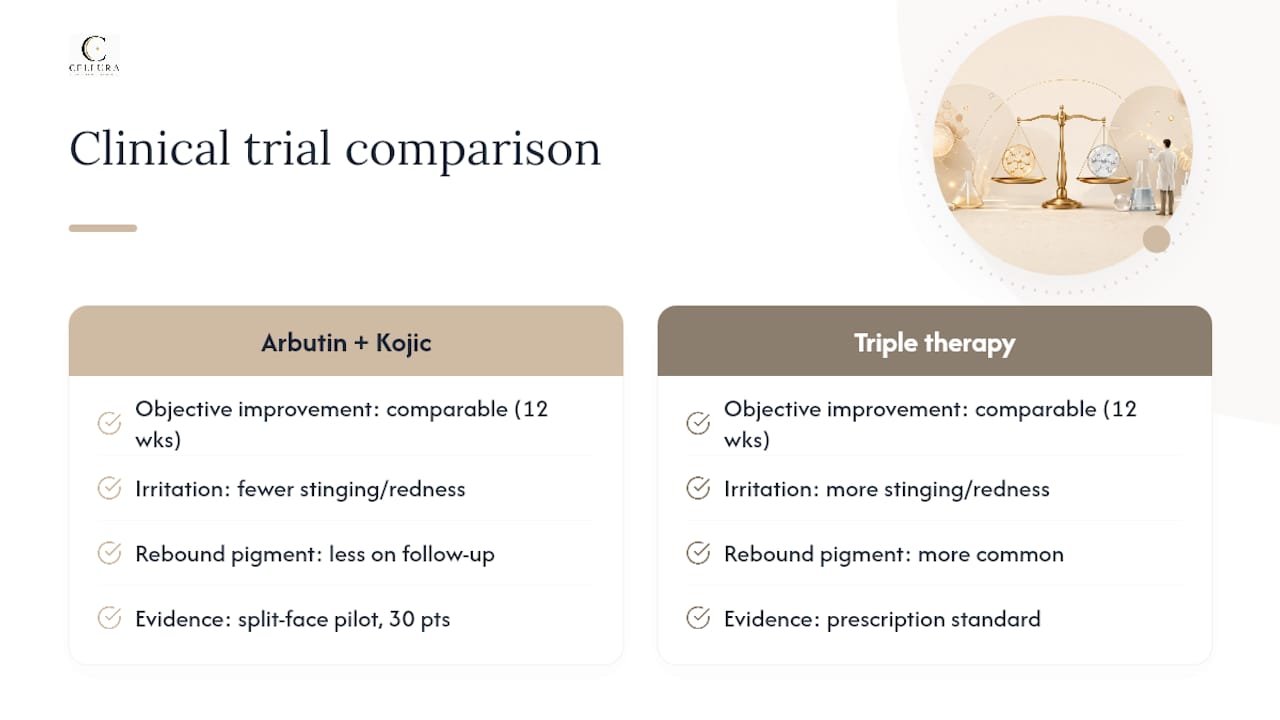
The strongest data point for this combination comes from a split-face, evaluator-blinded pilot study that tested a cream with alpha arbutin and kojic acid at concentrations studied in clinical trials against triple-combination cream, the prescription-strength standard for melasma, which mixes hydroquinone, tretinoin, and a corticosteroid.
Both sides of the face showed comparable improvement on standardized melasma scoring after 12 weeks, but the side treated with the alpha arbutin and kojic acid combination, when well formulated showed fewer instances of stinging and redness, and less pigment returning during the follow-up period.
That’s a meaningful finding, but it deserves context. The split-face randomized pilot study involved 30 participants, which is a small sample by clinical research standards. It’s a real signal, not a settled verdict. What it does establish clearly is that a well-formulated arbutin and kojic acid combination can rival prescription-strength triple therapy on objective measures while causing less irritation and less rebound pigmentation once treatment stops, which matters enormously for anyone who has experienced the frustrating cycle of hydroquinone working, then stopping, then watching spots creep back within weeks.
Laboratory research tells a slightly more complicated story. Studies on depigmenting agent combinations tested in vitro found that when you isolate tyrosinase in a test tube and throw multiple inhibitors at it, some combinations show antagonism, meaning the ingredients partially cancel each other out at the enzyme level. But when researchers moved to actual human melanocyte cell cultures and measured real melanin output, arbutin and kojic acid combinations generally produced additive inhibition instead. Enzyme kinetics in isolation don’t always predict what happens inside a living cell.
The practical takeaway: don’t read too much into a single enzyme assay you might see cited in a marketing claim. The cellular and clinical data, which is what actually matters for your skin, consistently point toward additive benefit rather than the ingredients working against each other.
The limits worth naming honestly: most of the clinical literature on this specific pairing is still built on small trials, formulation quality varies wildly between brands, and pigmentation from melasma or acne marks tends to recur once you stop treatment and unprotected sun exposure resumes. This is maintenance skincare, not a one-time fix.
Why Formulation and pH Determine Whether It Actually Works
Concentration on a label means very little if the formula around it falls apart in the bottle. This is where a lot of otherwise well-dosed products underperform, and it’s the piece most shoppers skip past entirely.
Kojic acid is notoriously unstable. It’s prone to oxidation, and an oxidized kojic acid product often turns a brownish or amber color, which is a visible red flag that the active ingredient has already started degrading before it ever touches your skin. It performs best in acidic conditions and needs antioxidant support (vitamin C derivatives, vitamin E, or similar stabilizers) to hold up over its shelf life. Some formulators sidestep this entirely by using kojic dipalmitate, a lipophilic derivative that resists oxidation better in oil-based systems, though it typically needs to be broken down enzymatically on skin to release the active form, so it can be less potent gram for gram.
Alpha arbutin behaves better in water-based formulas, but it isn’t bulletproof either. Its stability is pH-dependent, and formulas need to stay roughly between pH 3.5 and 6.5 to prevent hydrolysis, the process by which alpha arbutin breaks down into free hydroquinone. A poorly buffered formula sitting outside that range can quietly convert into something you didn’t sign up for.
A few things to check before you buy:
- Look for opaque or airless packaging rather than a clear jar that lets in light and air.
- Check whether the brand names antioxidant or chelating co-ingredients rather than just listing the two actives alone.
- Notice the product’s color and texture over time. Any drift toward brown or amber in a kojic acid formula signals oxidation.
- Favor brands that disclose exact percentages rather than hiding behind a proprietary “brightening complex.”
Pro Tip: If a serum smells noticeably different or has darkened since you opened it, that’s not just cosmetic. It’s a sign the actives have degraded, and you’re likely no longer getting the concentration printed on the label.
How to Avoid Irritation and Paradoxical Darkening
Kojic acid carries a meaningfully higher sensitization risk than alpha arbutin, which is generally well tolerated across Fitzpatrick skin types and is often the safer long-term maintenance ingredient for deeper skin tones. That doesn’t mean kojic acid is off-limits. It means it needs a more careful introduction.
- Patch test first. Apply a small amount to your inner forearm or behind your ear and wait 48 hours before putting anything on your face.
- Start every other night. Give your skin barrier time to adjust before committing to nightly use, and only escalate once you see zero flaking, stinging, or persistent redness.
- Wear broad-spectrum SPF every single morning, rain or shine. Both ingredients make skin more reactive to UV, and unprotected sun exposure is the single fastest way to undo weeks of progress or trigger new dark marks. Our guide on what SPF really does for dark spots covers this in more depth.
- Watch for paradoxical darkening. If a spot gets darker instead of lighter, it’s often a sign of irritation-driven post-inflammatory pigmentation, not a failure of the ingredients themselves. Back off frequency immediately.
- Stop and consult a dermatologist if you see blistering, persistent burning, or pigmentation that worsens over several weeks rather than improving.
Sensitive skin, active eczema, or a compromised skin barrier from over-exfoliating are all reasons to slow down further, not push through.
Building an AM/PM Routine Around These Two Ingredients
Consistency beats intensity here. A routine you actually stick with for 10 weeks will outperform an aggressive one you abandon after five days of irritation.
Morning routine:
- Gentle cleanse.
- Apply your combination serum (alpha arbutin plus kojic acid) to clean, dry skin.
- Follow with a lightweight moisturizer if your skin runs dry.
- Finish with broad-spectrum SPF 30 or higher. Non-negotiable.
Evening routine:
- Cleanse thoroughly to remove sunscreen and daily buildup. A cleanser containing gentle acids, like one that combines salicylic, azelaic, and kojic acid such as the Cellura ClearMark Bar, can do double duty by supporting exfoliation before your treatment step.
- Apply your alpha arbutin and kojic acid serum.
- Layer a hydrating, barrier-supporting product on top, ideally one with niacinamide or hyaluronic acid.
- On nights you’re not using the brightening serum, this is where a retinoid or gentle chemical exfoliant can rotate in, but never stack a retinoid directly on top of kojic acid until your skin has built tolerance to both separately.
Niacinamide and hyaluronic acid aren’t just filler steps. Niacinamide helps reinforce the skin barrier and takes some of the irritation edge off kojic acid, while hyaluronic acid keeps the skin hydrated enough to tolerate active ingredients without flaking. If you’re weighing which complementary actives pair best, our comparison of tranexamic acid versus niacinamide for dark spots breaks down when each makes sense.
For stubborn, isolated dark spots rather than widespread discoloration, spot-treating with a slightly higher-frequency application directly on the mark, while keeping the rest of your face on a gentler schedule, often gets results without unnecessary irritation elsewhere.
Pro Tip: If your skin tolerates the combination well after two weeks of every-other-night use, escalate gradually rather than jumping straight to twice-daily application. Slow escalation is what prevents the barrier damage that causes rebound pigmentation later.
What to Look for on the Label
Marketing copy loves the word “brightening,” but that word means nothing without numbers behind it.
Beyond the percentages, look at what surrounds those actives. A trustworthy kojic acid formula will usually disclose an antioxidant or chelating ingredient nearby, since that’s what keeps the active from oxidizing on the shelf. Opaque bottles, pumps, or airless dispensers are a good sign the brand thought about degradation, not just marketing photography under studio lighting.
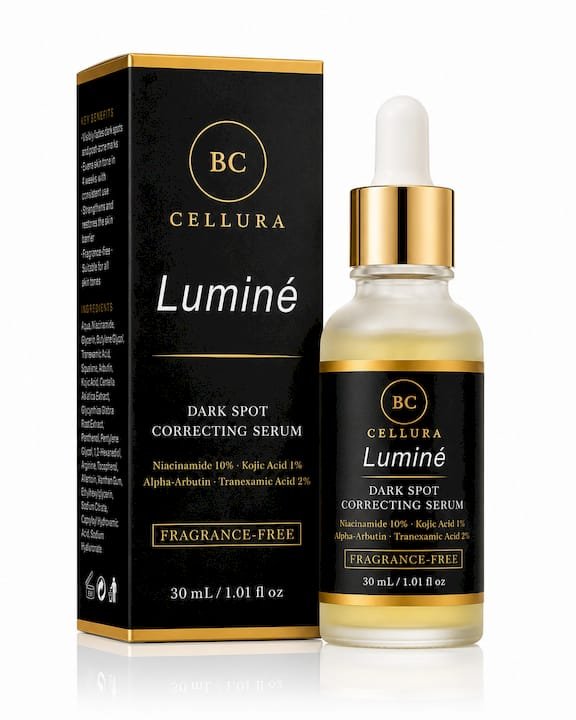
Beauvex LLC publishes exact concentrations and links to the research behind each active in the Luminé Brightening Serum, which combines alpha arbutin and kojic acid with niacinamide and tranexamic acid. That kind of disclosure is the standard worth holding every brand to, whether or not you buy from them: if a brand won’t tell you the percentage, ask why.
If you want a deeper breakdown of how alpha arbutin, kojic acid, and tranexamic acid compare on tolerability and speed, this comparison guide walks through the differences in more detail.
Watch Out for These Ingredient Interactions
Layering order isn’t the only thing that matters. Some ingredient combinations change how alpha arbutin and kojic acid actually perform on your skin, for better or worse.
Vitamin C (ascorbic acid) is a mixed bag. It shares a similar mechanism with these two, since it also interferes with tyrosinase activity, so combining all three can compound brightening benefits. But ascorbic acid is also quite acidic and can be irritating on its own, so stacking it with kojic acid on sensitive skin sometimes tips into overload. Many people do better applying vitamin C in the morning and saving the arbutin and kojic combination for nighttime.
Retinoids increase cell turnover and can temporarily increase sensitivity to other actives, including kojic acid. Introducing both at the same time is a common reason people report burning or peeling that they wrongly blame on the brightening serum alone.
Benzoyl peroxide, often present in acne treatments, can oxidize certain actives on contact and reduce their effectiveness if layered directly. Space these out by using one in the morning and the other at night rather than mixing them in the same application.
Chemical exfoliants like glycolic or lactic acid thin the outer skin layer, which can actually help arbutin and kojic acid penetrate better, but it also raises irritation risk substantially. If you’re already using an AHA a few nights a week, dial back the frequency of your brightening serum rather than running both nightly.
Who Should Avoid This Combination
Not every skin type or situation calls for alpha arbutin and kojic acid together, and knowing when to hold back matters just as much as knowing how to use them.
Active eczema, rosacea flares, or a visibly compromised skin barrier are reasons to pause entirely until the underlying condition calms down. Introducing tyrosinase inhibitors onto already-inflamed skin tends to backfire, triggering more redness rather than fading pigment.
Pregnancy and breastfeeding deserve a direct conversation with your doctor before starting kojic acid specifically. While topical kojic acid isn’t classified the same way as oral hydroquinone exposure concerns, the caution is standard enough in dermatology practice that it’s worth clearing with a physician rather than guessing.
People with a documented allergy to fungal-derived ingredients should be cautious with kojic acid, since it’s produced through fermentation of certain fungi species. A patch test isn’t optional in this case, it’s essential.
Very deep, stubborn melasma that hasn’t responded to consistent over-the-counter treatment after 12 weeks is a sign to see a dermatologist rather than continuing to self-treat indefinitely. Melasma driven by hormonal factors sometimes needs prescription-strength intervention or in-office treatment alongside topical care, and a professional can rule out other pigmentation causes that look similar on the surface but respond to entirely different treatments.
Adjusting Your Routine for Sensitive Skin
There’s no single correct concentration for every face.
Watch for any tightness, flaking, or lingering redness the next morning before increasing frequency. Once your skin tolerates that without complaint, move to every other night, then nightly, then consider a slightly higher concentration only if progress has stalled after a full 8 to 12 week cycle.
If you already know your skin runs sensitive or reactive, you may find that alpha arbutin alone, without kojic acid, gets you most of the benefit with a fraction of the irritation risk. That’s a completely reasonable long-term maintenance strategy, especially for deeper skin tones where the sensitization risk of kojic acid tends to run higher.
Conversely, if you have a genuine tolerance built from months of consistent use and progress has plateaued, a short-term increase to the 2% end of the kojic acid range under professional guidance, rather than permanently, can sometimes restart visible improvement without escalating risk indefinitely.
Sourcing Products You Can Actually Trust
The gap between a good ingredient list and a good product is formulation, and that gap is invisible until you know what to check. Start by reading the full ingredient list, not just the front-of-bottle marketing claim, and confirm the brand states an actual percentage for both alpha arbutin and kojic acid rather than burying them deep in a long list with no numbers attached.
Check whether the brand publishes or references any research behind its formulation choices. A company willing to link to a clinical study or a technical brochure explaining why it chose a specific concentration is signaling something a vague “clinically proven” claim on a bottle never will. Packaging matters as much as the ingredient deck: airless pumps and opaque containers protect both actives from the light and air exposure that degrade them over time.
Price alone tells you nothing about formulation quality, and neither does a long list of trendy add-in ingredients if the two actives that matter most aren’t dosed at meaningful levels. If you’re building out a full routine, our guide to alpha arbutin’s proven benefits for skin is a useful reference point for what a well-supported product claim actually looks like versus marketing filler.
Where Combination Products Fit Into a Real Maintenance Plan
Some skincare approaches are built around a three-step ritual: cleansing, treatment, and barrier support, because pigmentation from acne marks rarely responds to a single product used in isolation. Certain serums pair alpha arbutin and kojic acid with niacinamide and tranexamic acid specifically to interrupt pigment formation at more than one stage, rather than relying on one mechanism to do all the work.
Transparent concentrations matter because they let you actually evaluate a claim instead of taking a marketing headline on faith. When research references are published alongside the exact percentage of each active, you can compare a formulation against the clinical literature yourself rather than guessing whether “clinically proven” means anything at all.
That’s the standard worth expecting from every brand you consider.
— Beauvex LLC
Try a Transparent, Evidence-Backed Routine
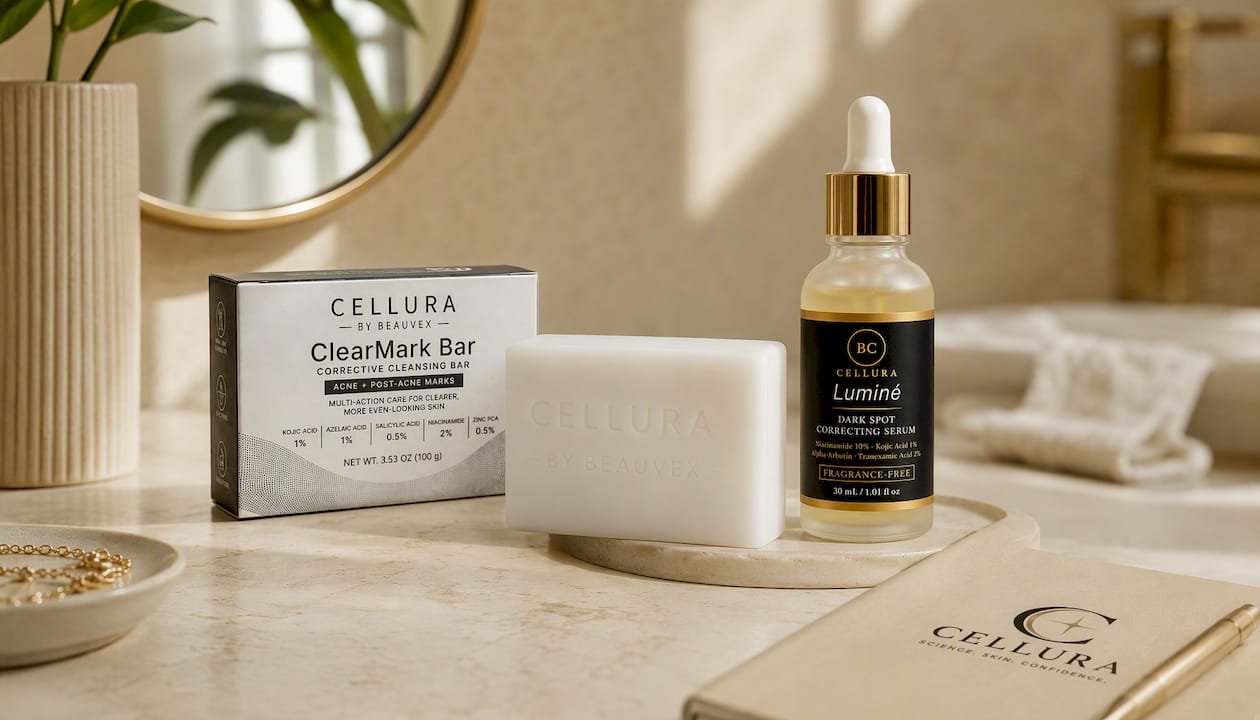
Most brightening products ask you to trust a marketing claim. Beauvex LLC asks you to check the math instead: every concentration on the label matches what’s in the bottle, and every active is tied to a published reference you can read yourself. The Cellura ClearMark Bar cleanses with salicylic, azelaic, and kojic acid to prep skin before treatment, while the Cellura Luminé Brightening Serum delivers alpha arbutin and kojic acid alongside niacinamide and tranexamic acid for a multi-target approach to post-acne dark spots.
Disclosed concentrations mean you’re never guessing whether a product is under-dosed. If your pigmentation is complex, widespread, or hasn’t responded to consistent care, a dermatologist consultation alongside patch testing is still the right first move. Explore the full Cellura line to build a routine around ingredients you can actually verify.
FAQ
Can I Use Alpha Arbutin With Kojic Acid?
Yes. They target the same pigmentation pathway through different mechanisms, and a split-face clinical trial found the combination performed comparably to prescription triple-combination cream while causing fewer side effects. Introduce them gradually and always pair with daily sunscreen.
Why Is Alpha Arbutin Making My Skin Darker?
This is usually irritation, not the ingredient itself. Overuse, layering too many actives at once, or skipping sunscreen can trigger post-inflammatory darkening that looks like the product failed when it’s actually a barrier or sun-protection issue. Cut back frequency, confirm you’re using SPF daily, and give your skin two to three weeks before judging results.
How Long Do Alpha Arbutin and Kojic Acid Take to Work?
Most people notice initial changes in overall tone within 4 to 8 weeks, with more consistent fading of stubborn spots by 8 to 12 weeks. Results depend heavily on formulation quality, consistency of use, and daily sun protection.
What Cannot Be Paired With Alpha Arbutin?
Avoid layering alpha arbutin directly with benzoyl peroxide, since it can reduce the active’s effectiveness through oxidation on contact. Stacking it with high-strength retinoids or strong chemical exfoliants on the same night also raises irritation risk considerably, so most people do better spacing those out across morning and evening routines.