
Salicylic acid fades dark spots, but only the kind sitting near the surface. It works well on post-acne marks, the flat brown or red patches left behind after a blemish heals, because it exfoliates the pigmented cells sitting in the epidermis rather than shutting down melanin production. It does little for deeper dermal pigment like melasma. Pair it with daily sunscreen and a pigment-targeting active such as niacinamide or tranexamic acid, and the fading speeds up considerably.
TL;DR:
- Salicylic acid effectively fades surface-level post-acne spots but does little for deeper pigment like melasma or lentigines.
- It works through exfoliation by loosening dead skin cells but does not inhibit melanin production, limiting its impact on stubborn pigmentation.
- Pairing salicylic acid with pigment inhibitors like niacinamide or tranexamic acid accelerates fading, especially when combined with consistent sunscreen use.
- Starting with low concentrations of 0.5% to 1% and avoiding frequent use of high-strength peels prevents irritation and supports gradual skin tolerance.
- Combining salicylic acid with strong retinoids or in-office treatments without recovery time raises barrier damage and irritation risk.
Table of Contents
- What Is Salicylic Acid and How Is It Formulated for Dark Spots?
- How Does Salicylic Acid Fade Dark Spots and Where Does It Fall Short?
- How Do You Use Salicylic Acid for Dark Spots?
- What Should You Pair (and Not Pair) With Salicylic Acid?
- What Are the Side Effects and When Should You Stop Using It?
- How Does a Multi-Step Routine Like Beauvex’s Address Dark Spots More Fully?
- Why Most Dark Spot Advice Oversells One Ingredient
- Where Beauvex LLC Fits Into Your Dark Spot Routine
- Sources
- FAQ
What Is Salicylic Acid and How Is It Formulated for Dark Spots?
Salicylic acid is a beta hydroxy acid, or BHA, and its defining trait is oil solubility. Where alpha hydroxy acids like glycolic acid work mostly on the skin’s surface, salicylic acid slips into sebum and gets down into the pore itself, which is why it’s been a staple acne ingredient for decades. That same oil affinity makes it useful for post-acne pigmentation, since acne marks and clogged pores tend to show up in the same oily zones.
You’ll find it in three main formats:
- Cleansers and washes — brief contact time, gentler daily use, good for prevention rather than aggressive fading.
- Leave-on treatments — typically 0.5% to 2%, the range most people should start with at home.
- Professional peels — 20% to 30% concentrations, applied by a dermatologist or esthetician for faster, deeper results.
Its anti-inflammatory action matters more than people realize for anyone prone to post-inflammatory hyperpigmentation, since calming irritation before it escalates is often what keeps a new dark spot from forming in the first place.
How Does Salicylic Acid Fade Dark Spots and Where Does It Fall Short?
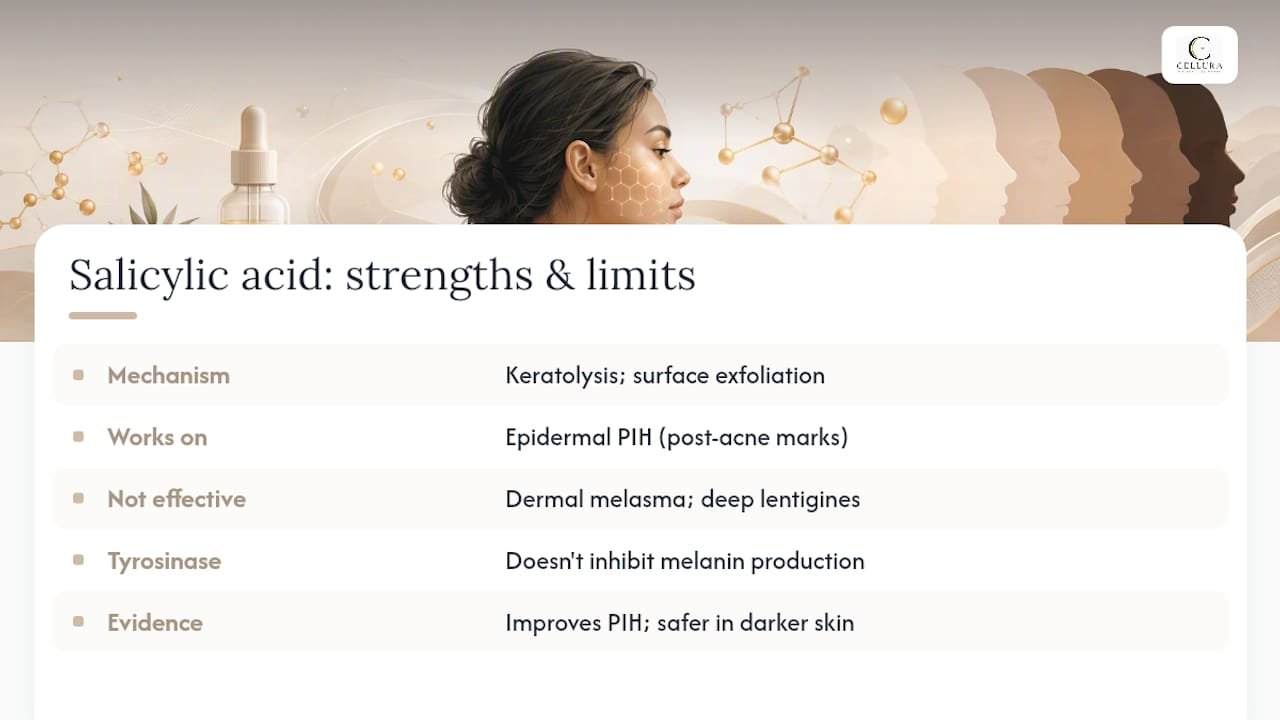
The mechanism is keratolysis, not pigment suppression. Salicylic acid loosens the bonds between dead skin cells so that hyperpigmented corneocytes shed faster than they would on their own, which is a mechanistic review of keratolytics confirms. It’s exfoliation, essentially, aimed at the outermost layer where post-acne marks tend to sit.
That distinction explains why results vary so much by pigment type. Epidermal post-inflammatory hyperpigmentation, the flat brownish marks left after a pimple heals, responds reasonably well because the discoloration lives in cells salicylic acid can actually reach and remove. Melasma and deep lentigines are a different story. Those involve pigment deposited deeper in the dermis or melanocytes that are simply overactive, and no amount of surface exfoliation touches that.
Salicylic acid does not inhibit tyrosinase, the enzyme responsible for melanin production, so it never addresses the root cause of stubborn pigment the way an ingredient like azelaic acid or kojic acid can.
Clinical evidence does back its use for PIH specifically. A study on a combination salicylic acid formulation found measurable improvement in hyperpigmentation, and comparative peel research suggests salicylic acid peels carry a lower risk of paradoxical hyperpigmentation in darker skin than some alternative peel acids, largely thanks to that anti-inflammatory profile. That’s a meaningful safety edge if you have skin of color and have been burned by aggressive treatments before.
How Do You Use Salicylic Acid for Dark Spots?
Start low. A 0.5% to 1% leave-on product is the right entry point for most people, especially if you haven’t used exfoliating acids before. Save 2% concentrations and professional peels for after your skin has proven it can tolerate the basics without flaring up.
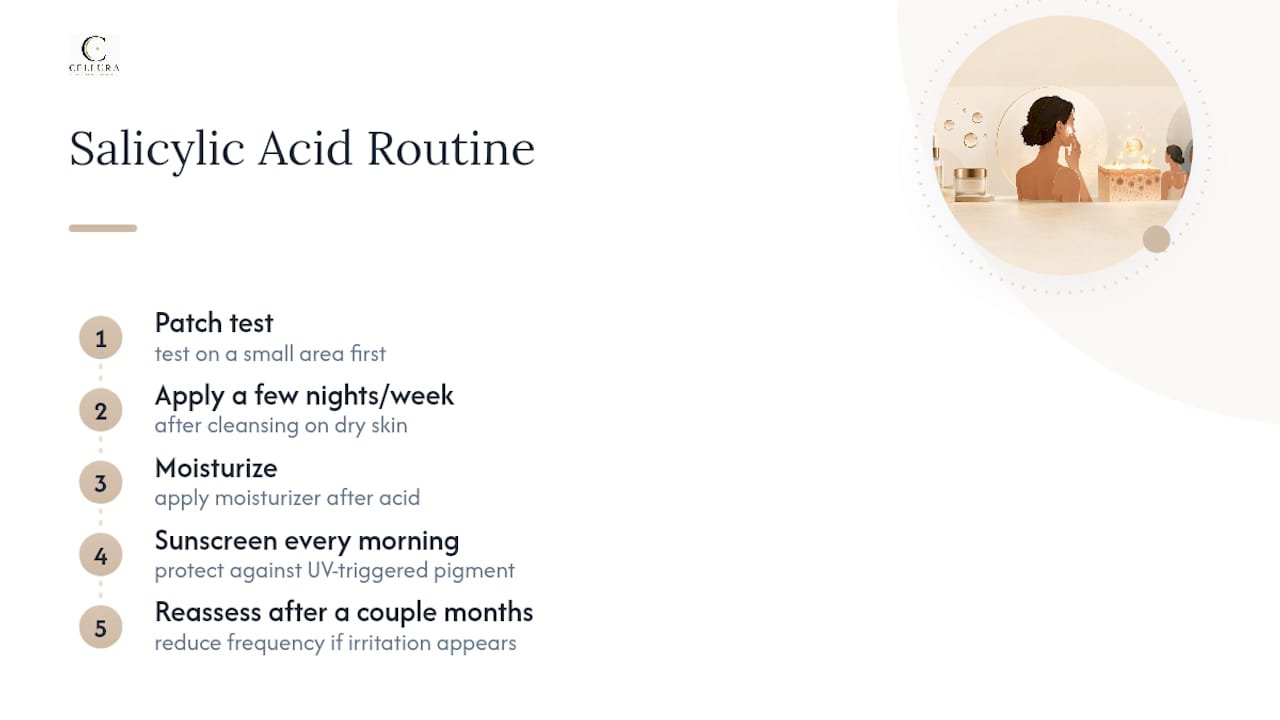
A typical routine may include patch testing first, starting use a few nights per week after cleansing and before moisturizing, gradually increasing frequency if tolerated, applying sunscreen every morning to protect against UV-triggered pigment formation, and reassessing progress after a couple of months, as fading times vary.
If you see excessive dryness, stinging that doesn’t settle within a few minutes, or peeling that looks more like irritation than gentle flaking, cut back to once or twice weekly rather than pushing through it.
Pro Tip: Apply salicylic acid to dry skin, not damp skin. Water on the skin’s surface speeds absorption and can turn a tolerable product into an irritating one within minutes.
What Should You Pair (and Not Pair) With Salicylic Acid?
Salicylic acid exfoliates. It doesn’t stop pigment production. That’s the entire reason pairing it with a tyrosinase inhibitor or a melanin transfer blocker produces better results than using it alone, a point dermatology reviews on pigmentation treatment stacks make repeatedly. One clears the debris on top; the other slows the pigment being made underneath.
Strong pairings worth building a routine around:
- Niacinamide — blocks melanin transfer to surface cells, layers easily with salicylic acid, low irritation risk.
- Tranexamic acid — reduces pigment signaling, often used alongside niacinamide for a multi-pathway approach.
- Azelaic acid — a mild tyrosinase inhibitor with anti-inflammatory benefits similar to salicylic acid’s own profile; see how azelaic acid concentrations compare for acne-prone skin.
- Vitamin C — antioxidant support that also interferes with pigment formation, best used in the morning under sunscreen.
- Retinoids — effective for cell turnover, but risky combined with salicylic acid every night. Alternate nights or use on separate parts of the day instead.
What to avoid: stacking a high-strength leave-on BHA with a strong retinoid nightly, especially early on. That combination overwhelms the skin barrier fast. The same caution applies to layering salicylic acid with in-office peels or other acids within the same week; give your skin recovery time between aggressive treatments, and always check with a dermatology provider before combining professional procedures with an active at-home routine.
What Are the Side Effects and When Should You Stop Using It?
Most people tolerate salicylic acid fine, but the common complaints are predictable:
- Dryness and flaking, especially in the first two weeks.
- Mild stinging or redness right after application.
- Peeling that’s more noticeable in colder, drier climates.
Dial back frequency and add a richer moisturizer if these show up. They usually resolve as your skin adjusts.
Rare but serious reactions include full allergic responses (hives, swelling, difficulty breathing) and systemic salicylate toxicity, which can occur with excessive use over large areas of skin, particularly in children or people with kidney or liver conditions. Mayo Clinic’s guidance on topical salicylic acid also flags monitoring for unusual symptoms as a standard precaution, not an overreaction.
Stop and seek care if you notice swelling, ringing in the ears, confusion, or rapid breathing after use. Skip salicylic acid entirely on broken, sunburned, or actively inflamed skin, and check with a doctor first if you’re pregnant, managing diabetes, or dealing with circulation issues.
How Does a Multi-Step Routine Like Beauvex’s Address Dark Spots More Fully?
Salicylic acid clears the surface. It doesn’t touch the pigment pathway underneath, which is exactly why a single-ingredient approach so often plateaus. A three-step ritual involving a cleansing bar with salicylic, azelaic, and kojic acids for exfoliation and mild tyrosinase inhibition, followed by a treatment serum and a barrier-support step, helps the skin tolerate active use without breaking down.
The Cellura Luminé Brightening Serum is where the pigment-targeting work happens. It combines niacinamide, tranexamic acid, kojic acid, and alpha-arbutin, four ingredients that interrupt melanin production and transfer at different points, which is the multi-pathway strategy dermatology research consistently favors over single-agent treatment.
What can differentiate this serum from others is transparency about ingredient concentrations and citing research behind each active, helping consumers better understand the product’s formulation.
If you want a deeper breakdown of how salicylic cleansing bars perform for acne-prone skin, or how tranexamic acid stacks against niacinamide for pigment specifically, those comparisons are worth reading before you commit to a full routine.
Why Most Dark Spot Advice Oversells One Ingredient
The biggest problem with how salicylic acid gets marketed for pigmentation is the implication that exfoliation alone solves the problem. It doesn’t, and the research backs that up clearly: salicylic acid has no effect on tyrosinase, the enzyme actually driving pigment production. It’s a supporting player, a very good one for post-acne marks, but a supporting player nonetheless.
What gets underestimated is how much sunscreen consistency matters compared to which brightening serum you buy. You can spend real money on a well-formulated active and lose most of the benefit to unprotected sun exposure. The order of priorities should be sunscreen first, exfoliation second, targeted actives third, not the reverse order most routines default to.
If there’s one thing worth doing differently, it’s treating salicylic acid as one piece of a stack rather than the whole strategy. Anyone still expecting a single ingredient to erase months of acne scarring is setting themselves up for disappointment, and probably irritated skin along the way.
— Beauvex LLC
Where Beauvex LLC Fits Into Your Dark Spot Routine
If you’ve been treating post-acne marks with an exfoliant alone and hitting a plateau, the gap is usually the missing pigment-targeting step. Beauvex LLC built its three-step ritual specifically to close that gap: a salicylic and azelaic acid cleansing bar to exfoliate, the Luminé Serum to interrupt pigment production at multiple points, and a copper peptide balm to keep the skin barrier intact while you use active ingredients consistently.
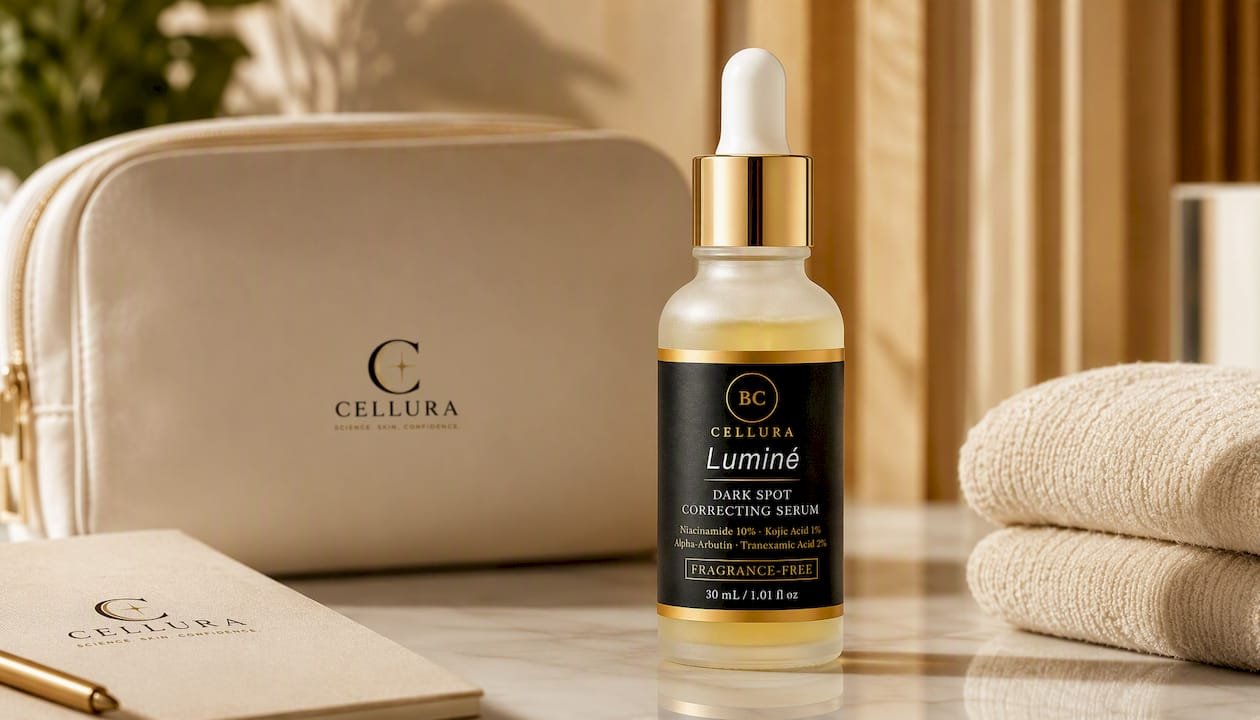
Every product lists its exact ingredient concentrations and the research behind them, so you can compare what you’re using now against what’s actually in the bottle. If your current routine leans on salicylic acid alone, adding the Cellura Luminé Brightening Serum is the most direct next step toward addressing the pigment pathways exfoliation can’t reach on its own. Check the product page for full ingredient breakdowns and start where your skin actually needs support.
Sources
- Drugs
- Mechanisms and actions of keratolytics (PMC article)
- Tolerance and Efficacy of a Product Containing Ellagic and Salicylic Acids – J Drugs Dermatol
FAQ
Can Salicylic Acid Remove Dark Spots?
It fades superficial post-acne dark spots by exfoliating pigmented surface cells, but it doesn’t remove deeper pigment like melasma or work as a standalone melanin blocker.
How Long Does It Take for Salicylic Acid to Fade Dark Spots?
Measurable fading of post-acne marks generally occurs over several weeks to a few months with consistent use, though more persistent marks may require longer treatment.
What Fades Dark Spots the Fastest?
Combining an exfoliant like salicylic acid with a pigment-targeting active such as tranexamic acid or niacinamide, plus daily sunscreen, tends to produce faster results than any single ingredient used alone.
What Should You Never Mix With Salicylic Acid?
Avoid combining high-strength leave-on salicylic acid with strong retinoids nightly or with in-office chemical peels in the same week, since both raise irritation risk significantly without a gradual introduction period.