
Tallow balm works best for very dry, flaky, or mature skin that needs heavy occlusive support, and it’s risky for oily or acne-prone skin without a careful patch test first. The core tradeoff is simple: the same waxy density that locks in moisture so well is also what can clog pores. If you’re still deciding, the sections below cover application steps, a DIY recipe, how to vet a commercial product, and where a formulated barrier balm might serve you better than plain rendered fat.
TL;DR:
- Tallow balm provides a strong occlusive layer that is most beneficial for severely dry, flaky, or mature skin, especially in cold or dry environments.
- Its fatty acid profile, similar to human sebum, allows it to lock in moisture but also risks clogging pores on oily or acne-prone skin.
- Proper application involves patch testing, targeted use on dry patches, and applying to slightly damp skin at night to prevent greasiness.
- Commercial formulations should prioritize transparency, ideally with grass-fed sourcing, minimal ingredients, and no added fragrances or botanicals.
- Evidence supports its use mainly as a moisture sealant, while its anti-inflammatory and healing effects require more human research and should not replace active treatments.
Table of Contents
- What Is Tallow Balm and How Does It Work on Skin?
- When Does Tallow Balm Actually Help Your Skin?
- Why Do Some Dermatologists Caution Against Tallow Balm?
- How Do You Apply Tallow Balm on Your Face Safely?
- How Do You Make a Whipped Tallow Balm at Home?
- What Should You Look for in a Commercial Tallow Balm?
- How Does Beauvex Fit Into an Evidence-Led Skin Care Ritual?
- An Editorial Take: Ancestral Simplicity Meets Modern Dermatology
- Ready to Try a Barrier Balm Built for Transparency?
- Sources
- FAQ
What Is Tallow Balm and How Does It Work on Skin?
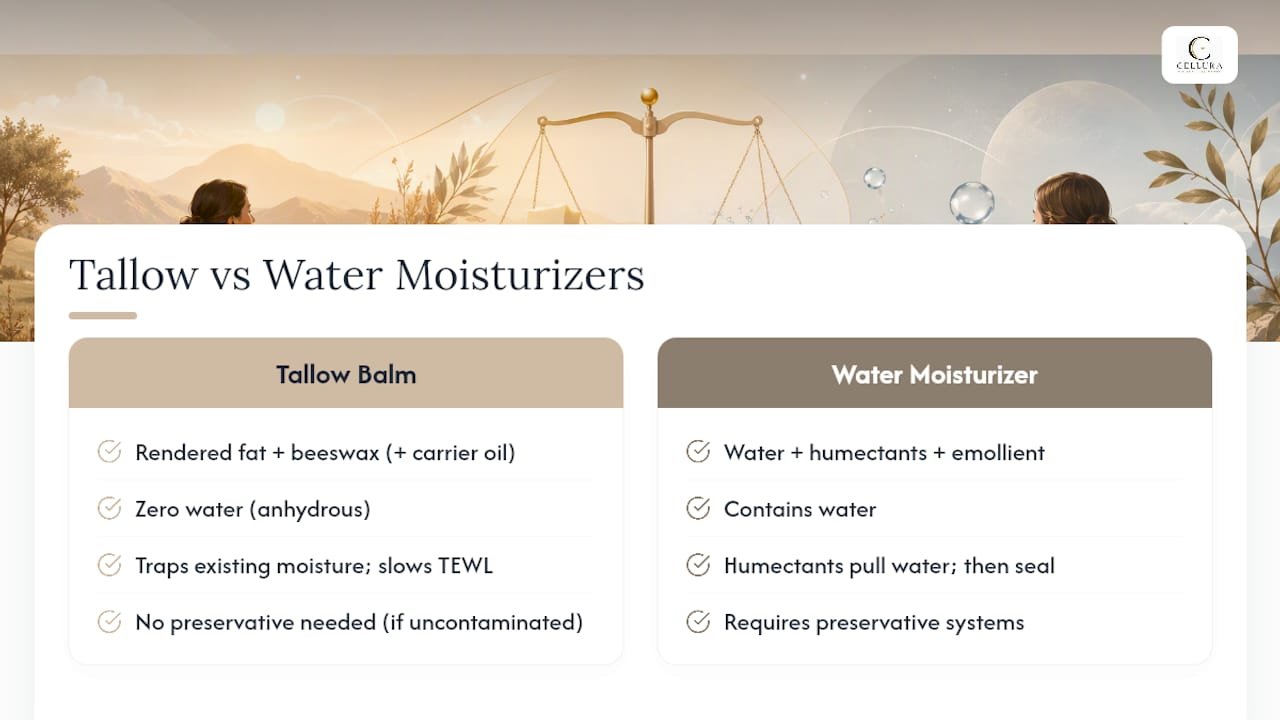
Tallow balm is rendered animal fat, usually from beef, whipped or melted with beeswax and sometimes a carrier oil like jojoba or olive. That’s the whole formula in most cases. No emulsifiers, no preservatives, no water. It’s an anhydrous product, meaning it contains zero water content, which is part of why it behaves so differently from the lotion in your medicine cabinet.
The reason tallow gets so much attention in natural skin care circles comes down to its fatty acid makeup. It’s rich in oleic acid, stearic acid, and palmitic acid, the same fatty acids that show up in human sebum. That overlap is why people describe tallow as “biocompatible”: your skin doesn’t have to work hard to recognize it. A scoping review published in PMC screened 147 studies on tallow’s interaction with skin and included 19 in its analysis, concluding the fat is generally well tolerated and moisturizing, though the human evidence base is still thin.
Compare that to a standard water-based moisturizer, which relies on humectants like glycerin or hyaluronic acid to pull water into the skin, then seals it with a lighter emollient. Tallow skips that step entirely. It doesn’t add water, it just traps whatever moisture is already there and slows transepidermal water loss. That’s why people with genuinely dry, tight, flaking skin tend to notice a bigger difference than people with normal or combination skin, whose barriers aren’t struggling in the same way.
There’s also a shelf-stability angle worth knowing. Because tallow balm has no water, it doesn’t need the preservative systems that water-based creams require to prevent bacterial growth. A well-rendered, properly stored tallow balm can last months at room temperature without a hint of rancidity, provided it isn’t contaminated during use.
Not all tallow is equal, either. Fat from grass-fed and grass-finished cattle tends to carry higher concentrations of vitamins A, D, E, and K than fat from grain-finished animals, along with a somewhat different fatty acid ratio. That’s the reasoning behind the “grass-fed” label you’ll see stamped on nearly every tallow balm marketed for skin, and it’s a legitimate distinction, not just a marketing flourish. This mineral and vitamin density is one reason minimalist formulas built from little more than tallow and beeswax have found an audience among people who react to long ingredient lists. Fewer ingredients means fewer chances for a preservative, fragrance, or emulsifier to trigger sensitivity.
When Does Tallow Balm Actually Help Your Skin?
The clearest, best-supported benefit is occlusion. Tallow forms a physical layer over skin that slows water loss for hours, which is exactly what a compromised barrier needs while it repairs. If your skin is cracking around the nose, flaking on the cheeks in winter, or generally feeling tight no matter what you apply, that kind of long-lasting seal can make a real difference within days.
Beyond basic moisture-trapping, there’s a smaller but genuinely interesting body of evidence pointing toward anti-inflammatory and wound-support effects. The same PMC scoping review noted that some of the included studies, largely animal models and small comparative trials, reported symptom relief in dermatitis models and improved healing metrics when tallow-based emulsions were applied to wounds. That’s a real signal, but it comes with a caveat the researchers themselves flagged: the human data set behind it is small, and results have been inconsistent across studies. This is not the kind of evidence that supports calling tallow a treatment for eczema or a proven wound-care product. It’s early, and it’s mostly preclinical.
Where tallow balm earns its reputation, in practical terms, is a fairly narrow set of scenarios:
- Severely dry, flaky patches around the mouth, nose, or cheeks, especially in cold or dry climates
- Mature skin with reduced natural sebum production, where the risk of clogged pores is lower
- Localized barrier repair after over-exfoliation, retinoid irritation, or harsh weather exposure
- Nighttime use as an occlusive “seal” over other hydrating steps, rather than as a standalone daily moisturizer
One figure worth sitting with: that same review screened 147 candidate studies and could only justify including 19 of them in its final analysis. That’s a small foundation for the confident claims you’ll see in some skin care content, and it’s exactly why dermatology sources treat tallow as a supportive occlusive rather than an active treatment.
On timeline, most people who notice a benefit do so within three to five nights of consistent use on dry patches, since the effect is mechanical (sealing in moisture) rather than something that requires weeks of cellular turnover to show up. If you’ve seen no change in flaking or tightness after two weeks of nightly use, tallow probably isn’t the right tool for whatever is causing your dryness, and it’s worth looking at other causes, like a damaged barrier from over-cleansing or a reaction to a different product in your routine.
Why Do Some Dermatologists Caution Against Tallow Balm?
The biggest concern dermatologists raise about tallow balm isn’t safety in a broad sense. It’s comedogenicity, the tendency of a product to clog pores. Dermatologist Mika Tabata, M.D., describes tallow as an extremely heavy moisturizer that is also moderately comedogenic, and notes it lacks ceramides, the lipids your skin actually uses for active barrier repair. That distinction matters for anyone considering tallow as a fix for barrier damage: it can seal moisture in effectively, but it isn’t doing the same rebuilding work that a ceramide-based formula does.
Dermatology summaries from health systems echo this. Scripps Health’s dermatology writeup points out that while tallow can moisturize effectively, it may clog pores on facial skin specifically, and many dermatologists steer acne-prone patients toward tested, non-comedogenic alternatives instead. Face skin has more, and generally smaller, pores than skin on the arms or legs, so a product that behaves fine on your elbows can behave very differently on your forehead or chin.
The research gap compounds the uncertainty. The PMC scoping review that forms the backbone of most serious tallow research concluded that human trials are limited and that side-effect reporting across the existing studies is inconsistent, some report no irritation, others note breakouts or contact reactions. That’s not a reason to avoid tallow outright, but it is a reason to treat every anecdote you read online, including glowing ones, as a single data point rather than a guarantee.
There’s a category of user who should be especially cautious: anyone currently dealing with active acne. Layering a heavy occlusive fat over inflamed, oil-producing skin is a reasonable way to make a breakout worse, not better. If your main skin concern right now is active breakouts rather than dryness, tallow balm is probably the wrong tool for the job.
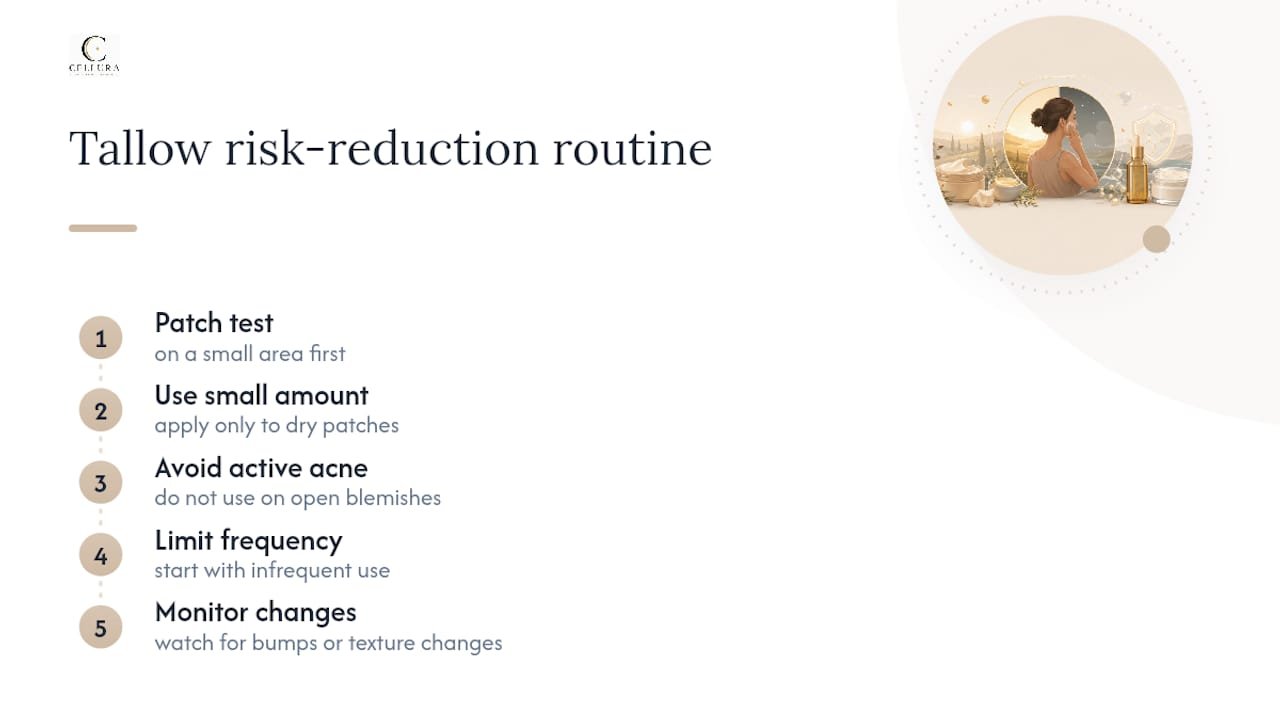
A short risk-reduction routine includes patch testing on a small area before facial use, starting with a small amount on dry patches only, avoiding use on active acne or open blemishes, limiting frequency initially, and monitoring skin changes carefully.
Pro Tip: If you’re not sure whether your skin runs oily or dry, apply tallow to one side of your jaw only for a week. If that side develops texture or bumps while the untreated side stays clear, you have your answer without risking your whole face.
There’s also a values-based consideration some readers weigh heavily: tallow is animal-derived, which rules it out for anyone following a vegan or plant-preferring routine. The same scoping review noted limited but real evidence around reef-safety concerns tied to animal-fat runoff, alongside a broader consumer shift toward plant-based skin care alternatives. If either of those factors matters to you, a squalane or jojoba-based balm gives you similar occlusion without the animal-sourcing question.
How Do You Apply Tallow Balm on Your Face Safely?
Technique matters more with tallow than with almost any other moisturizer, mostly because it’s so easy to overapply and end up looking like you rubbed a candle on your cheeks. Here’s the sequence that actually works.
- Patch test for a full week first. Apply a small amount to your inner forearm or behind your ear daily for seven days, checking for redness, bumps, or itching before you go anywhere near your face. This step alone prevents most of the bad experiences people report with tallow.
- Start with targeted spots, not your whole face. For the first two to four weeks, apply only to specific dry patches, like around the nose or on flaky cheek areas, rather than committing to full-face use right away. This gives you time to observe how your skin tolerates it before scaling up.
- Use a pea-sized amount on slightly damp skin. Warm the balm between your palms first, then press it into skin that’s still a little damp from cleansing or a hydrating mist. Dermatology guidance from INTEGRIS Health specifically recommends this technique because the warmth and moisture help the balm emulsify and sink in rather than sitting on top as a greasy film.
- Apply it last, and mostly at night. If you use hydrating serums or actives like niacinamide, apply those first and let them absorb, then seal with tallow as your final step. Because it’s heavily occlusive, nighttime use is generally easier to manage than wearing it under makeup during the day.
- Remove thoroughly the next morning. A basic cleanser sweep can leave a residual film behind, so double-cleanse or use a proper facial cleansing bar to fully lift the fat before applying anything else.
If you’re layering tallow under makeup, expect some pilling unless you give it several minutes to fully absorb first. Most people who complain about tallow “not working with makeup” are applying foundation too soon after the balm rather than waiting.
Pro Tip: If your skin feels sticky rather than smooth ten minutes after application, you used too much. Tallow should feel absorbed, not tacky. Scrape back to a thinner layer and reassess after a few nights.
Watch for warning signs that mean it’s time to stop: new whiteheads or blackheads appearing in areas you didn’t have them before, increased redness that doesn’t settle within a day, or a persistently oily, unabsorbed feeling more than 20 minutes after application. Any of those is your cue to pull back to targeted-patch use only, or to drop tallow entirely in favor of a lighter formula. Reviewing a structured patch-test method before you start gives you a clearer baseline for spotting when something’s actually wrong versus normal adjustment.
How Do You Make a Whipped Tallow Balm at Home?
A basic whipped tallow balm needs just two ingredients in most recipes: rendered tallow and beeswax, in roughly a 10:1 ratio, with an optional tablespoon of jojoba or olive oil per cup of tallow to soften the texture. That’s genuinely the whole formula most people use.
Here’s the method:
- Melt the tallow and beeswax together. Use a double boiler or a heatproof bowl set over simmering water. Melt slowly on low heat until fully liquid, then remove from heat.
- Stir in your optional oil. If you’re adding jojoba or olive oil, mix it in now while everything is still liquid.
- Cool until semi-solid. Let the mixture sit at room temperature, or in the fridge for 20 to 30 minutes, until it turns opaque and starts to firm up around the edges but isn’t fully hardened.
- Whip with a hand mixer. Beat for 5 to 10 minutes until the mixture turns pale, fluffy, and roughly doubles in volume. This step is what turns dense tallow into a spreadable balm instead of a hard block.
- Transfer to a clean, dry jar. Store at room temperature away from direct sunlight.
Because this is an anhydrous product with no water content, contamination risk comes almost entirely from what you introduce during use, not from the fat itself going bad on its own. The main safety guidance here is straightforward: use heat-sterilized tools, always dry-scoop with a clean spatula, and never introduce water or wet fingers into the jar, since water is what creates the environment bacteria and mold need to take hold.
A quick sourcing and safety checklist before you start:
- Buy tallow specifically labeled grass-fed or grass-finished, not just “beef tallow,” since the fatty acid and vitamin profile differs meaningfully between grass-fed and grain-finished sources
- Confirm the supplier discloses sourcing, not just a vague “sustainably raised” claim with no farm or region named
- Choose unbleached, food-grade or cosmetic-grade beeswax if you have known pollen sensitivities, since raw beeswax can carry trace propolis
- Skip added fragrance oils entirely for facial use, even “natural” ones, since fragrance is one of the most common skin sensitizers
- Do a full patch test on this batch specifically, since homemade batches vary jar to jar depending on your rendering process
If you’d rather skip the kitchen project, understanding how balm compares to standard creams can help you decide whether a DIY batch or a formulated commercial product fits your routine better.
What Should You Look for in a Commercial Tallow Balm?
The single biggest differentiator between a good tallow balm and a mediocre one is transparency, specifically, whether the brand actually tells you where the fat came from and what else is in the jar. A label that just says “tallow, beeswax, love” without naming a sourcing standard is a marketing choice, not information.
Start with the source. Look for explicit grass-fed or grass-finished labeling, ideally with some indication of the farm or region, since that’s tied directly to the higher vitamin A, D, E, and K content that makes grass-fed tallow more useful for skin. Then check the full ingredient list. The best facial formulas stay minimal: tallow, beeswax, and maybe one lightweight oil like squalane or jojoba to reduce tackiness and improve spreadability. Squalane in particular is a smart addition because it’s lightweight and non-comedogenic on its own, so it can offset some of tallow’s heaviness without adding much acne risk.
What to avoid is just as important. Heavy fragrance blends, unfamiliar “proprietary botanical extract” listings with no named plants, and coloring agents are common ways brands dress up a simple fat-and-wax base while adding sensitization risk with no real skin benefit.
A few label red flags worth watching for:
- The word “natural” used with no supporting sourcing or certification claim behind it
- No mention of where the tallow comes from, grass-fed, grain-fed, or otherwise
- A long list of botanical extracts with no explanation of what each one does
- Marketing copy that promises to “cure” eczema, acne, or aging, claims no current human research supports
| What to check | Look for | Red flag |
|---|---|---|
| Source | Grass-fed or grass-finished, named region | No sourcing info at all |
| Ingredient list | Tallow, beeswax, one supporting oil | Long list of unnamed extracts |
| Added actives | Squalane, jojoba for lighter feel | Heavy fragrance, dyes |
| Claims | Moisturizing, barrier support | “Cures” acne or eczema |
If the brand won’t tell you where the fat comes from, assume it’s a commodity blend and treat the product as a basic occlusive rather than anything more specialized. For a lighter-weight version of this same minimalist philosophy, pairing a simple cleanse step with a treatment step, a two-product routine built around cleansing and brightening shows how far a short ingredient list can go without sacrificing results.
How Does Beauvex Fit Into an Evidence-Led Skin Care Ritual?
Beauvex LLC builds its entire system around a three-step ritual: cleanse, treat, then support the barrier. That structure exists because active ingredients, the kind that actually shift pigmentation and texture, need a stable barrier to work safely. A balm that seals moisture in without clogging every pore isn’t a nice add-on to that process. It’s the step that determines whether your skin can tolerate the actives at all.
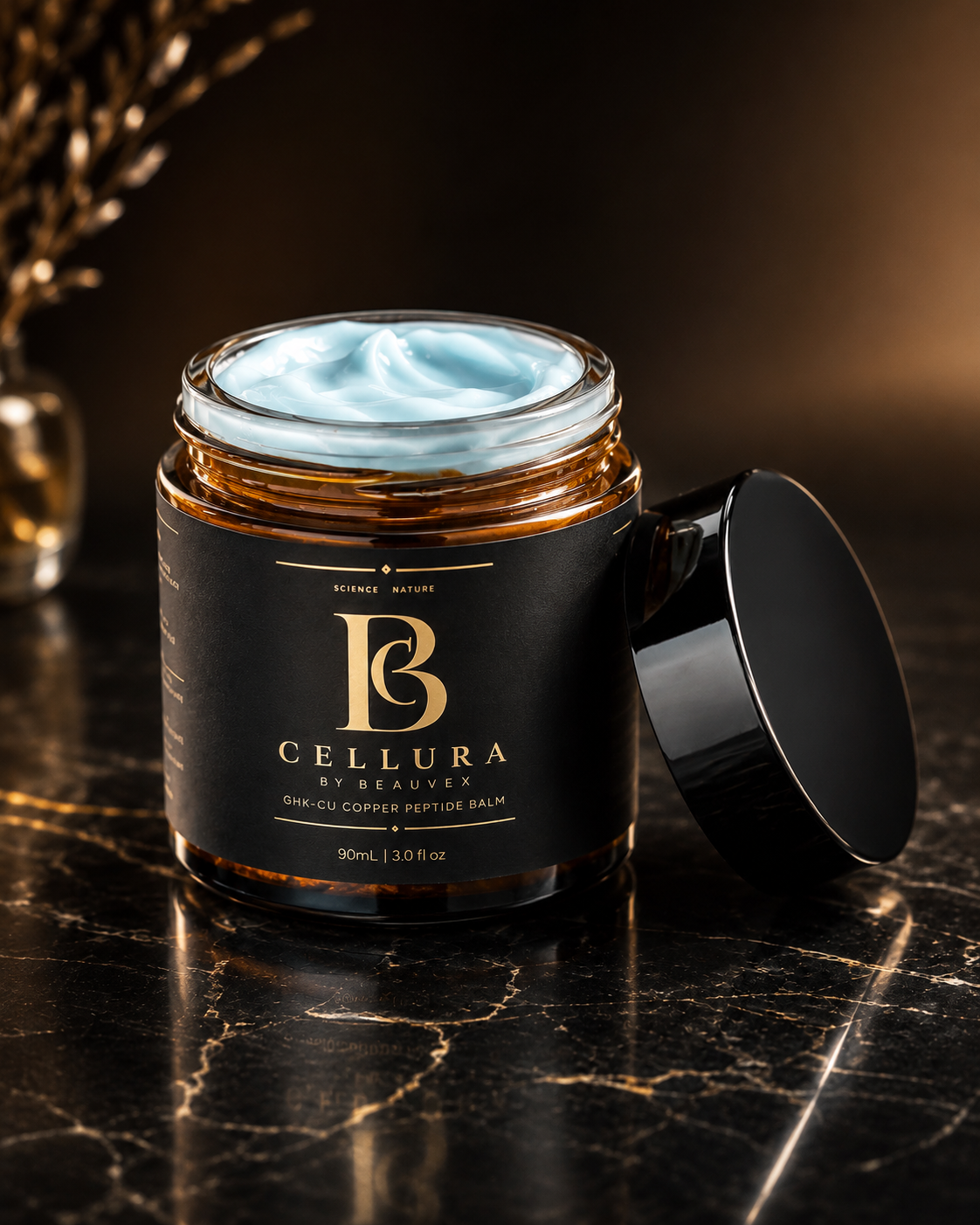
The Cellura Balm is built on exactly that logic. It combines GHK-Cu copper peptide, an ingredient studied for supporting skin repair and firmness, with tallow for occlusion and squalane for lightweight hydration. Rather than relying on tallow alone and hoping for the best on comedogenicity, the formula pairs it with copper peptide and squalane specifically to support barrier function while managing the pore-clogging tradeoff dermatologists warn about.
That balm is designed to sit at the end of a routine that starts with the Cellura ClearMark Bar, a multi-active cleansing bar formulated with salicylic, azelaic, and kojic acids for pigmentation-prone skin. Cleansing first, treating with actives second, then sealing with a barrier balm follows the same order-of-operations logic covered earlier: hydrate and treat, then occlude last.
What separates this from a jar of plain rendered fat is transparency. Some brands publish ingredient concentrations and research references for each product, so you’re not guessing whether “tallow” on a label means grass-fed and minimal or a mystery blend cut with fragrance. If you’ve read this far and decided tallow’s occlusion sounds useful but you want the comedogenicity risk offset by a more deliberate formula, that’s the gap such a product is built to close. And whichever route you take, the patch-test and damp-skin application steps from earlier in this guide still apply.
An Editorial Take: Ancestral Simplicity Meets Modern Dermatology
The tallow trend taps into something real: a fatigue with 12-step routines and unpronounceable ingredient lists. That instinct isn’t wrong. But treating tallow as a cure-all, or dismissing it outright because it’s “just animal fat,” both miss the point.
Tallow is a tool for a specific job: sealing moisture into a barrier that’s already compromised. It is not a substitute for niacinamide, tranexamic acid, or any ingredient actually studied for shifting pigmentation. The dermatology sources cited throughout this piece are consistent on that point, and the research gaps in the scoping literature back up a cautious stance rather than an enthusiastic one.
Our stance: test it small, track what happens over two weeks, and pair it with actives rather than expecting it to replace them. If you see new breakouts, stop and talk to a dermatologist about what’s actually going on with your skin. Evidence-first experimentation beats blind trend-following every time.
— Beauvex LLC
Ready to Try a Barrier Balm Built for Transparency?
If you’ve weighed the tradeoffs above and decided plain rendered tallow feels too unpredictable for your face, a formulated barrier balm gives you the same occlusive benefit with a clearer safety profile. The Cellura Balm pairs tallow with GHK-Cu copper peptide and squalane specifically to support barrier repair without leaning on fat alone, and every concentration is published so you know exactly what you’re applying.
Pair it with the Cellura ClearMark Bar, formulated with salicylic, azelaic, and kojic acids, and you’ve got a cleanse-and-seal routine that follows every selection criterion covered in this guide: transparent sourcing, a short ingredient list, and a stated purpose for every component. Start with the balm on its own if you’re only dealing with dry patches, or shop the full ritual if you’re managing post-acne marks alongside barrier repair. Either way, patch test first, apply the way you would any tallow product, and give your skin two to four weeks before judging results.
Sources
- Beef tallow: dietitian and derm weigh in | UT MD Anderson
- Tallow, Rendered Animal Fat, and Its Biocompatibility With Skin: A Scoping Review – PMC
- How to Use Tallow Balm in Your Daily Skincare Routine | INTEGRIS Health
- Beef Tallow in Skin Care: Safety, Benefits and Risks
FAQ
Is Tallow Balm Good for the Face?
It can help genuinely dry, flaky, or mature skin by sealing in moisture, but it’s a heavy occlusive that isn’t formulated for oily or acne-prone skin without a careful patch test first.
Why Don’t Some Dermatologists Recommend Beef Tallow?
The main concern is comedogenicity: tallow can clog facial pores, and it lacks ceramides, so it seals moisture without doing the active barrier-repair work some dermatologists prefer for their patients.
Is Tallow Better Than Retinol for Skin Concerns?
No, they do different jobs. Tallow is an occlusive moisturizer, while retinol is an active ingredient studied for cell turnover and texture; tallow doesn’t replace what an active like retinol or a targeted serum accomplishes.
What Are the Disadvantages of Tallow Balm?
The main disadvantages are comedogenicity for acne-prone skin, a greasy finish if overapplied, limited human research on side effects, and the fact that it’s animal-derived, which rules it out for vegan skin care routines.