
For most people managing melasma or post-inflammatory hyperpigmentation, topical tranexamic acid matches hydroquinone’s pigment-reducing power in clinical trials, with fewer side effects and a lower relapse rate. Hydroquinone still works, and works fast, but it carries more irritation risk with unsupervised long-term use. The right first move isn’t picking a side. It’s seeing a clinician to map your skin type and pigment pattern, then locking in daily sunscreen before either active goes near your face.
TL;DR:
- Topical tranexamic acid offers similar pigment reduction to hydroquinone with fewer side effects and lower relapse rates in clinical trials.
- Hydroquinone carries risks of irritation, contact dermatitis, and rare but serious conditions like ochronosis, especially with long-term unsupervised use.
- Tranexamic acid is particularly effective when inflammation or vascular activity contributes to pigmentation, making it suitable for post-inflammatory hyperpigmentation.
- Using daily sunscreen and limiting hydroquinone duration are key strategies to minimize long-term risks and prevent pigment rebound.
- Combining tranexamic acid with other ingredients like niacinamide can target multiple mechanisms and enhance safety during pigment treatment.
Table of Contents
- Tranexamic Acid vs Hydroquinone: What the Clinical Trials Show
- How Do Tolerability and Long-Term Risk Compare?
- Which Active Fits Your Skin’s Pigment Pattern?
- How Are These Actives Actually Formulated and Dosed?
- How Beauvex’s Ritual Supports Multi-Pathway Pigment Control
- What Should You Realistically Expect Over Time?
- A Research-Aligned Take on Long-Term Pigment Management
- A Maintenance Option Worth Adding to Your Routine
- Sources
Tranexamic Acid vs Hydroquinone: What the Clinical Trials Show
The head-to-head data is more consistent than most skincare debates get. A split-face randomized trial of 100 patients comparing topical tranexamic acid 5% cream to hydroquinone 4% cream over 12 weeks found both sides improved by similar objective measures, but the tranexamic acid side showed a significantly greater reduction in area percent melanin, with fewer adverse effects reported.
That result isn’t a fluke. Multiple randomized controlled trials, including split-face designs with sample sizes from 20 to 120 patients, report comparable mMASI and MASI reductions between the two actives in the 8 to 12 week window, with tranexamic acid groups consistently logging less irritation and lower relapse.
A separate randomized, double-blind trial pairing tranexamic acid with niacinamide, in both conventional and niosomal cream formats, found the combination matched hydroquinone 4% for efficacy while causing fewer adverse reactions. That pairing matters. It suggests tranexamic acid’s real strength isn’t outperforming hydroquinone on raw pigment clearance. It’s holding its own while being gentler on the skin barrier.
A few caveats keep this from being a clean verdict:
- Trial designs vary widely: some use topical creams, others intradermal injections, a handful test oral dosing, and outcomes aren’t always directly comparable across routes.
- Most trials run 8 to 12 weeks, which tells you little about what happens at month six or month twelve.
- Sample sizes cluster in the 20 to 120 range, smaller than the ideal for detecting rare adverse events.
- Skin tone and melasma subtype (epidermal vs dermal vs mixed) shift results, and not every trial reports this breakdown clearly.
The takeaway from the trial data: tranexamic acid closes the efficacy gap with hydroquinone while opening a tolerability gap in its own favor.
How Do Tolerability and Long-Term Risk Compare?
Hydroquinone’s biggest liability isn’t week one. It’s month six. Continuous, unsupervised use raises the risk of contact dermatitis, persistent irritation, and in rarer cases, exogenous ochronosis, a form of blue-gray skin discoloration that can be difficult to reverse. That risk profile is exactly why the FDA has flagged unsafe over-the-counter skin-lightening products as a consumer safety concern, particularly formulations sold without dosage limits or medical oversight.
Statistic Callout: In the split-face trial comparing 5% tranexamic acid to 4% hydroquinone, the tranexamic acid side reported measurably fewer adverse effects over the same 12-week period, even as both sides achieved similar pigment improvement.
Topical tranexamic acid isn’t risk-free, but its irritation rates run lower across most trials. Oral tranexamic acid is a different conversation entirely. It requires clinician screening for clotting disorders and thromboembolic risk before you start, and ongoing supervision while you’re on it. This isn’t a supplement you self-prescribe.
Practical ways to lower risk with either active:
- Cap hydroquinone courses at the duration your dermatologist recommends rather than using it indefinitely.
- Patch-test any new formulation on your inner arm for 48 hours before applying to your face.
- Use daily broad-spectrum sunscreen regardless of which active you choose, since UV exposure reactivates melanocyte activity.
- Book follow-up visits at set intervals rather than judging progress by mirror-checking alone.
Melasma tends to come back after treatment stops, and expert consensus on topical tranexamic acid points to relapse rates dropping when patients shift to a non-hydroquinone maintenance phase rather than stopping treatment cold.
Which Active Fits Your Skin’s Pigment Pattern?
The mechanisms explain why dermatologists reach for one over the other in specific cases. Tranexamic acid works by inhibiting the conversion of plasminogen to plasmin, which lowers the inflammatory signaling that triggers melanocytes into overdrive. That makes it particularly useful when inflammation or vascular activity is part of your pigment story, which describes a lot of post-inflammatory hyperpigmentation from acne.

Hydroquinone works differently. It directly inhibits tyrosinase, the enzyme melanocytes use to manufacture melanin in the first place. That’s a more direct hit on pigment production, which is part of why it can clear pigment fast, but it doesn’t touch the inflammatory piece at all.
A few decision cues worth weighing with your dermatologist:
- If your skin flares red or irritated easily, tranexamic acid’s lower irritation profile makes it the safer starting point.
- If your pigmentation followed an inflammatory event like acne or an injury, tranexamic acid’s anti-inflammatory mechanism targets that root cause more directly than hydroquinone does.
- If you’re pregnant or planning to be, discuss both actives with your doctor, since oral tranexamic acid in particular needs individualized clearance.
- If you’ve reacted to hydroquinone before, tranexamic acid is the logical next active to trial.
Pro Tip: If you’re not sure whether your dark spots are inflammation-driven or purely pigment-driven, a dermatologist can usually tell from pattern and history alone. That distinction should guide which active you try first, not a guess.
How Are These Actives Actually Formulated and Dosed?
Trial protocols give a useful baseline for what “using it correctly” looks like in practice.
- Topical tranexamic acid: most studied at 2% to 5% concentration in creams or solutions, applied once daily.
- Topical hydroquinone: typically formulated at 3% to 4%, applied nightly, for a limited course rather than continuous use.
- Intradermal tranexamic acid: administered in-clinic with dosing that varies by protocol and provider; some trials show it outperforming topical hydroquinone in specific dose ranges, though results are inconsistent across studies.
- Oral tranexamic acid: generally dosed at 250 to 500 mg twice daily, strictly under medical supervision given clotting risk screening requirements.
- Evaluation checkpoints: most protocols assess progress at 4, 8, and 12 weeks, then shift to a maintenance plan rather than stopping treatment outright.
How Beauvex’s Ritual Supports Multi-Pathway Pigment Control
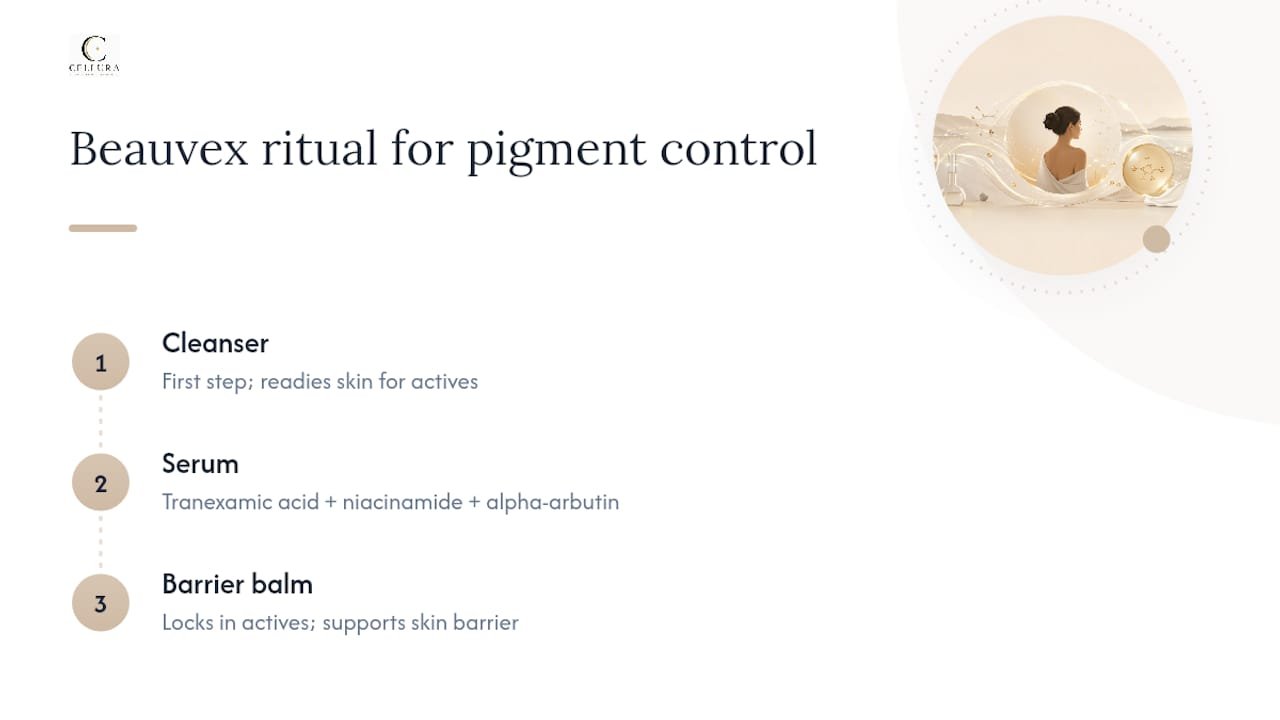
A three-step ritual with cleanser, serum, and barrier balm mirrors what the research on combination therapy points toward: hitting pigmentation from more than one angle at once. The Luminé Brightening Serum pairs tranexamic acid with niacinamide and alpha-arbutin, which experts note is a common combination because it targets pigment transfer and tyrosinase activity alongside the inflammatory pathway tranexamic acid addresses. Exact concentrations and the research behind each active are published, so consumers can weigh the formula against the same trial data covered here rather than taking a marketing claim on faith.
What Should You Realistically Expect Over Time?
Visible improvement in melasma trials typically shows up between weeks 4 and 12, but melasma is a chronic condition prone to resurfacing, especially with sun exposure or hormonal shifts. Nobody “cures” it in one course of treatment.
- Daily sunscreen isn’t optional. UV exposure is one of the most reliable relapse triggers, and skipping it undoes weeks of progress fast.
- Rotating in a maintenance active like tranexamic acid after a hydroquinone course, rather than stopping treatment entirely, tends to hold results longer.
- Barrier support matters more than most routines account for. Irritated, compromised skin is more reactive to UV and more prone to rebound pigmentation.
- If irritation, unusual discoloration, or no improvement after 12 weeks shows up, that’s the signal to check back in with a dermatologist rather than push through on your own.
Pro Tip: Treat the maintenance phase as the real project, not an afterthought. The actives that clear pigment fastest aren’t always the ones that keep it away.
For readers weighing procedural options alongside topical actives, it’s worth knowing when light-based treatments like IPL enter the conversation, generally as an adjunct for stubborn sun-driven pigment rather than a replacement for the fundamentals above.
A Research-Aligned Take on Long-Term Pigment Management
We think the honest answer here is that neither active wins outright. What works is layering a well-formulated, transparent maintenance routine underneath whatever a clinician prescribes, not instead of it. That’s the philosophy behind Beauvex LLC’s ingredient-transparent approach to hyperpigmentation, and it’s where we’d point you next.
— Beauvex LLC
A Maintenance Option Worth Adding to Your Routine
If your dermatologist has you on a hydroquinone course or a prescription-strength active, the question that comes next is what happens after. That’s the gap the Cellura Luminé Brightening Serum is built for: a maintenance-phase formula combining tranexamic acid, niacinamide, and alpha-arbutin at transparent, published concentrations, designed to slot in once your clinician-directed treatment winds down.

The routine works in sequence. Start with the Cellura ClearMark Bar to cleanse without stripping the barrier your skin needs intact for any brightening active to work well. Follow with the brightening serum once your prescription-phase treatment ends, or alongside it if your dermatologist confirms the ingredients don’t overlap in ways that cause irritation. Concentrations are listed on the product page, so customers are not guessing what they’re applying. If you’re ready to build a maintenance phase that doesn’t rely on hydroquinone alone, check out the Luminé Serum here.
This article is general information, not a substitute for advice from a qualified doctor. Consult a qualified healthcare professional about your own circumstances before acting on anything here.