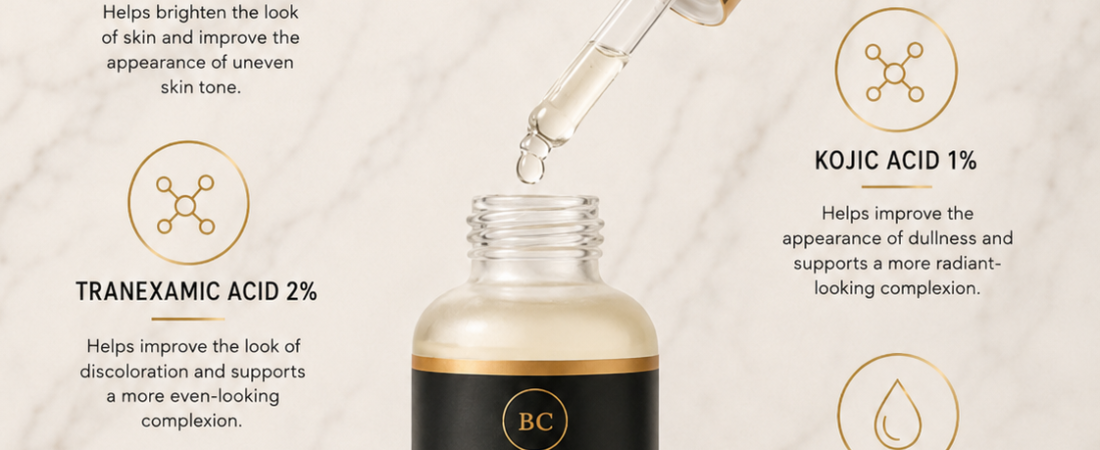
Tranexamic acid for hyperpigmentation has moved from a niche dermatology talking point to a mainstream skincare active, and for good reason: it approaches dark spots from a different angle than most brightening ingredients. Instead of only slowing pigment production at the enzyme level, it works upstream on the inflammatory and vascular signals that tell your skin to make pigment in the first place.
Here is what the ingredient actually is, what the research supports, who tends to benefit, and how to fit tranexamic acid for hyperpigmentation into a routine without overloading your skin.
What Is Tranexamic Acid?
Tranexamic acid (often shortened to TXA) is a synthetic derivative of the amino acid lysine. It was originally developed, and is still used in medicine, as an antifibrinolytic — a compound that helps reduce excessive bleeding by preventing plasminogen from converting into plasmin.
The skincare application was discovered somewhat by accident. Clinicians noticed that patients taking it for other reasons showed lightening of facial pigmentation. That observation led to decades of follow-up work on its use in melasma and post-inflammatory marks. In cosmetic formulas today it appears on ingredient lists simply as tranexamic acid, usually at low single-digit percentages, and it is a well-tolerated, non-exfoliating active. That long clinical history is a large part of why tranexamic acid for hyperpigmentation is now a standard entry on cosmetic ingredient lists.
How Tranexamic Acid for Hyperpigmentation Actually Works
Most brightening ingredients you have heard of — kojic acid, alpha-arbutin, vitamin C — act primarily on tyrosinase, the enzyme melanocytes use to build melanin. Tranexamic acid does something different.
By inhibiting the plasminogen-to-plasmin pathway, it dampens a chain of inflammatory messengers that would otherwise stimulate melanocytes to produce more pigment. Research also points to anti-angiogenic effects, meaning it appears to reduce the small-vessel activity that contributes to the redness-plus-brown mix seen in stubborn melasma. In practical terms, that gives it two useful properties.
- It targets the trigger, not just the output. Pigment driven by inflammation — sun exposure, breakouts, friction — is where it tends to be most relevant.
- It layers well. Because its mechanism differs from tyrosinase inhibitors, it complements them rather than duplicating them.
Peer-reviewed reviews of topical, oral, and injected forms consistently report reductions in pigmentation scores in melasma and post-inflammatory hyperpigmentation, with topical formulations generally showing fewer irritant reactions than older reference treatments. A 2026 literature review published in the Journal of Cosmetic Dermatology summarises that evidence base across delivery routes. Oral and injected forms are prescription territory and carry their own considerations — the topical version is the one that belongs in a cosmetic routine.
How It Compares to Other Brightening Actives
| Active | Primary mechanism | Best suited to | Irritation potential |
|---|---|---|---|
| Tranexamic acid | Calms inflammatory signalling to melanocytes | Melasma, post-acne marks, sun-triggered patches | Low |
| Alpha-arbutin | Gentle tyrosinase inhibition | General uneven tone, sensitive skin | Low |
| Kojic acid | Tyrosinase inhibition | Discrete dark spots | Low to moderate |
| Niacinamide | Limits pigment transfer; supports the barrier | Almost all skin types | Very low |
| Vitamin C | Antioxidant plus tyrosinase inhibition | Dullness, environmental damage | Moderate, formula dependent |
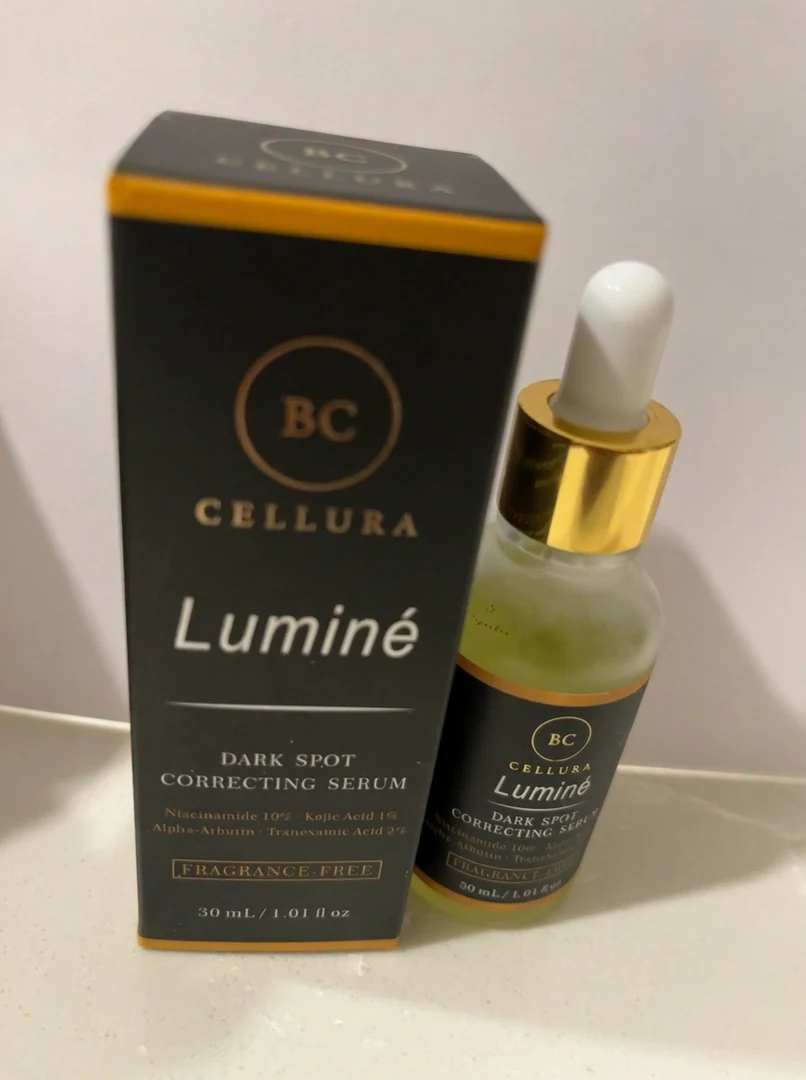
This is why multi-active formulas have become common. Our Cellura Luminé Brightening Serum pairs tranexamic acid with niacinamide, alpha-arbutin, and kojic acid so several complementary pathways are addressed in one step, which helps keep a routine short. That is how most people end up using tranexamic acid for hyperpigmentation in practice — as one ingredient among several rather than a standalone treatment. If you want a closer look at one of those partner ingredients, our guide to kojic acid for dark spots covers it in detail.
Is Tranexamic Acid for Hyperpigmentation Right for You?
Using tranexamic acid for hyperpigmentation is worth considering if you are dealing with any of the following and want something that helps improve the appearance of uneven tone without the sting of an exfoliating acid.
- Melasma-type patches — the diffuse, symmetrical discolouration across cheeks, forehead, or upper lip that tends to flare with heat and sun.
- Post-inflammatory marks — the flat brown or grey shadows left behind after a breakout has healed.
- Sensitive or reactive skin that has not tolerated stronger brightening routines.
- Deeper skin tones, where minimising irritation matters, since irritation itself can generate more pigment.
How to Use It in a Routine
A routine built around tranexamic acid for hyperpigmentation should stay simple. Cleanse, apply your serum to clean, slightly damp skin, follow with moisturiser, and finish every morning with broad-spectrum SPF. Sunscreen is not an optional extra here — UV exposure is one of the main drivers of the pigment pathway you are trying to calm, and without it any brightening effort works against a moving target.
Start once daily, build to twice daily if your skin stays comfortable, and give it time. Pigment turnover is slow, and visible change in the appearance of dark marks is typically a matter of months rather than weeks. Consistency does more than intensity.
Frequently Asked Questions
Can I use tranexamic acid if I have sensitive skin?
Usually yes. Tranexamic acid for hyperpigmentation is not an exfoliant and does not typically cause the tingling or flaking associated with acids or retinoids. Patch test a small area behind the ear or on the inner forearm for a few days first, as you would with any new product.
How long until I see a difference?
Most people using tranexamic acid for hyperpigmentation should plan on eight to twelve weeks of consistent daily use before judging results, and longer for deeper or long-standing pigmentation. Take a photo in the same lighting every few weeks, because gradual change is hard to notice in the mirror.
Can I use it with vitamin C, retinol, or exfoliating acids?
Generally yes. Tranexamic acid for hyperpigmentation layers with most actives, though you may prefer to separate them by time of day — brightening serum in the morning, retinol at night. Introduce one new active at a time so you can tell what your skin is responding to.
Is topical tranexamic acid the same as taking it orally?
No. Oral tranexamic acid is a prescription medication with systemic effects and should only be used under a doctor’s supervision. Topical cosmetic formulations are a separate category and are what you will find in over-the-counter serums.
Do I still need sunscreen if I am using it?
Yes, and it matters more than usual. Daily broad-spectrum SPF protects the progress that tranexamic acid for hyperpigmentation is making and helps prevent new sun-triggered pigmentation from forming.
Can I use it while pregnant or breastfeeding?
Melasma often appears or worsens during pregnancy, so this question comes up often. Check with your doctor or midwife before starting any new active during pregnancy or breastfeeding — that advice applies to topical products too.
The Bottom Line
Tranexamic acid for hyperpigmentation is one of the better-supported gentle options available in cosmetic skincare. It is most useful for inflammation-driven and sun-triggered discolouration, it pairs well with tyrosinase-inhibiting actives rather than competing with them, and it rarely causes the irritation that can derail a brightening routine. Combined with daily sun protection and realistic expectations about timelines, it is a sensible addition to a routine focused on a more even-looking complexion.